Paper announcement📢 GimmBO: Interactive Generative Image Model Merging via Bayesian Optimization
Chenxi Liu, Selena Ling (@seleniumlzh), Alec Jacobson
🏆 SIGGRAPH 2026 Best Paper
Selena and I will be presenting in LA (July 19-23)!
🌐 Project: https://t.co/cnbPVJx4fx
[1/7]
I am *very* excited to announce our SIGGRAPH 2026 workshop:
Lines & Minds: Visual Abstraction in Art, Psychology, and Computer Graphics 🎨🧠🫖
🔗 https://t.co/dZaoDPv5Zt
📅 Sunday, July 19
Join us to explore how visual abstraction shapes how we think, create, and communicate.
Our short film Dear Upstairs Neighbors is previewing at @sundancefest. 🎬
It’s a story about noisy neighbors, but behind the scenes, it’s about solving a huge challenge in generative AI: control.
Developed by Pixar alumni, an Academy Award winner, researchers, and engineers, here’s how it came together. 🎨
This is absolutely shameful. Agents of a federal agency unnecessarily escalating, and then executing a defenseless citizen whose offense appears to be using his cell phone camera. Every person regardless of political affiliation should be denouncing this.
Did Blender help you this year? Help back!
If every active user contributed $5 this month, Blender would be funded for the entire year 2026. Professional 3D software. No subscriptions. No limits. Just your support.
Do your part. Donate today.
https://t.co/aoJDUK8Sm5 #b3d
📢 Lyra: Generative 3D Scene Reconstruction via Video Diffusion Model Self-Distillation
Got only one or a few images and wondering if recovering the 3D environment is a reconstruction or generation problem? Why not do it with a generative reconstruction model!
We show that a camera-conditioned video diffusion model can be transformed into a generative reconstruction model that directly outputs a high-quality 3D Gaussian Splatting representation through self-distillation, without requiring real-world training data.
Check out our results in the video (wait for dynamic scenes in the second half!) :
Project Page: https://t.co/pKtry0BdOL
Code and Models: https://t.co/p4zVBrMKU5
Paper: https://t.co/ZuMM1LCP82
Season 1 of Toronto School of Foundation Modelling kicks off this Thursday at New Stadium!!!
60 people will be attending weekly sessions for 3 months, learning to build Foundation Models from scratch. Around 10 guest speakers (more to come) will be flying to Toronto to talk about what they do best.
I'm grateful for the support of Cohere, New, Vengeance and all the donors. I will make this a series worth your time. And apologies to the people I didn't get back to - spots are all taken but will reach out if that changes.
I’m excited to announce that our paper, “Learning Riemannian Metrics for Interpolating Animations,” has been accepted to GSI 2025! 🧵
co-authored with @vm2358 at @UofT and @ninamiolane at the @UCSB@geometric_intel lab!
https://t.co/34doeOfkOc
Every lens leaves a blur signature—a hidden fingerprint in every photo.
In our new #TPAMI paper, we show how to learn it fast (5 mins of capture!) with Lens Blur Fields ✨
With it, we can tell apart ‘identical’ phones by their optics, deblur images, and render realistic blurs.
“Everyone knows” what an autoencoder is… but there's an important complementary picture missing from most introductory material.
In short: we emphasize how autoencoders are implemented—but not always what they represent (and some of the implications of that representation).🧵
Check out our new paper on robust motion segmentation!
Wanna run your SfM pipeline on dynamic scenes? Consider using our RoMo masks to get improvements!! 🚀
For folks in the @siggraph community:
You may or may not be aware of the controversy around the next #SIGGRAPHAsia location, summarized here: https://t.co/uCbD5cDVrz
If you're concerned, consider signing this letter: https://t.co/YDWfXh31d9
via this form
https://t.co/dq8wgQmrB7
We show many more experiments across different implicit surface representations in our paper. Please check out our #SGP25 paper here https://t.co/ZSc4bTt7Ej and reach out if you have any questions! Code coming soon! (9/9)
Our #SGP25 work studies a simple and effective way to uniformly sample implicit surfaces by casting rays. (1/9)
“Uniform Sampling of Surfaces by Casting Rays” w/ @_abhishekmadan@nmwsharp@_AlecJacobson
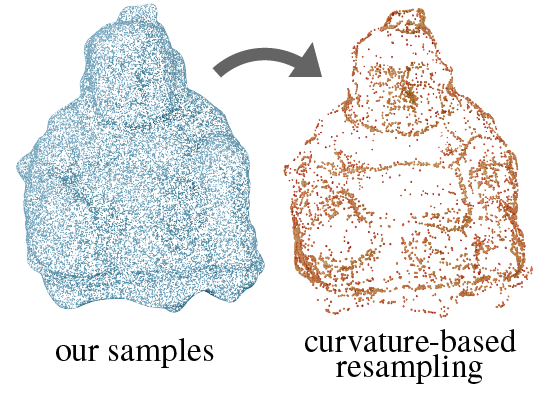
With uniformly sampled points, one can also easily perform importance sampling using curvature or other quantities like losses, and construct geometry-aware regularization terms to improve neural implicit optimization. (8/9)



![chenxil21's tweet photo. Paper announcement📢 GimmBO: Interactive Generative Image Model Merging via Bayesian Optimization
Chenxi Liu, Selena Ling (@seleniumlzh), Alec Jacobson
🏆 SIGGRAPH 2026 Best Paper
Selena and I will be presenting in LA (July 19-23)!
🌐 Project: https://t.co/cnbPVJx4fx
[1/7] https://t.co/1XJVRFjKJ4](https://pbs.twimg.com/media/HJ-9HUsWwAAVGv8.jpg)