3D geometry researcher: graphics, vision, 3D ML, etc | Senior Research Scientist @NVIDIA | running, hockey, baking, & cheesy sci fi | opinions my own | he/him
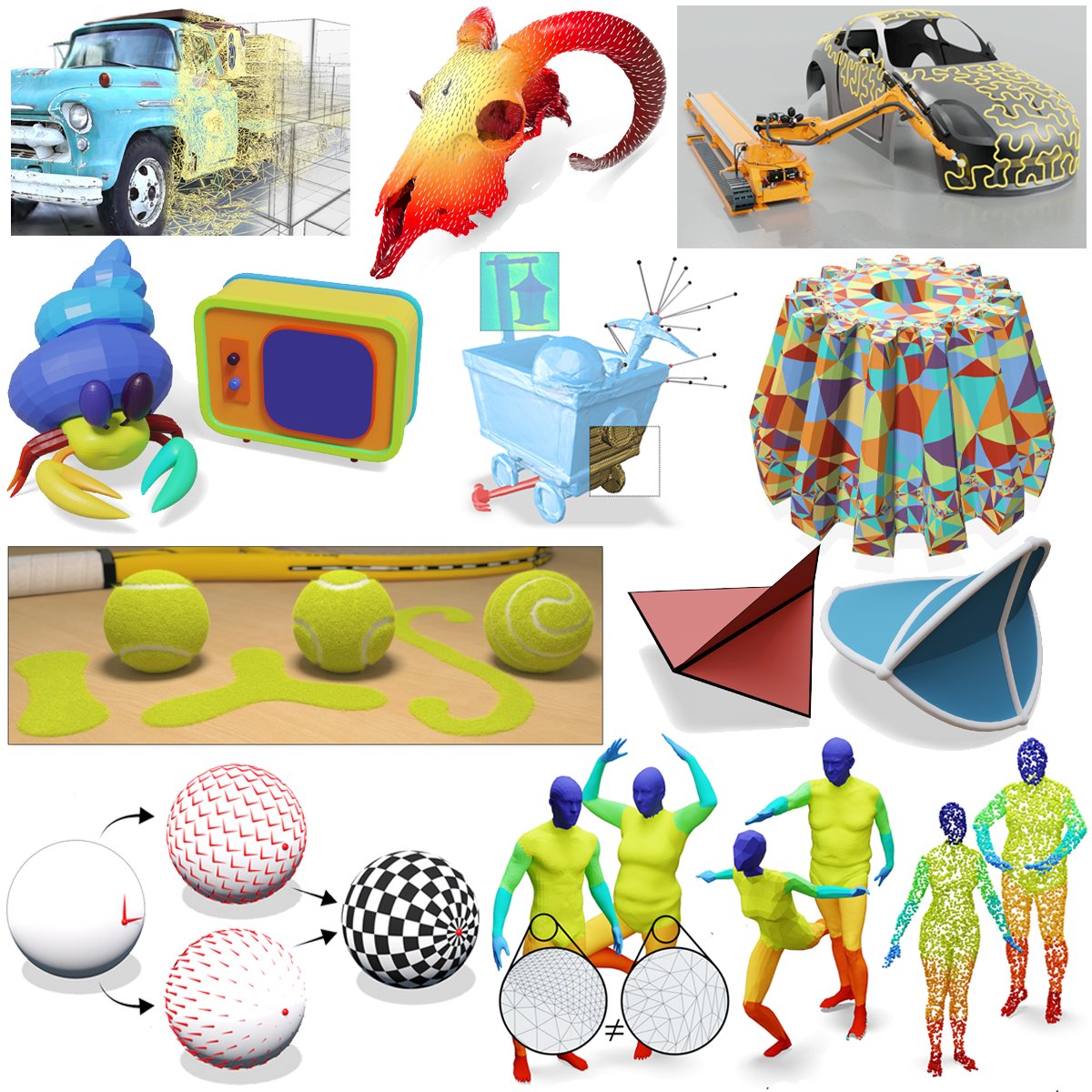
Giant new v1.2 release of Polyscope! Adds support for tet & hex meshes, transparency, ground shadows, slice planes, variable-size points, setting camera views, and more.
Try Polyscope for easy 3D visualization in C++ & Python: https://t.co/Nq1SlppwQo
Thread of new features! 1/n
The Eurographics 2027 State of The Art Report submission deadline is in 11 days! (abstracts in 5)
STARs survey of a subarea in computer graphics, to summarize, taxonomize, and benchmark. They're hugely important and highly-cited. Submit your surveys!
https://t.co/5d8bBduZDj
In this era of artificial intelligence, it is becoming urgent to distinguish human art from what machines produce. There is an ontological difference, even before an aesthetic one, between art and what a machine can generate through statistical calculation based on millions of images created by others. Algorithms lack the spark of humanity. For this reason, the Church wishes to renew an alliance with artists and cultural institutions to safeguard our humanity.
The era of Physical AI is coming, and I firmly believe that embodied intelligence will not emerge from imitation learning alone. Just as humans first learn by observing the world and then build deeper understanding through interaction, the breakthrough moment for Physical AI will come through interactive learning.
Real-world trial and error is too slow, expensive, and unsafe. To scale interactive learning, we need to recreate the richness of reality without being constrained by reality itself. We need simulated reality—a place where embodied intelligence can experience situations, make mistakes, learn from them, and try again millions of times before encountering them in the real world.
I am incredibly excited to build @VeedaAI alongside my co-founders, @FidlerSanja and @HuanLing6 , and an extraordinary group of researchers and engineers. Together, we are developing the next generation of interactive foundation world models for Physical AI.
There is no team I would rather take on this challenge alongside, and I couldn’t be more excited for what we’re going to build.
https://t.co/n1MoVM6qZn
Excited to announce: In 2027 I'll join the UW Allen School (@UWCSE) in Seattle as tenure-track faculty in Computer Science!
My group will advance core geometry processing + 3D AI for visual computing, science, & engineering. I'll be recruiting PhD students in the next cycle!
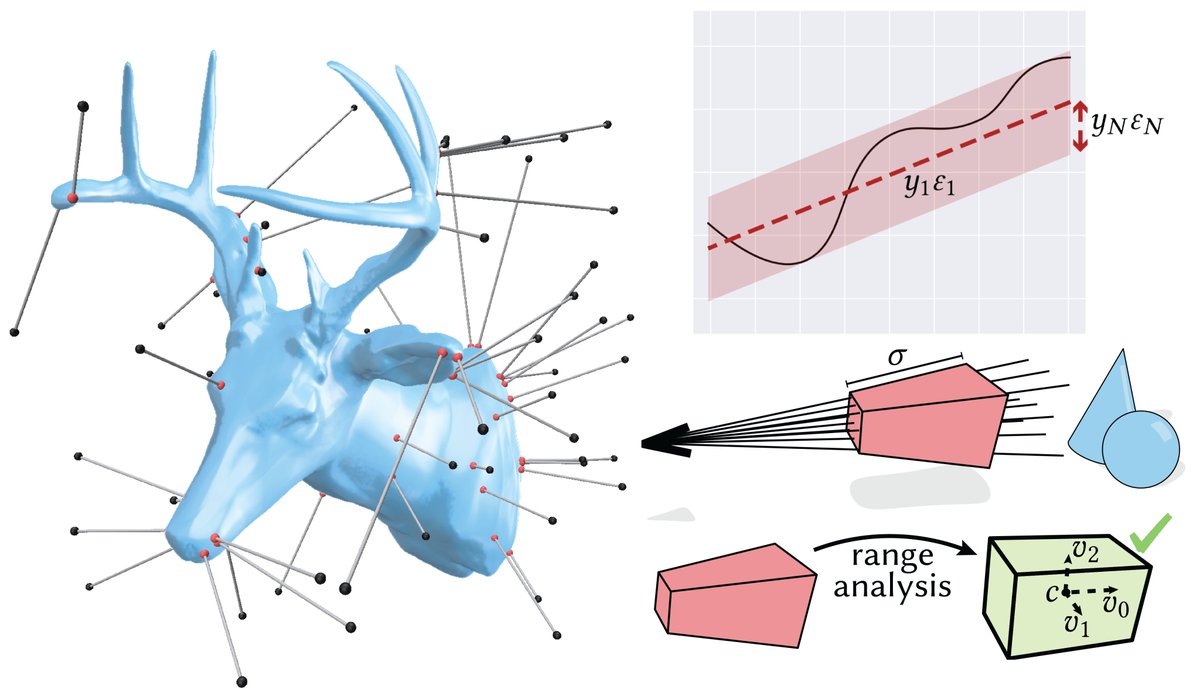
Tomorrow I'll speak at the FPTalks series on floating point and numerical analysis, about robust geometry for neural implicit surfaces (work w/ @_AlecJacobson).
The other talks sound amazing, and I love this area! Check out this great organization.
https://t.co/lvL3VM3L1v
Have you dug deep into an evolving area of visual computing? Consider submitting to the 2027 EG STARs track!
STARs are survey reports providing insight into the current state of the art and future directions. They're impactful and highly-cited!
https://t.co/5d8bBduZDj
🎉 Excited to introduce TRON, a relighting framework for 3D captures.
💡TRON pairs a neural renderer with 3D Gaussian reconstructions, achieving realistic quality, with 3D, material, & lighting control at interactive frame rates.
https://t.co/q7NlnFQIT7
https://t.co/GnlzdyD2Q2
@Colonthreee@yousufmsoliman It's very related! It's the latest in a line of advanced algorithms for decaling. See also things like @rms80's expmaps https://t.co/WzoIUbqxML
Compared to classic approaches, these geometric methods can wrap decals around curved meshes, and aren't affected by UV seams.
Logarithmic maps are incredibly useful for algorithms on surfaces--they're local 2D coordinates centered at a given source.
@yousufmsoliman and I found a better way to compute log maps w/ fast short-time heat flow in "The Affine Heat Method" presented @ SGP2025 today! 🧵
Releasing Walk on Spheres Extensions (WoSX): a GPU-accelerated C++/Python library for Monte Carlo physics simulation on complex geometry
Think path tracing but for physics beyond light transport: heat, electrostatics, potential flow, deformation & more!
https://t.co/1F59rys9tw
Paper announcement📢 GimmBO: Interactive Generative Image Model Merging via Bayesian Optimization
Chenxi Liu, Selena Ling (@seleniumlzh), Alec Jacobson
🏆 SIGGRAPH 2026 Best Paper
Selena and I will be presenting in LA (July 19-23)!
🌐 Project: https://t.co/cnbPVJx4fx
[1/7]
Code is out! Feel free to try it here: https://t.co/Zm2ZRrCy5u
We’ll also be presenting our work as a CVPR oral at Bluebird Ballroom on Sunday, June 7, at 3:00 PM. Hope to see you there!"
Visual reconstruction started with meshes, then NeRFs, and now Gaussian Splats.
We went through the same with physical reduced order models: from classic tet meshes, to neural fields, and ultimately a careful particle-based method that gets the best of all worlds. Check it out!
Excited to share FreeForm☁️: Reduced-Order Deformable Simulation from Particle-Based Skinning Eigenmodes at #CVPR2026
FreeForm enables fast elastodynamic simulation for robotics and beyond, directly on messy data (no mesh needed)!
This summer I'll be speaking at LOGML, a program on geometry & learning in London! Come find out how the discrete structure of 3D data meets the tools and techniques of ML 🚀
Applications to the program are still open for a few more days, check it out!
📣 Participant Applications Open: LOGML’26, Imperial College London (13–17 July)
A week on geometry/topology + ML talks, tutorials, projects & networking.
👩🎓 Students/PhD/Postdocs
💰 Limited fee waivers & travel support
🗓 Deadline: 1 May 2026
🔗 Apply: https://t.co/bfynGCiD86