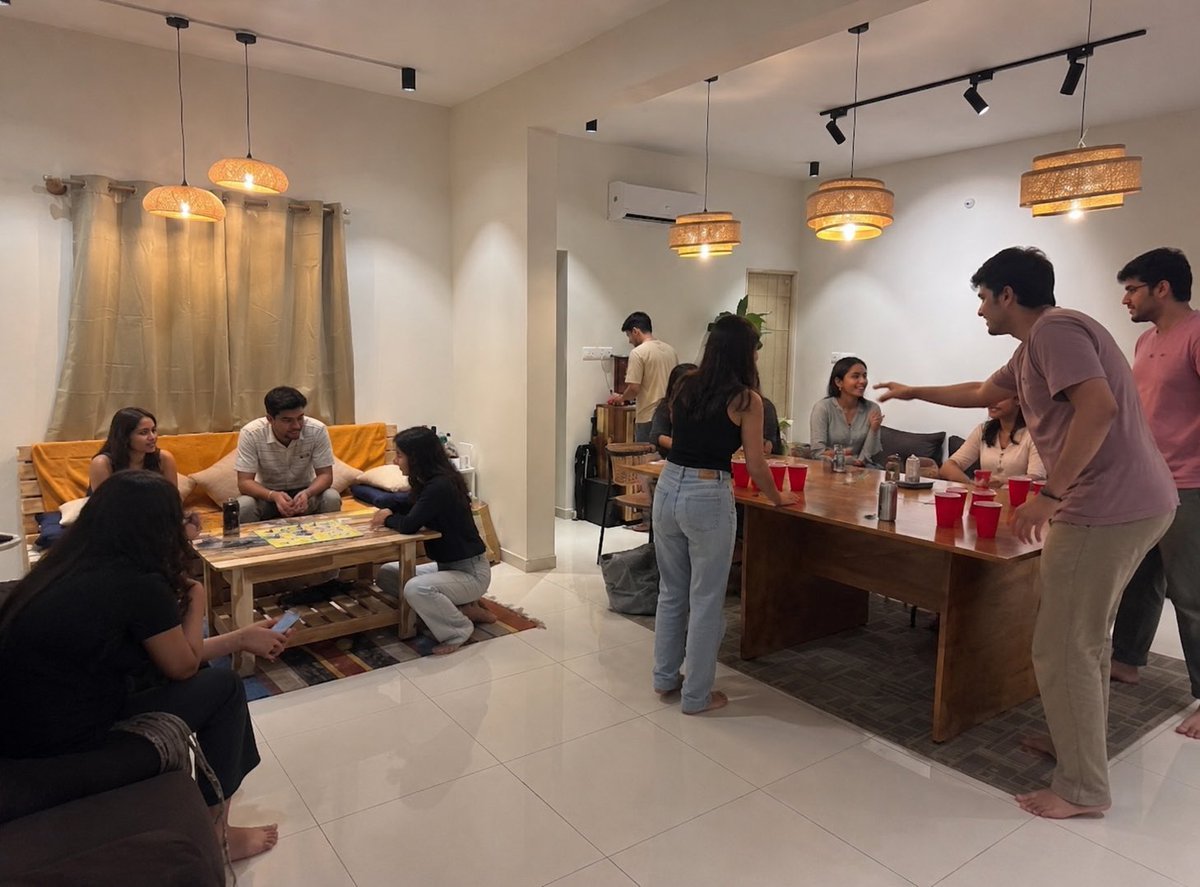
someone at our last hangout told me it was the first real friends they’d made since moving to bangalore.
that’s the whole reason we started FriendsHouse.
no bar, no agenda, just a house full of people who actually showed up to hang out.
next one’s soon. drop a reply and i’ll fill you in.
#peakbangalore
@buildinpublic Designer-turned-coder here 🙋♂️
Working on the "recipes" for GetMyCreative. We're building the logic layer that stops AI from hallucinating and makes it actually follow a brand kit.
Shipping the new editor update by Friday! 🚢
I got rejected by 144 investors before raising $150M for my $200M+ rev/year startup.
After 144 rejections, I started questioning our approach.
Were we solving the right problem?
What were we doing wrong?
Why weren’t investors seeing what we were seeing?
Were we the right team to build this?
We tried everything: different pitch angles, new deck structures, and reframing the problem.
Then came the 145th meeting, where we closed our first growth round.
That yes made everything worth it. But getting there took years of mistakes and hard work.
We went through a lot of trial and error just to figure out what resonates with investors.
We tried dozens of approaches to figure out what made investors engage.
Some landed, most didn't. But each iteration taught us something about what builds conviction versus what just sounds good on paper.
And once we cracked that code, our Series C closed faster than expected.
And today, I see so many founders in the exact same position I was in 10 years ago: grinding through rejections, questioning everything, and trying to figure out what works.
So today I want to give you the resource I wish I had back then:
Something that shows you exactly how to structure these conversations and navigate the entire process
(because the fundraising cycle can be a big distraction and take a toll on you as a founder).
So I've partnered with Notion's Startups Team to create the essential fundraising resource that helps you avoid the mistakes that cost me years.
Here's what you are getting:
• The actual decks I used to raise $150M for Super[.]com (Series B, C)
• 50 real examples from funded startups like Eleven Labs and Artisan AI
• A searchable database of 10,000+ investors - angels, VCs, and accelerators you can reach out to immediately (this alone would take months to build manually)
• An AI-powered fundraising agent built into Notion with step-by-step prompts (no separate ChatGPT needed)
Want access?
• Like and share this post
• Comment "FUNDRAISE"
• Follow me so I can DM you the link
I'll send it over ASAP.
P.S.: If you are serious about fundraising (now or in the future), you should grab it right away.
While everyone panics about AI taking jobs:
Smart companies are doing this instead:
→ Upskilling existing workforce
→ Human + AI collaboration models
→ Creating AI trainer positions
→ Building conversation design teams
The future isn't AI vs humans.
It's AI + humans.
Unpopular opinion:
AI replacing Indian call center workers isn't the real problem.
The real problem is we're not preparing them for AI-powered roles.
Every displaced worker could become an AI trainer, prompt engineer, or conversation designer.
But nobody's talking about that.
80% workforce reduction.
4.3 million jobs at risk.
$283B industry transforming overnight.
AI isn't coming for Indian call centers.
It's already here.
The question: Are we ready for what's next?
#AI#IndiaJobs#TechTransformation
Companies like LimeChat claim their AI can handle 10,000 customer queries with just 20% of the original staff.
That's not automation.
That's elimination.
2/7