Great advice.
In my first 1-2 years reading these things, I read hundreds of shareholder letters, dozens of Mauboussin's articles, dozens of books, podcasts. Everything.
Books and letters are the ones with the lowest returns. They mostly say the same thing over and over again.
Technical accounting books and Mauboussin's articles, to some extent, travel a bit further. You do learn a few things you can then apply.
However, nothing comes close to reading 10ks and 10qs. Not even conf call transcripts.
SEC filings are messy, in lawyer language, and almost nothing is given to you. Everything needs to be figured out. The more of these that you read, trying to understand, the better.
Reading filings is doing the work. You start building a mental database of businesses, start comparing how things went vs what you thought, and you stop fearing companies. You just read and think.
Almost all details are there.
It's surprising that in such a large industry, filled with brilliant people, you can still build an analytical edge by doing the old, unexciting work.
Every time Buffett gets asked how he'd do it, if he had to do it all over again, he says: "I'd start with the As"
Every college syllabus should include these graphs.
Use AI for homework, you will get it done faster and get a higher grade, and then get crushed on the exam.
Before AI, the standard teaching approach worked reasonably well for both motivated and demotivated students.
Now you kind of have to choose.
You can teach them to learn with AI and they'll be superpowered, but doing so makes assessment / grading near impossible. 1/
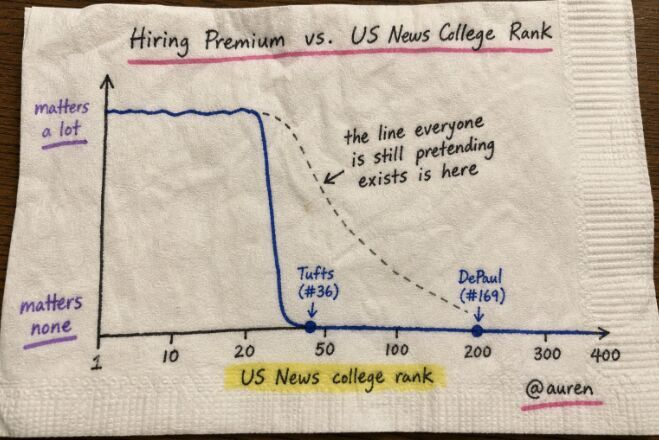
"Unless it's a top university, go to the cheapest one that you like."
This is the right advice for those deciding on which college to attend when thinking about future employment
Going to Boston University or Oberlin just won't matter
h/t @auren
A Wharton economist ran a randomized controlled trial on almost a thousand high school students in Turkey.
The result was so brutal for the AI-in-education narrative that it had to be peer-reviewed by PNAS before people would believe it.
Her name is Hamsa Bastani. She teaches operations and information at the Wharton School at the University of Pennsylvania, and the study she published in 2025 alongside her co-authors is one of the cleanest experiments anyone has run on what AI actually does to learning when you remove it from the equation and check what is left.
The setup was a randomized controlled trial, the same methodology used in clinical drug trials. Nearly a thousand high school math students in Turkey were split into three groups and put through four sessions of ninety minutes each. One group practiced with GPT Base, a standard ChatGPT-4 interface that could answer any question directly. One group practiced with GPT Tutor, a version of the same model that had been prompted to guide students with hints rather than hand them the answer. One group practiced with nothing but their textbook and their own head.
During the practice sessions, the AI groups looked like a miracle. The GPT Base group solved 48% more problems than the students working alone. The GPT Tutor group solved 127% more. Every administrator looking at those numbers would have written a press release about the transformative power of AI in education and moved on.
Then the actual exam came, and AI was not allowed.
The students who had practiced with GPT Base scored 17% worse than the students who had practiced alone. Seventeen percent worse, despite having solved nearly half again as many problems in the sessions leading up to it. The students who had struggled the most, who had sat with the confusion and worked through it without a tool to rescue them, were now the only ones who could actually do the math when it counted.
Bastani's team read through the chat logs to understand what had actually been happening during the practice sessions, and the answer was exactly what the exam results had already implied. The GPT Base group had not been learning. They had been extracting answers and moving on, and every moment that felt like understanding was actually the model doing the cognitive work while the student's brain waited for the next problem to arrive. The paper describes it precisely: without guardrails, students attempt to use GPT-4 as a crutch during practice, and subsequently perform worse on their own.
The detail that should follow every conversation about AI in education is the one buried in the post-test survey results. The students who had relied on AI the most during practice were also the most confident they had understood the material. The tool had not just failed to teach them. It had convinced them they had learned something they had not, which is a different kind of failure entirely and a much harder one to correct because the student has no idea it is happening.
The crutch had made them confident and weak at the same time.
Soy profesora universitaria hace once años. He tenido estudiantes brillantes, estudiantes que llegaron sin base y terminaron sorprendiéndome, estudiantes que prometían mucho y desaparecieron a mitad del camino.
Hace dos semestres tuve al mejor estudiante que he visto en once años.
No el más inteligente. El más comprometido. Hay una diferencia enorme entre los dos y no siempre se entiende.
Entregaba todo antes del plazo. Hacía preguntas que obligaban a pensar. Participaba sin necesitar que lo llamara.
A mitad del semestre me pidió una reunión.
Harvard, apparently, is about to adopt a new policy to combat grade inflation. I devised my own anti–grade inflation policy 25 years ago. I’ve shared it with provosts and deans, to no avail. Here it is:
The Muñoz Plan Against Grade Inflation
The plan has three key components:
India’s weight-loss drug market just ran a live experiment in price elasticity.
Novo Nordisk’s semaglutide patent expired 20 March 2026.
Within 3 weeks:
15+ generics launched
Cheapest at Rs 2,000/month (branded was Rs 10,000+)
Novo cut Ozempic and Wegovy prices by 36-48%
But here is the part nobody saw coming.
🧵
A city has slums. Two options: bulldoze and move residents to new housing, or upgrade the slum where it stands. New housing sounds better. Chile tested both for 20 years. It wasn't even close.
An excel model is like a bicycle. You can hire someone to ride your bicycle all day and then tell everyone how much use you get out of your bike. But the point isn’t that the bicycle gets ridden, it’s that you ride the bicycle.
Reed explains that the job of a board member is not to add value or give advice. It is to replace the CEO:
"If the company falls apart, I will be part of replacing the CEO. That's basically the entire job. To have the confidence to do that, you have to learn the business.
Board members are not here to add value. They can hire consultants who know the industry and are not conflicted for advice. So I shouldn't spend my time trying to give advice.
So then what am I doing? I'm here as a board member as an insurance layer.
Don't measure yourself by did you give a suggestion? Measure yourself by did you get more prepared for the small chance that you will have to take big action."
One of the most bizarre things I observed at Shell was how someone would spectacularly fail at a $$$ project, and instead of being demoted or fired, the opposite happens. They get transferred to manage another high-visibility project or even get a promotion!
It took me a long time to understand this but when I did, it changed everything for me.
You see, performance is measured in most companies on two prongs: the what and the how. The “what” is the actual result: did you or did you not strike oil after drilling that well? The “how” is the behavior you displayed during the entire process.
I was too focused on the actual results but I later found out that leaders rate behaviors higher. Hence, a project might fail in that it did not meet its stated objectives and yet the project manager might come out a winner because of how he carried himself through it all.
So what are the behaviors highly cherished by the higher ups?
First is daily updates. Forget weekly reports. Tell your boss and other key stakeholders about how the project is going at least once a day. When I say “tell”, I mean “tell.” Don’t rely solely on an email or a tool. Find a way to get in their face daily even if just for a min or two to verbally articulate the status of things. The pros at this put a standing 5-10 min meeting on their calendars and they come prepared to discuss the highlights and issues that need addressing. Which leads me to the second point.
Second, involve your superiors in solving the problem. Don’t form James Bond or Jackie Chan, trying to do it all alone. Any issue that will lead to a delay or cost overrun or any other wahala should be brought up asap to be discussed. Much easier to do if you talk with them daily. It is hard for them to blame you on the outcome of a project they have been integral to.
Third, conduct a “lessons learned” session where you perform an autopsy on the dead project. Share these lessons far and wide. You will be hailed as a sage. Suddenly you are now the guy helping the company become better by spreading wisdom gained from the school of hard knocks. This act alone has landed many people their promotion.
Bottom line: you can secure victory from defeat. The high flyers in your company do it all the time. If the project succeeds, they win. If the project fails, they win.
Be like them.