Building a yield product in-house takes serious engineering, risk and compliance work.
With Smart Yield Widgets, any app can offer Sentora’s @Morpho@upshift_fi & @veda_labs vaults in three steps, now with compliance screening by @HypernativeLabs .
https://t.co/7zbHVh0uzJ
AI agents are starting to allocate capital onchain, and they behave very differently from human investors.
Tomorrow at 12:00 PM ET, Jesus Rodriguez explains how Sentora designs vaults for capital managed by agents.
Secure your spot:
https://t.co/WA6N0XMbW2
Sentora vaults are now available inside Claude, ChatGPT, Gemini and Grok thanks to our collaboration with @agorawealthai !
Join the waitlist with code SENTORA
👉https://t.co/IlDYtqcxaZ
Why the current money system fails you. a 🧵
In September 2026, the M2 money supply reached a record $23.41 trillion.
Trillions of those dollars sit in bank accounts earning nothing, or nearly nothing, while the risk-free rate is near 4%.
Institutional adoption of onchain vaults depends on clear risk frameworks and credible curation.
This report addresses both, with a rigorous look at the market and the infrastructure behind it.
The State of Onchain Vaults is out today.
2026 is the year of onchain finance, and vaults are its culmination: the point where tokenized Treasuries, stablecoins, and trillion-dollar asset managers converge on the same structure.
Our new 47-page report explains where the market stands and what it would take to get from here to there.
What’s inside:
· A taxonomy of vaults by yield source
· What allocators want, who the curators are, and how regulators in the US and abroad are approaching the category
· A Vault Ecosystem Map
· Case studies on Midas mF-ONE and Coinbase’s Steakhouse-curated lending on Morpho
· A risk framework across smart contract, oracle, liquidity, counterparty, and governance layers, worked through the Kelp DAO case
· Commentary from @aave@MorphoLabs@wintermute_t@paretocredit@MidasRWA@SteakhouseFi@grovedotfinance@upshift_fi@SentoraHQ@hare_xyz
Read the report: https://t.co/d0Qo57EseC
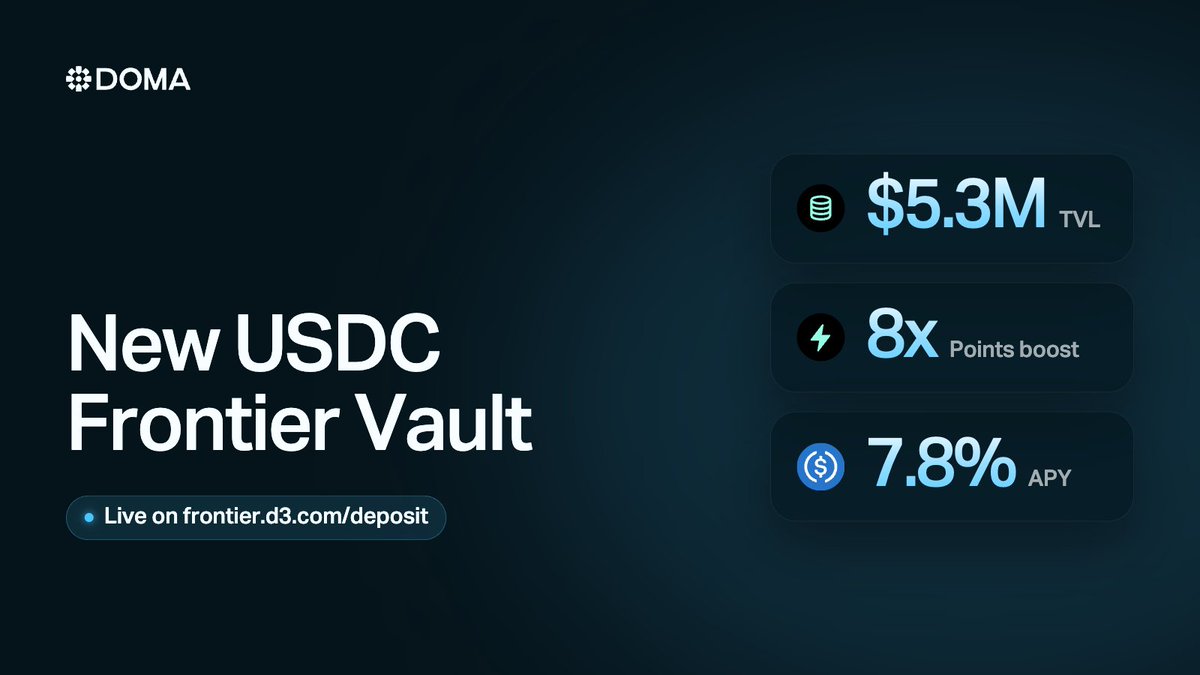
Frontier now supports a new USDC vault, powered by @upshift_fi and @SentoraHQ
The easiest way into Frontier just landed 👇
https://t.co/ZxQKW1Db0y
(Note: Only available outside the US.)
Customer-facing platforms spent the past year selling DeFi yield through Earn products, and curated vault TVL grew 26% to ~$10B while lending fell 39%.
One problem persists: when a protocol or vault gets hacked, depositors absorb the loss.
@Firelightfi, incubated by @SentoraHQ, lets XRP holders stake on @FlareNetworks to back cover for vaults, paying out if a protocol a vault deposits into is exploited. It now covers vaults at Kraken, Lido, and Sentora.
Our new report on why Total Value Covered belongs next to TVL: https://t.co/8WNZvbMShs
Stablecoin vaults fund depositor yield from the interest borrowers pay.
Our new report looks at which borrowers have a lasting need for capital, and whether vault yields hold up once temporary issuer support ends.
https://t.co/6G2EgXpaS1
Frontier on @D3inc, powered by Upshift.
The new Doma Sentora Frontier Vault takes USDC on Ethereum, curated by @SentoraHQ.
Deposits accrue Frontier Points, which give points holders priority access on new domain endings such as .agent, .wallet, .labs and .api.
A new USDC vault is now supported on Frontier.
Powered by @upshift_fi and @SentoraHQ 🤝
Frontier is how you build priority on the new internet extensions you’re backing, ahead of general sale.
.agent .nft .labs .wallet .crypto .api + 100s more
Deposit USDC now: https://t.co/Mh99xpnAsZ
Sentora’s USD Vault is now live on @D3inc.
Users can allocate stablecoins to Sentora strategies directly in the D3 app, with execution on @upshift_fi infrastructure.
Read more: https://t.co/DeAwZ48I1N
You can supply to Sentora’s Hub on Aave V4 today.
The ethereum:0x8292bb45bf1ee4d140127049757c2e0ff06317ed market currently has a variable supply rate of 7.0% APY, set by live borrowing demand.
Get started: https://t.co/HGoLFGNeLN
Sentora’s Aave V4 deployment has passed $100M in deposits.
Our Ethereum Liquidity Hub runs the first externally curated markets on @aave V4, with borrowing in RLUSD, PYUSD and OUSD.
I just published an essay, Financing Prometheus, on the future of DeFi in frontier industries and “after crypto”:
https://t.co/YopMklCQ2t
“After crypto” is not an exit from digital assets. It names an expanding economic purpose. Crypto remains part of the system, while repayment increasingly comes from electricity delivered, computing capacity used, goods shipped, and discoveries made useful.
The assets of that future are the claims that make this possible: equipment and facilities for intelligence, the power that sustains them, the receivables that keep commerce moving, and the milestones that carry science from a laboratory into production. These are not substitutes for tokenized Treasuries or fund shares. Representing an existing security, making it useful inside DeFi, and originating new productive credit are distinct achievements. The frontier requires all three.
A company building a computing facility may have valuable customer contracts and very little spare collateral. Somebody must evaluate those contracts, finance construction, allocate losses, and commit for an appropriate term. Putting an existing bond onchain does not perform those jobs.
DeFi’s opportunity is to organize confidence for that next industrial age: capital markets that can underwrite uncertainty, assemble entire capital structures, and give promising enterprises time to become productive.
We have no shortage of extraordinary possibilities. The work now is to put foundations under them.
Firelight kicked off its second epoch this week. Adding Lido to the coverage model doubles organic yield. The headline staking rate is still ~3%, but the organic-to-incentive ratio is 2/3 to 1/3. Pretty big move in one month.
https://t.co/TrUmjFoBQ2
This week, Sentora Vaults gained a major new capability: integrating a vault now takes just a few simple steps.
Read more here: https://t.co/ThkSAXDznk
$6.36B left Binance last week. Within hours, $2.7B of it was frozen on-chain, the largest coordinated freeze in DeFi history.
This week’s digest covers what stablecoin guardrails could stop and what they couldn’t.
https://t.co/SeTftcVJhG
This week in DeFi:
- TVL: $112.44B (–$861M). Roughly flat as ETH round-tripped a volatile week.
- Stablecoins: $293.69B (–$6.02B). Down every single day, the largest drop in weeks.
- High-risk loans: $5.95B (–$123M). Leverage quietly unwound with limited forced selling.