A new 🔥 release from @screamingfrog with v24.0, including their official MCP! This is one of those AI + SEO updates that I find genuinely useful, because it can help reduce a lot of the repetitive manual work involved in pulling, exporting, segmenting, and combining crawl data with other sources.
Used alongside other SEO tools MCPs already available, like @Similarweb , @semrush , @seogets , Glippy, @ahrefs , etc. it opens the door to more practical workflows where you can easily integrate crawl, visibility, keyword, traffic, backlink, and competitive data faster.
For example:
✅ Segment crawl data at scale
✅ Compare technical issues with performance signals
✅ Combine different data sources without endless exports/imports
✅ Identify patterns that would otherwise take much longer to spot
✅ Spend more time validating, prioritizing, and deciding what to do next
That’s the part I’m interested in: not replacing the analysis, but making it less painful to get to the useful part of the analysis.
My only wish is that I didn’t have to burn so many credits across some of these tools to get the information I actually need 😅
And of course, the usual caveat: validate everything. The data still needs to be accurate, and the output needs to be checked. Especially when combining multiple sources or asking AI to interpret the results. I have trust issues, sorry.
But overall, this is a very useful direction for SEO workflows: better access to the data we already use, less manual handling, and more time spent on actual SEO thinking.
If you haven't yet tested it, do it now 🙌
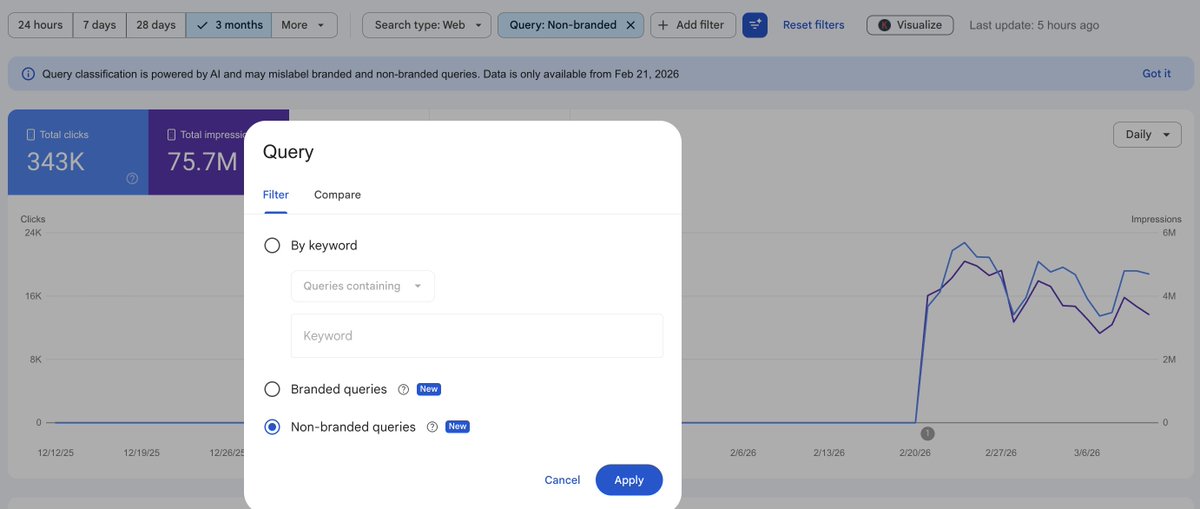
Google has started rolling out quick filtering options for Branded and Non-Branded queries in Google Search Console.
This matters because query classification has always been far more complex than the old SEO reflex of labeling everything as only “transactional” or “informational.”
Google’s systems deal with many different query types, including:
implicit question queries
entity-seeking queries
numeric queries
syntactic queries
navigational queries
and many others
Navneet Panda, who is often associated with the architecture behind the Panda updates, worked on systems that evaluate site quality partly through navigational, in other words, branded queries.
That is one of the reasons why, since my first Topical Authority case study, I have always emphasized that 0 search volume query terms and branded queries connected to topic-related queries are directly important for proving ranking necessity to Google.
Just yesterday, we shared an example of an EMD generating $15,000 per month with only a homepage, largely because it benefits from the siteNameFactor.
In the same way, Google now seems to be exposing a small glimpse of its internal query classification system inside Search Console.
This is useful because what Google considers branded vs non-branded may not always be as obvious as SEOs assume.
For example, queries containing:
synonym variations of brand terms
domain name terms
site name terms
close brand associations
may still be interpreted as branded by Google.
And since domain terms, site names, and brand phrases do not always perfectly overlap, this can influence how Google classifies a query.
Because of that, the new Branded / Non-Branded filter in GSC can become a valuable hint for understanding Google’s perspective more clearly.
To learn more: https://t.co/pbnF18gPmh
Are you getting #BrightonSEO FOMO? This will help.
Thankfully, @Errioxa has compiled links to 30+ slide decks about SEO (and more) from talks given.
Tons of awesome slides from the October in-person @brightonseo event – find them here: https://t.co/HDcZoZQiYX
Google is now officially offering SEO certification taught by Google employees - this is something Google said they won't be offering but now they are - not sure this is a great idea... https://t.co/62PCAlH3ag
Estimate: Apple's iOS App Tracking Transparency policy cost Snap, Facebook, Twitter, and YouTube almost $10B in combined lost ad revenues so far (@patrickmcgee_ / Financial Times)
https://t.co/ldDvTbKSaL
https://t.co/f5RhB9YkfB
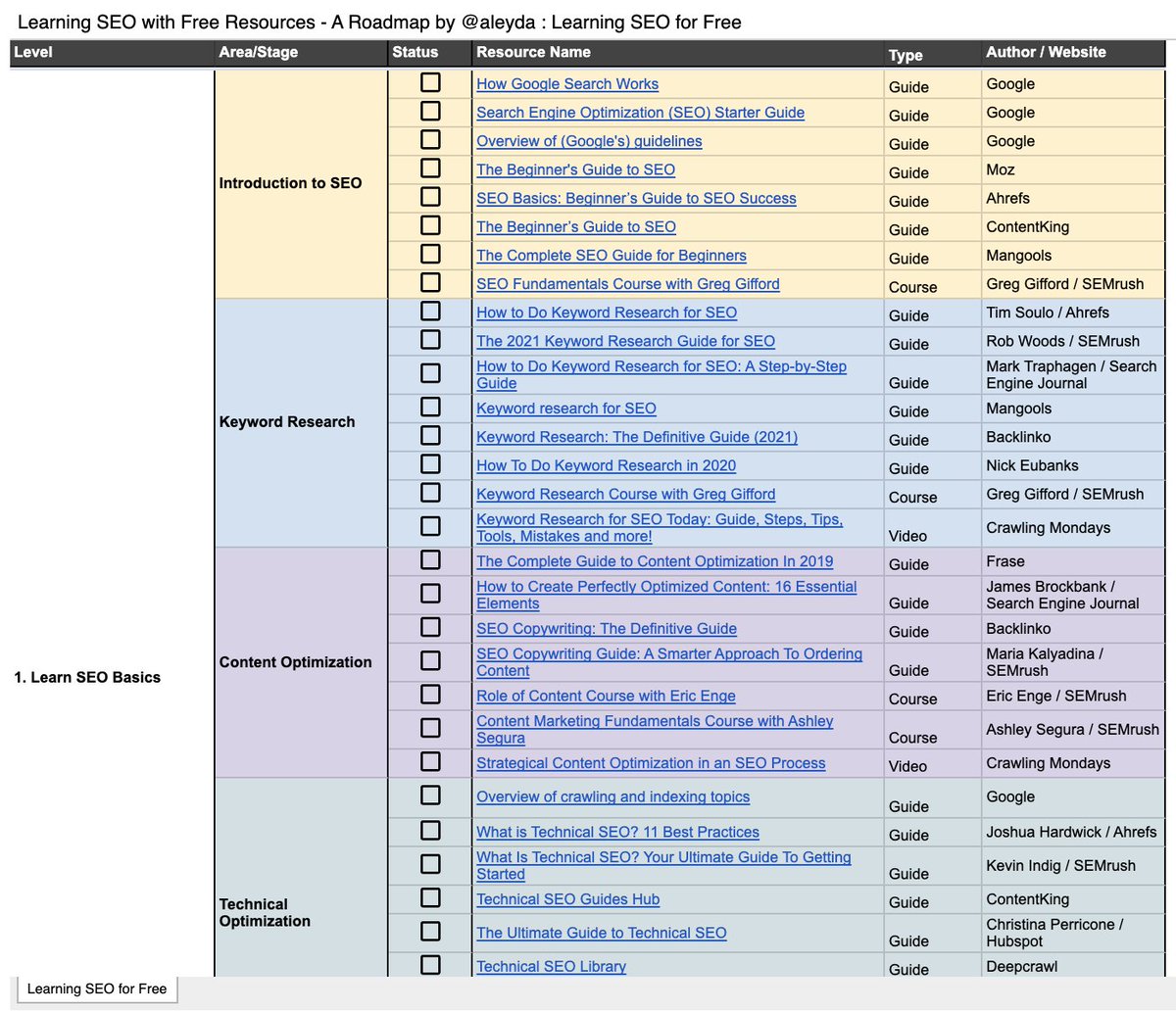
If you're learning SEO, and don't know where/how to start/continue, with good and free reliable resources, I've created this #LearningSEO site:
https://t.co/TTjcOIXGCq
It features a roadmap + google sheet to copy/paste with an aggregation of free guides and courses 📚🙌🤩
JavaScript SEO Best Practices Guide for Beginners:
* What is and why is so important
* How does JavaScript impact your SEO performance?
* Rendering options
* Render Budget
* More!
Another awesome guide from @contentking 👇
https://t.co/tIghH9ZeuX