@I_loveblack_ When an African will make a rocket to land on the moon you and your supporters will also say that it is a nothing to be proud of since the USA did it 60 years ago abi?
YOU WANNA BOOKMARK THIS
The ultimate resource for running LLMs locally is now available online to read for free
Covers what to use on
- Laptop / edge / odd hardware
- Mac-first workflows
- Single RTX GPUs
- 2-4+ NVIDIA / CUDA GPUs
- General production serving
- Long-context / MoE / routing
- NVIDIA max performance
- Cluster orchestration
Software
- llama.cpp
- MLX / MLX-LM
- ExLlamaV2
- ExLlamaV3
- vLLM
- SGLang
- TensorRT-LLM
- NVIDIA Dynamo
You should read this, and if you cannot now then you most definitely wanna bookmark it for later
Messi's IG post from 3 hours ago. 😭❤
See that first "adjustment" - it's not script o.
Demonic genius with autistic OCPD.
My leader has seen all the social media noise, injeeeeeeccct it o. 😭
@WellCoachLynell@glennbeck@SecKennedy As if all his personal opinions were to become the official statements and positions of the agency He was working for😮💨😮💨😮💨
The world wants me to die.
My incurable disease diagnosis became global news. It was omnipresent on social media and 1,900 articles were written in a matter of days.
Many were saddened.
However, joy dominated the commentary.
People pointed to schadenfreude, the pleasure of another's failure. Yes, there’s that. There is a special place in people’s hearts that loves to see others fail, especially when that person’s presence threatens their own psychological stability in some way or helps them feel better about themselves.
But, if you look over the social media commentary about me, you’ll see that pattern:
“he deserved it.”
I deserved it because I challenged death. The crowd was running a deeply rooted psychological script that represents the oldest, most deeply embedded stories of human culture.
This was the first story ever written down, 4,000 years ago. Gilgamesh sought eternal life after losing someone he loved, only to have the plant of youth stolen by a serpent as he bathed. Leaving him to accept his mortality.
Asclepius became so skilled at rejuvenation that he raised the dead. As punishment, Zeus struck him down with a thunderbolt to enforce life and death authority.
This is the story of Jesus. Pontius Pilate offered a choice between a thief and the immortalist, and the crowd demanded the execution.
People need this story conclusion to keep themselves sane. The challenger must lose and the loss must appear deserved. It’s a shield of self preservation.
For if death is inevitable, their existence and that of their loved ones is justified and unavoidable. If death is not inevitable, nothing about their reality is safe.
I occupy the same philosophical and archetypal position as Gilgamesh, Asclepius and Jesus.
This statement will draw outrage and accusations of blasphemy, hubris and narcissism. Nevertheless, it’s the pattern that has repeated itself for thousands of years.
Death has been the omnipresent concern of the human race. It encapsulates our greatest fears, joy and curiosities. The discourse around it changes over time; however, the fundamentals remain unchanged.
What’s different about this moment, that is unlike any other moment, is that physical death may no longer be inevitable.
What if I didn’t deserve it?
And what if I am your ally, and not a threat?
“Loop engineering” is a hot buzzphrase after mentions of it by Boris Cherny (Claude Code’s creator) and Peter Steinberger (OpenClaw's creator) went viral on social media. Loops are now a key part of how we get AI agents to iterate at length to build software. In this letter, I’d like to share my 3 key loops, shown in the image below, for building 0-to-1 products. These loops guide not just how I build software, but also how I decide what software to build.
Agentic coding loop: Given a product specification and optionally a set of evals (that is, a dataset against which to measure performance), we can have an AI agent write code, test its work, and keep iterating until the code is bug-free and meets its specification. This idea of closing the loop took off around the end of last year, and it has been a game changer in enabling coding agents to work longer productively without human intervention. For example, over the weekend, I was building an app for my daughter to practice typing, and my coding agent could easily work for around an hour, using a web browser to check what it had built multiple times before getting back to me, without needing my intervention.
The engineering loop executes quickly. Every few minutes, the coding agent might build and test a new version of the software. I hear frequently from developers who are finding new ways to engineer more effective engineering loops. This is an active area of invention!
Developer feedback loop: In this loop, a developer examines the current product and steers the coding agent to improve it. Last year, a lot of developers (including me) were acting as the QA (quality assurance) function for our coding agents, manually finding bugs and then asking the agent to fix them. But with coding agents much more able to test their own code, the amount of time we need to spend on this function has decreased significantly. This allows us to make higher-level product decisions, such as what key features to offer, where the UI needs improvement, and so on.
The developer-feedback loop operates over time intervals between tens of minutes and hours — that's how frequently a developer might review a product and give feedback. In the case of the typing app, I changed my mind a few times about the visual design, what cat costumes she can unlock as she learns (she loves cats), and the user flow for a grown-up to log in and steer the child's learning experience.
When a developer has a clear vision for what to build, it is still a lot of work to translate that vision into a specification for a coding agent to implement. Further, after the developer has seen an implementation, they might update (or perhaps clarify) the spec to steer it toward what they want. If you find that the system repeatedly runs into certain problems, building a set of evals for the agent becomes useful.
AI-native teams are increasingly using AI to help shape product direction, for example, automating the gathering and analysis of usage data, summarizing written and verbal customer feedback, or carrying out competitive analysis. However, for pretty much all the products I’m involved in, I see humans as having a significant context advantage over current AI systems — we know a lot more than the AI system about the users and the context the product has to operate in — and thus humans play a critical role. Many people describe this human contribution as “taste,” but I prefer to think of it as humans having a context advantage, since that gives us a clearer path to helping AI systems get better. This also speaks to why this step can’t be automated: So long as the human knows something the AI does not, human-in-the-loop is needed to to inject that knowledge into the system.
External feedback loop: This includes a wide range of tactics like asking a few friends for feedback, launching to alpha testers, or putting the code into production with A/B testing. These tactics are usually slow, rarely taking less than hours and sometimes taking days or even weeks. This data informs the developer vision, which in turn continues to drive the detailed product spec, which in turn drives the coding agent.
With coding agents speeding up software development, more engineers are starting to play a partial product management role. For many engineers who are growing into this role, the hardest part is shaping the product vision and striking a balance between building (bridging the gap between vision and spec) and getting user feedback to evolve the vision. It is important to do both!
I will write more about how to do this in future posts, but for now, I find it encouraging that engineers are playing an expanded role (just as product managers and designers now do more engineering).
[Original text: The Batch]
Our thoughts on the importance of AI sovereignty.
1. Your AI sovereignty dictates your institution’s future. Sovereignty is the precondition for choice. Relinquishing sovereignty transfers the future choices of your institution to others, who are likely to exploit it for their gain and your loss.
2. Data retention is your treasure. Transfer it at your own peril. Your ability to win is dictated by your ability to recognize and use your unique edges, and you keep winning by compounding the underlying data to generate new insights. Transferring that data hands over access to your pre-existing winning plays and yields the means of production for new ones.
3. Tokenmaxxing hijacks your value orientation and decreases your institutional fortitude and intelligence. The pursuit of high token usage incentivizes disposable scripts over robust software — with the addictive feeling of false progress. There is a reason why those selling tokens refuse to charge based on value.
4. Controlling your weights is controlling your fate. Weights are the distilled form of hard-won, accumulated institutional knowledge. If you let others control your weights, you are allowing them to migrate the alpha of your business to theirs.
5. There is no contradiction between sovereignty and alpha. The architecture that maximally preserves sovereignty is one that enables institutions to own their tribal knowledge, and to compound it as alpha.
6. Politicizing the technical issues involving sovereignty is what your adversary wants. Techno-politicization is the wellspring of false sovereignty. Techno-politicization drives decisions that seem to reduce dependency, but ultimately limit agency — especially on the battlefield in the West.
7. Real expertise is existential. Allowing politics or favoritism to determine your technical decisions rewards whoever is best at politics, not whoever is right. Listen to those closest to the problems, not those speaking most compellingly about them.
8. Learn from institutions that are winning or that have consistently delivered. Institutions facing existential threats do not have the luxury of making technical decisions based on political preferences.
9. Only listen to institutions, countries, and people who have a proven record of being right. A track record of correctness is the best and only signal for future correctness. Judging something as right or wrong based on who you like is exceedingly misguided.
@UgochukwuCFR Your friend has not reached the frontier of Claude and other AI tools, the level where they are totally helpless. And to push them to that frontier, computer science concepts are essential. Claude will implement your solution, but are you sure that it caught all the invariants?
@_OKJ__ I agree with your first point. Of course the early non Hebrew Christians were not given the old testament as holy reading, only the gospels and letters of the apostles. The first Bible by Marcion around 100AD did not contain the OT either. The OT was added 200 years later.
@winexviv It looks like you may not be familiar with the program of mechanical engineering, not only in Nigeria, but worldwide. A final year even in MIT or Harvard in mechanical engineering will also not be able to fix a power generator, or do you think otherwise?
Je suis un énorme fan d'Étienne Klein. J'ai regardé toutes ses conférences et j'aimerais lui faire un feedback public sur ce que je pense de ses positions actuelles sur l'IA.
Étienne Klein répète depuis des mois une idée qui sonne juste : les grandes découvertes scientifiques ne sont presque jamais nées de la data. Et il a raison.
Einstein n'a pas trouvé la relativité restreinte en analysant des téraoctets de mesures. Il avait 16 ans, il était obsédé par une question d'enfant : à quoi ressemblerait le monde si je chevauchais un rayon de lumière ? Dix ans plus tard, il publiait l'article qui détruisait Newton.
La relativité générale ? Une autre expérience de pensée. Un homme dans un ascenseur en chute libre. Pas un capteur, pas un dataset, pas une régression. Une image mentale.
La mécanique quantique ? Le chat de Schrödinger, le démon de Maxwell, l'expérience EPR, le microscope de Heisenberg. Toute la physique du 20e siècle a été construite par des cerveaux qui jouaient avec des situations imaginaires que personne ne pouvait mesurer. Bohr et Einstein ne se battaient pas avec des données. Ils se battaient avec des récits, des intuitions, des paradoxes.
Klein a donc raison sur le diagnostic. La science n'est pas un problème d'optimisation statistique. La science, c'est de la créativité conceptuelle.
Mais c'est précisément là où je pense qu'il se trompe sur l'IA.
Klein voit l'IA comme une machine à corréler de la data. Donc, logiquement, il en déduit qu'elle ne peut pas faire de science fondamentale. Le syllogisme est impeccable. Sauf que la prémisse est fausse.
L'IA d'aujourd'hui n'est pas un moteur statistique. C'est un partenaire de pensée. Et ça change absolument tout.
Imagine Einstein en 1905, seul à Berne, avec son cerveau et son carnet. Maintenant imagine Einstein en 2026, avec un modèle capable de tenir en parallèle dix mille variations de son expérience de pensée. Capable de lui répondre : "si tu modifies cette hypothèse, voilà ce qui se passe au niveau des transformations de Lorentz". Capable de jouer le rôle de Bohr, de Poincaré, de Mach, et de challenger chaque intuition en temps réel.
L'IA ne remplace pas l'expérience de pensée. Elle la démultiplie.
Un physicien qui pense seul peut explorer peut-être 5 ou 10 variantes d'une intuition par jour. Un physicien qui pense avec une IA peut en explorer 500. Pas parce que la machine pense à sa place, mais parce qu'elle élimine la friction entre l'intuition brute et sa formalisation.
C'est exactement ce que Feynman cherchait à faire avec ses diagrammes : compresser le temps entre l'idée et le calcul. L'IA, c'est le diagramme de Feynman du 21e siècle, mais à l'échelle du raisonnement entier.
Le vrai génie scientifique des prochaines décennies ne sera pas celui qui sait analyser le mieux les données du LHC. Ce sera celui qui sait converser avec l'IA comme Einstein conversait avec lui-même dans son train imaginaire. Celui qui transforme l'IA en caisse de résonance pour ses propres intuitions, qui itère mille fois là où ses prédécesseurs itéraient dix.
Klein a raison sur un point fondamental : la donnée ne fait pas la découverte. Mais il sous-estime que l'IA n'est pas un outil de data. C'est un outil de pensée.
Et un physicien natif de l'IA, qui aurait gardé l'âme d'enfant d'Einstein mais qui saurait amplifier ses expériences de pensée à la vitesse de la lumière, c'est probablement la figure scientifique la plus puissante que l'humanité aura jamais produite.
Le prochain Einstein ne battra pas l'IA. Il pensera avec elle.
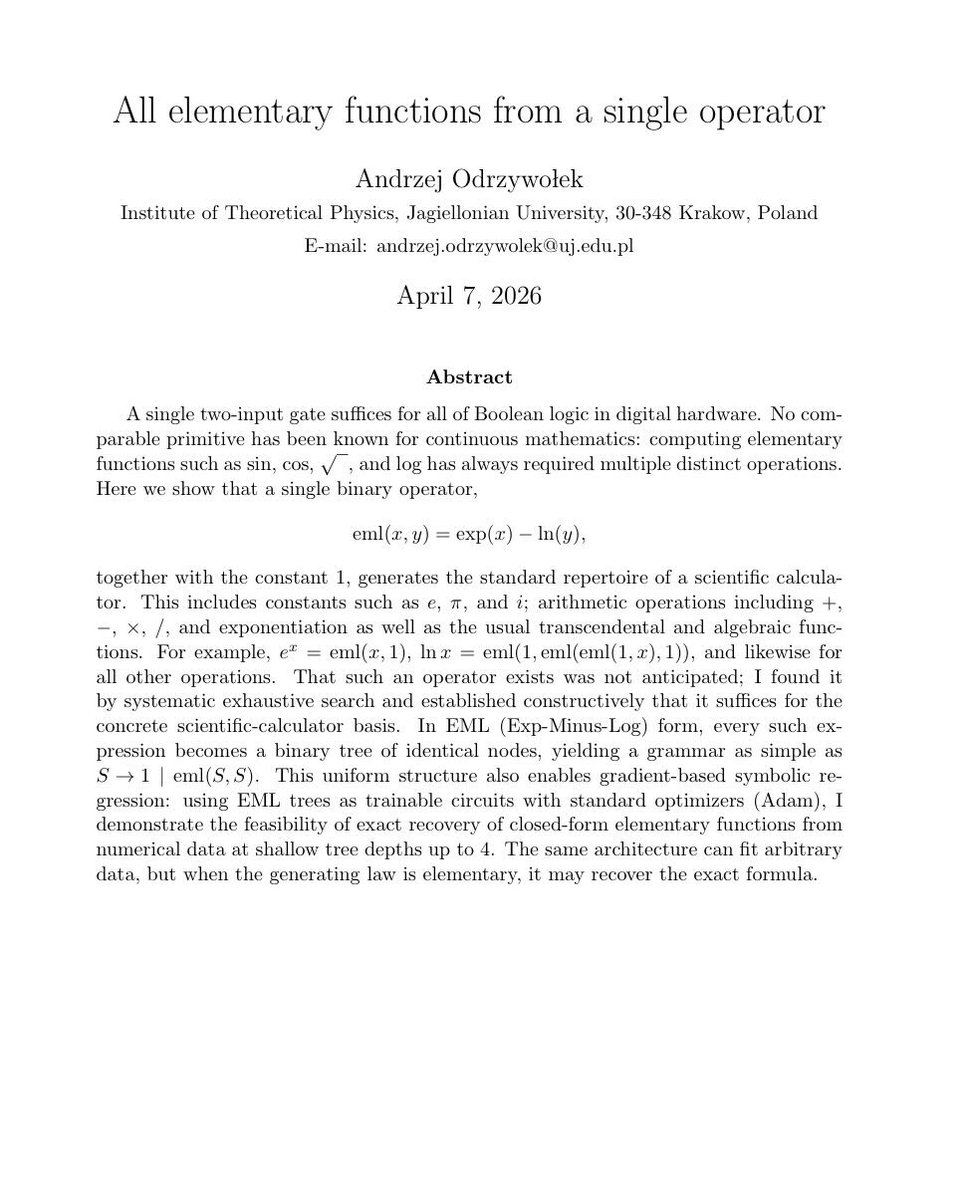
Physicist has written a fascinating big beautiful paper.Let’s not be afraid to call it what it is - groundbreaking. For hundreds of years, mathematics had dozens of “basic” functions: sine, cosine, logarithm, square root, exponential. You know these from school. Everyone does. Now it turns out that all of it is one single operator:
E(x, y) = exp(x) - ln(y), and the constant 1.
Sin, cos, π - everything follows from this neatly , just nest it properly. Nature hid the simplest possible description of reality. And it was just been found. The whole thing is beautiful and remarkable, here the word “groundbreaking” is not a marketing buzzword.
For instance, instead of writing π or 3.14, one can now elegantly write E(E(E(1,E(E(1,E(1,E(E(1,E(E(1,E(E(1,E(1,E(E(1,1),1))),1)),E(E(E(E(E(1,E(E(1,E(1,E(E(1,E(E(E(1,E(E(1,E(1,E(E(1,1),1))),1)),E(E(1,E(E(1,E(E(1,E(E(1,1),1)),E(E(E(1,E(E(1,E(1,E(E(1,1),1))),1)),E(1,1)),1))),1)),1)),1)),1))),1)),E(E(E(1,E(E(1,E(1,E(E(1,1),1))),1)),E(E(1,E(E(1,E(1,E(E(1,E(E(1,E(E(1,E(1,E(E(1,1),1))),1)),E(1,1))),1))),1)),1)),1)),1),1),1))),1))),1)),E(E(E(1,E(E(1,E(1,E(E(1,1),1))),1)),E(E(1,E(E(1,E(1,E(E(1,E(E(1,E(E(1,E(1,E(E(1,1),1))),1)),E(1,1))),1))),1)),1)),1)),1)
https://t.co/Pv2UUbTEay
@Hamzythacreator Another way to put this question, kind of a riddle, which arrangement or system will be needed for humans to be falling off the earth?
@garrytan The assumption here is that human reviewers are not needed, even the AI augmented ones. Once they are taken into account, they become the limiting factors (<500 LOC per review). Unfortunately, for the current state of AI, humans are still needed as automated tests are not enough.
@davepl1968 300 LOC is the target I give to the AI as 1000 LOC is quite much for reviewers. Automated testing is good but actually not enough at all. I setup a first pass for the AI to check for known AI slops, then code security, idioms and standard compliance, and (very useful) invariants
🚨 China has released an AI employee that runs 100% locally.
It can do research, code, build websites, create slide decks, and generate videos.. all by itself. And it comes with its own computer.
100% Open Source.
A breakthrough in real-time video generation.
As a research preview developed with @NVIDIA and shared at @NVIDIAGTC this week, we trained a new real-time video model running on Vera Rubin. HD videos generate instantly, with time-to-first-frame under 100ms. Unlocking an entirely new creative paradigm and bolstering the foundations of our General World Model, GWM-1.
Real-time generation opens a fundamentally different design space for video models and world simulation. We're investing in co-designing our models alongside advances in hardware to keep pushing this frontier.






![AndrewYNg's tweet photo. “Loop engineering” is a hot buzzphrase after mentions of it by Boris Cherny (Claude Code’s creator) and Peter Steinberger (OpenClaw's creator) went viral on social media. Loops are now a key part of how we get AI agents to iterate at length to build software. In this letter, I’d like to share my 3 key loops, shown in the image below, for building 0-to-1 products. These loops guide not just how I build software, but also how I decide what software to build.
Agentic coding loop: Given a product specification and optionally a set of evals (that is, a dataset against which to measure performance), we can have an AI agent write code, test its work, and keep iterating until the code is bug-free and meets its specification. This idea of closing the loop took off around the end of last year, and it has been a game changer in enabling coding agents to work longer productively without human intervention. For example, over the weekend, I was building an app for my daughter to practice typing, and my coding agent could easily work for around an hour, using a web browser to check what it had built multiple times before getting back to me, without needing my intervention.
The engineering loop executes quickly. Every few minutes, the coding agent might build and test a new version of the software. I hear frequently from developers who are finding new ways to engineer more effective engineering loops. This is an active area of invention!
Developer feedback loop: In this loop, a developer examines the current product and steers the coding agent to improve it. Last year, a lot of developers (including me) were acting as the QA (quality assurance) function for our coding agents, manually finding bugs and then asking the agent to fix them. But with coding agents much more able to test their own code, the amount of time we need to spend on this function has decreased significantly. This allows us to make higher-level product decisions, such as what key features to offer, where the UI needs improvement, and so on.
The developer-feedback loop operates over time intervals between tens of minutes and hours — that's how frequently a developer might review a product and give feedback. In the case of the typing app, I changed my mind a few times about the visual design, what cat costumes she can unlock as she learns (she loves cats), and the user flow for a grown-up to log in and steer the child's learning experience.
When a developer has a clear vision for what to build, it is still a lot of work to translate that vision into a specification for a coding agent to implement. Further, after the developer has seen an implementation, they might update (or perhaps clarify) the spec to steer it toward what they want. If you find that the system repeatedly runs into certain problems, building a set of evals for the agent becomes useful.
AI-native teams are increasingly using AI to help shape product direction, for example, automating the gathering and analysis of usage data, summarizing written and verbal customer feedback, or carrying out competitive analysis. However, for pretty much all the products I’m involved in, I see humans as having a significant context advantage over current AI systems — we know a lot more than the AI system about the users and the context the product has to operate in — and thus humans play a critical role. Many people describe this human contribution as “taste,” but I prefer to think of it as humans having a context advantage, since that gives us a clearer path to helping AI systems get better. This also speaks to why this step can’t be automated: So long as the human knows something the AI does not, human-in-the-loop is needed to to inject that knowledge into the system.
External feedback loop: This includes a wide range of tactics like asking a few friends for feedback, launching to alpha testers, or putting the code into production with A/B testing. These tactics are usually slow, rarely taking less than hours and sometimes taking days or even weeks. This data informs the developer vision, which in turn continues to drive the detailed product spec, which in turn drives the coding agent.
With coding agents speeding up software development, more engineers are starting to play a partial product management role. For many engineers who are growing into this role, the hardest part is shaping the product vision and striking a balance between building (bridging the gap between vision and spec) and getting user feedback to evolve the vision. It is important to do both!
I will write more about how to do this in future posts, but for now, I find it encouraging that engineers are playing an expanded role (just as product managers and designers now do more engineering).
[Original text: The Batch]](https://pbs.twimg.com/media/HMEtxp3bsAARJdi.jpg)