This post nails why we why we should take the Riemann Hypothesis breakthrough very seriously, even beyond math. We’re entering an era where solving problems will look very different from how we solved them in the past.
“This is not theory-building in the usual sense. It is something much weirder and more alien. The best human mathematicians know how to build theory, painstakingly, to reach a goal. But no human brain, on its own, is capable of creating a wormhole that requires a 25,000 page long tour through existing infrastructure with no obvious or realistic connection to the goal. But huge credit to Levent here: I think no current AI, on its own, is capable of this either.”
It used to be the case that to solve a particular problem - code, life sciences, math, cyber, engineering, and so on - you were ultimately bound by how much information an individual or team could retain and understand about the space. More information or more team members don’t always help, because it gets harder to connect the dots or coordinate amongst everyone. AI changes that completely.
For the first time ever we can decouple the human context limits and ability to work through information from our ability to drive productivity or discoveries. This is likely not just a small increase in the kinds of discoveries we can drive, but a qualitative shift in human output.
Now every single form of prior art, insight, past research, past decision, or unrelated breakthrough, can be used for the discovery or creation of something new. This is useful for anything from cybersecurity to life sciences research. Agents will be able to correlate entirely unrelated work to a separate project; scan every bit of data in your enterprise for solving a problem; and so on.
The solutions may not be as elegant as they were in the past, but we sure will have far more of them. We’re only in the first couple of months of actually understanding the implications of this but it’s clearly going to drive a lot of change.
@peteratmsr@peteratmsr, your creativity, collaboration, and profound confidence that things could be better have helped make them so for the healthcare community and, most importantly, the people it serves.
This morning I walk into my office at Epic for the last time. The future holds plenty of intrigue. Today, though, I'm grateful — 21 years' worth — for the customers who shared their dreams and challenges, the industry friends united in helping patients and caregivers, and the Epic colleagues who invented, sharpened one another's ideas, and relentlessly built.
You all taught me so much. Thank you.
Keep doing good!
Recently, a friend asked me, over a cup of coffee, what has AI actually changed around me personally. I immediately noted that the quality of understanding one can develop of topics is deeper through dialogue - and AI makes dialogue more accessible.
The combination of deep reading paired with dialogue - both with fellow humans and AI - is a skill we need to foster and teach.
Researchers at @Yale using Curiosity—Epic's generative medical event model, which simulates a patient's likely future course from their record — looked at adults discharged from the ED with abdominal pain, one of the most common and most uncertain presentations in emergency medicine. Traditional risk models answer a binary question: will this patient come back? Curiosity answers a richer one: if they return, when, and will that return end in discharge or admission?
Two patients can carry the same overall revisit probability but face very different paths—one headed toward a quick outpatient follow-up, another toward an early admission. A binary score flattens that difference. A trajectory surfaces it.
A single pretrained model, like Curiosity, can generate calibrated predictions across many outcomes without retraining. As a result, the focus and time shift away from building a bespoke model for every clinical question and toward deciding which questions are worth asking. The team moved from idea to results in a matter of weeks.
It also highlights an emerging skillset: clinicians who pair deep clinical reasoning with real fluency in generative AI. The questions they choose to ask are the key ingredient.
Preprint here: https://t.co/bvQJ1c5JK0
Longtime listener; first time caller. Had a blast exploring a wide range of topics - from scaling laws to Paperboy (the Nintendo game) - with @arjunmanrai and @AndrewLBeam .
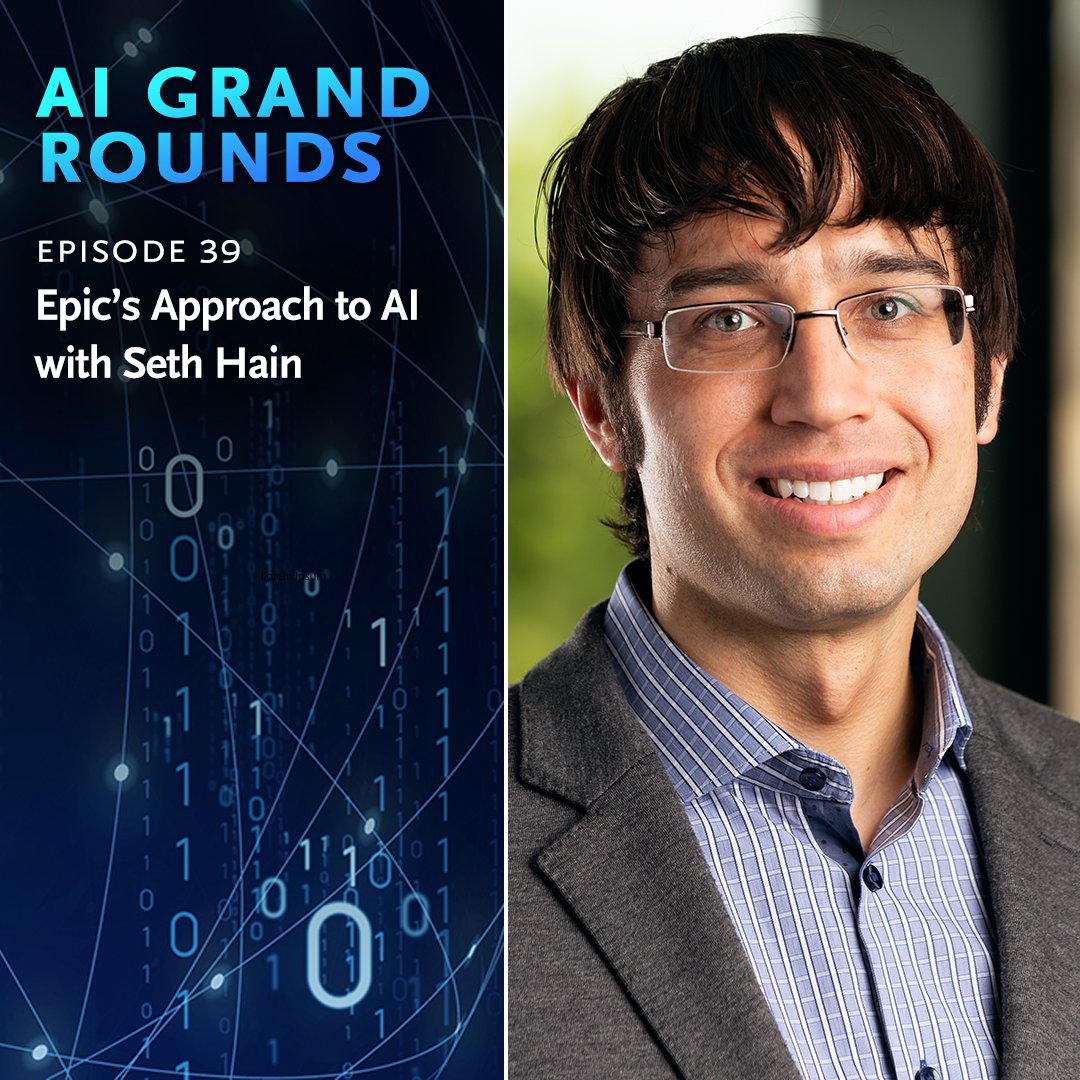
In the latest episode of AI Grand Rounds, @sethHain, senior VP of R&D at Epic (@HeyEpic), describes how his company is building foundation models that respect institutional autonomy, minimize burden, and prioritize safety. Full episode: https://t.co/8bURhrMXna
Imagining a thoughtfully curated, hard-bound book (a la @stripepress) collecting the essential essays and papers demonstrating how society dealt with this moment in AI. Trying to compile what truly deserves to make the cut.
Health systems are leading the way on AI research and adoption. It was an honor to share their real-world results with the tech community at #MSIgnite.
The speed and scale of what’s happening in healthcare right now is remarkable. And what’s coming next is even more exciting.
At Epic, we create technology to help people get and stay well.
AI is embedded throughout our applications—from the clinic, to the bedside, to the back office.
Worldwide, hundreds of thousands of clinicians are using it to improve care.
Here it is in action at #MSIgnite:🧵
US News Best Leaders 2025: Judy Faulkner - “You predict the future for two reasons,” Faulkner says. “One is to prepare for it. And two is to change it.” https://t.co/JImY3y3KlK
Geniunely enjoy ever conversation I get to have with @mattlungrenMD and @JustinNordenMD - including this one we decided to record.
https://t.co/CZjNidAb1V
@emollick What we may learn if this same mystery and the potential "law-like" structures apply to the Comet models (transformers trained on sequences of medical events) has been a key inspiration for us at @HeyEpic as well.
https://t.co/lZfKUTCdrG
We really have not made a lot of progress on explaining the deep mystery of LLMs:
How does a model using matrix multiplication to predict the next word manage to simulate human thought well enough to do all the very human-like things it does? And what does that mean about us?
Cool new paper out of Epic that trains foundation models + derives scaling laws for generative medical event modeling.
Interestingly enough - they find that the Chinchilla scaling parameters basically hold in this setting as well!
🧵some observations and questions below