5 coding agents. Same Halloween pixel-art prompt. Same local Qwen3.8 Flash Next (Q4XL→HGN) on Halogen/Ubuntu.
Results:
Claude Code: 14m 42s
OpenCode: 36m 30s
Copilot: 58m 30s
Pi: 1h 20m
Codex: 4h 4m
16.6× difference in completion time. Which looks best?
Introducing Edge0-145B and Edge0-120B, @Edge0_AI’s first device-native 100B-class foundation models with open weights.
Cloud-level intelligence on your laptop. Free, offline, and fast enough for real vibe coding.
- Smart: beats Claude Opus 4.6 on Terminal-Bench 2.1 (86.5% vs. 78.2%)
- Light: needs just 29G memory, 1/3 of a standard setup (100G+)
- Fast: decodes 75+ toks/s, prefills 1050+ toks/s on RTX Spark and Mac.
- Steady: handles 128K–256K tokens of context without slowing down, even on long tasks
Frontier-class agentic coding. No cloud API. No token bill. Your code and data never leave your machine.
Open weights are live on @huggingface. Run it locally or plug it into your favorite coding agent.
This is what TensorFold 1.2.7 looks like on AMD Strix Halo, and this is what my local dev branch looks like.
There's still more performance available on AMD.
"oh no what did we regress from pi"
> 8 tasks failed because reward hacking counts as failure (we add web search, duh)
> 3 tasks failed because we keep bg tasks scoped to the session so that people don't have runaway scripts
jebaited once again 💀
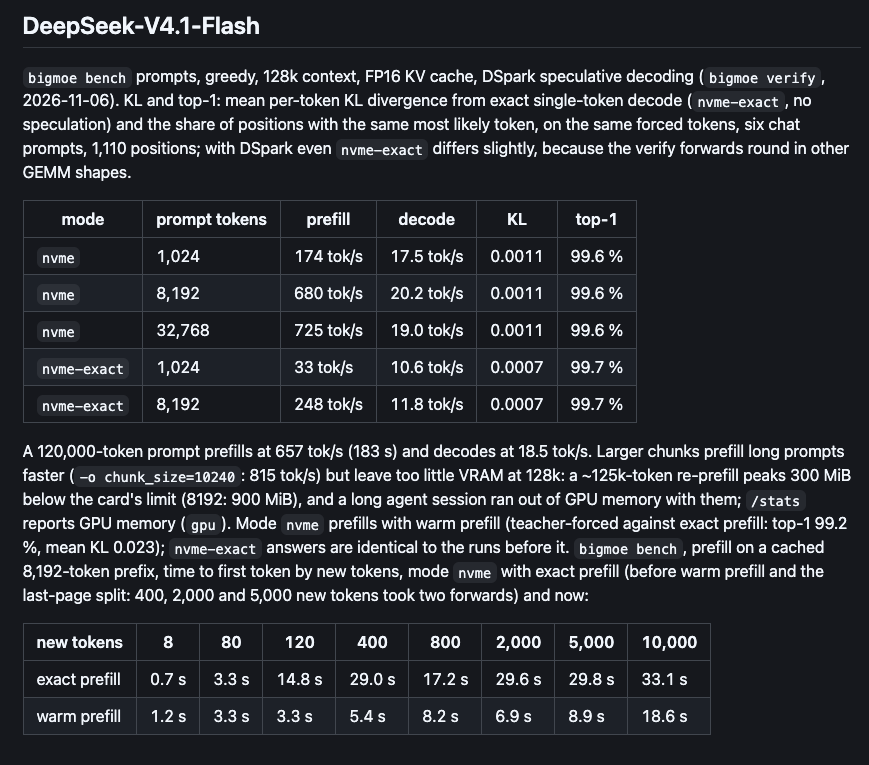
DeepSeek v4.1 Flash 1017 at home at 15 tokens/s on my RTX 3090 build is super viable now.
My roadmap:
1. Build my own inference engine, then
2. Undetected browsing plugin, then
3. New quantization framework
4. RSI over step 1-3 at home
You can do the same for $2.5k..
Some people were asking for the prompt for this, it was pretty straight forward, throw it into a harness and have it continue as much as you want.
Prompt below.