@KenRolands Colossians 1:22-23 NKJV
[22] in the body of His flesh through death, to present you holy, and blameless, and above reproach in His sight [23] if indeed you continue in the faith, grounded and steadfast, and are not moved away from the hope of the gospel which you heard...,
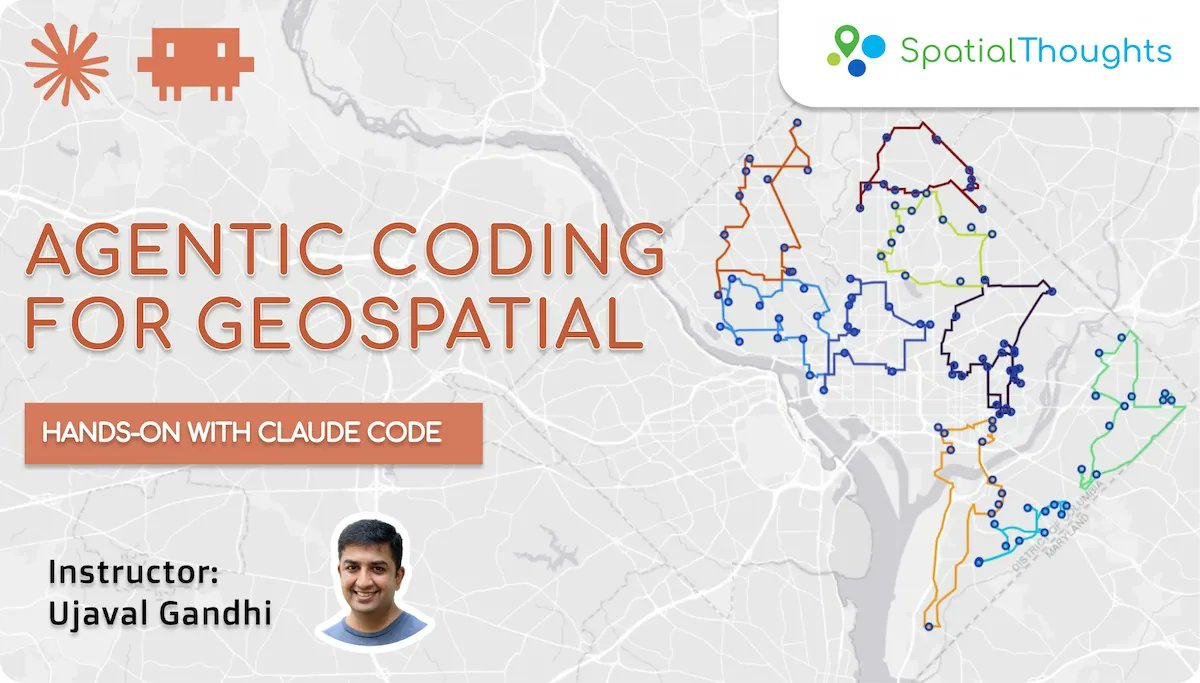
One of the hardest things I did over the past few months was to build a course to teach agentic coding techniques for geospatial problems. After endless hours of testing, refining, and writing, the full course is now launched - free and open to everyone➡️https://t.co/UrnRbYHchB
🔖 Data cheat sheet.
Save this for when you’re not sure which tool to use. 👇
• Store, analyze, and visualize → Microsoft Fabric
• Work with massive datasets → Azure Databricks
• Process data in real time → Stream Analytics
• Search logs instantly → Data Explorer
• Track and govern data → Microsoft Purview
Big update: Microsoft Credentials are evolving for the AI-first era.
• New Pro Badges (skills validated through real work)
• 17 new AI-focused certifications
• Expanded Applied Skills (agents, Copilot, Foundry)
• A more connected credentials experience coming to AI Skills Navigator
More practical. More role-aligned. More real-world.
Dive into the June roundup: https://t.co/SHrMFIGxfN
There are many fields in which AI can streamline processes and automate tedious tasks.
And one area with many applications for AI tools and technologies is agriculture.
In this book, Vahe details how AI can help increase crop yields, use water more efficiently, predict and react to stormy weather, and more.
https://t.co/0HswPOr3iW
PDFs often hide valuable business data inside reports, invoices, and contracts.
In this guide, @manishmshiva shows you how to automatically extract PDF data with Python.
You'll extract text and tables, handle scanned PDFs with OCR, clean the data, and export the results to Excel or CSV.
https://t.co/MqIraFgBn3
A plain RAG system usually follows a fixed path:
1. Take the user question
2. Search the knowledge base
3. Put the results into a prompt
4. Ask the LLM to answer
This works well when the query is clean and the retrieval step finds the right context.
It gets weaker when the query is messy.
In the workshop, I used a small example: a student asks how to run Ollama locally, but types it in a way that lexical search does not match well. In a fixed RAG flow, we already committed to the search query before the LLM sees the results.
With agentic RAG, the flow changes.
Instead of forcing search first, we tell the LLM:
"Here is the user's question. Here is a search tool you can use."
Then the LLM can decide:
- Whether search is needed
- What query to send
- Whether to rewrite the query
- Whether another search is needed
This is the important shift.
Agentic RAG is not magic. It is still retrieval plus generation. But the retrieval step becomes something the model can control through tool calls.
That makes the system more flexible, especially when the user's input is incomplete, misspelled, or phrased differently from the documents.
It also makes the system more complex. Now you have more calls, more state, and more things to observe.
So I would not start every RAG project with an agent. I would start with the fixed flow, measure where it fails, and add agentic behavior only where the system needs that extra flexibility.
Recording: https://t.co/lUE6t2hKDU
Want to learn how to build RAG and agents? Join LLM Zoomcamp, our free course that starts on June 8: https://t.co/HgDzeIw0O1
HUGGING FACE DROPPED A FREE CONTEXT ENGINEERING COURSE
and the curriculum is stacked:
▫️ unit 1: agent skills + SKILL.md format
▫️ unit 2: MCP (model context protocol)
▫️ unit 3: plugins for tool distribution
▫️ unit 4: subagents + multi-agent workflows
▫️ unit 5: hooks to guard the agent lifecycle
▫️ bonus: build your own agent from scratch
https://t.co/1HjjaXVOek
For Nigerians, please don't play the game of political banter with paid APC operatives. Block them and keep stating your points against the bad governance we have had. They are a distraction that needs to be isolated.
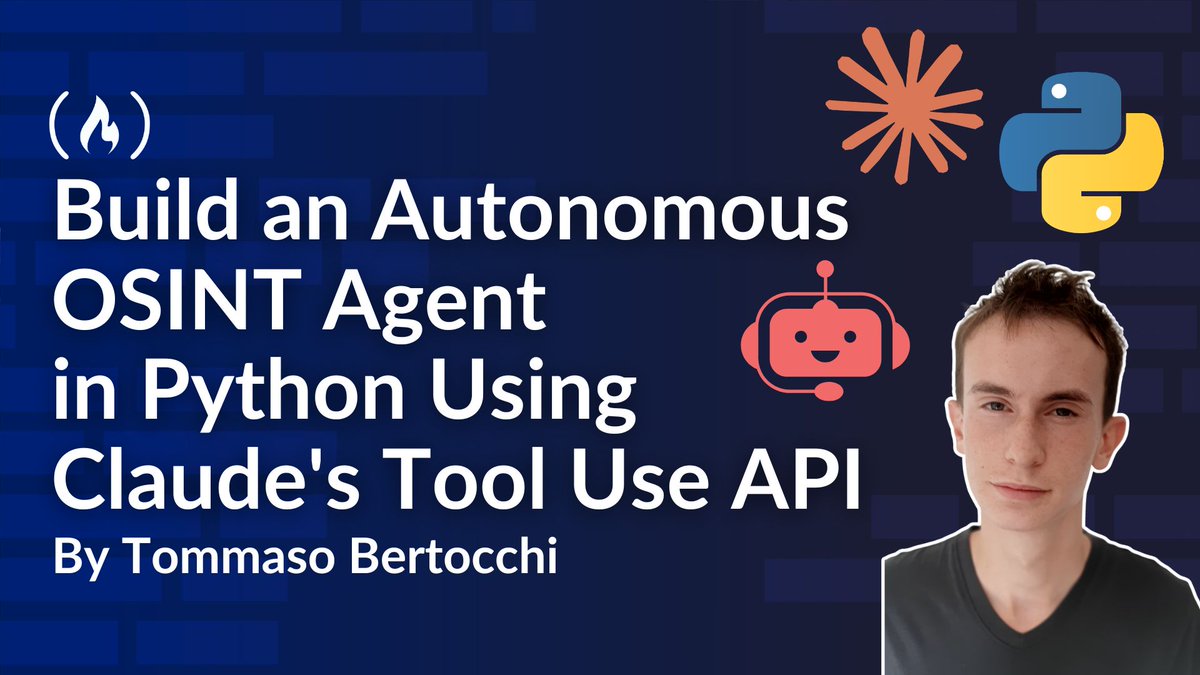
OSINT, or Open Source Intelligence, is the collection and analysis of information from public sources.
This info is used by security experts and journalists.
Here, Tommaso shows you how to set up the OpenOSINT framework, run autonomous investigations, & more.
https://t.co/leZaws3157
New course: Build agents that respond to users with not only plaintext, but custom UIs like charts, forms, and whiteboards, generated on demand and displayed right in the chat. This short course is built in partnership with @CopilotKit and taught by @ataiiam, co-founder of CopilotKit.
You'll learn three approaches: Your agent can pick from custom components you build, like charts and forms. It can compose new layouts from a set of building blocks you provide, like rows, cards, and text. Or it can incorporate existing third-party apps, like a whiteboard or a calendar, right inside the conversation.
Skills you’ll gain:
- Build agents that render custom components like charts and forms on demand
- Build an app where the agent and user collaborate on shared data, beyond just the chat window
- Place third-party apps like maps, calendars, and whiteboards right in your interface
Join and build agents that give users something to see and act on! https://t.co/lvMy0YdF3z
If you're transferring data between APIs or prepping JSON data for import, mismatched schemas can break things.
So you'll need to learn to clean and normalize your JSON data.
That's what you'll learn here, using both pure Python and Pandas. You'll also export the results into a new file based on a pre-defined schema.
https://t.co/ftjaTbVgm0
Junior data analysts: this one's for you. 💡
Using AI tools effectively in your workflow isn't a nice-to-have in 2026 — it's quickly becoming a baseline expectation for the role. Plus, it makes your life a whole lot easier.
Our Claude tutorial walks you through how to use Claude as a practical coding and analysis partner: writing and debugging code, interpreting outputs, and building the kind of AI-assisted workflow that sets you apart on the job.
Practical, no-fluff skills you can apply immediately.
🔗 Read the tutorial: https://t.co/6irUBweqUS
#DataAnalyst #AI #Claude #CareerDevelopment #DataSkills #LearningAndDevelopment #DataCamp #JuniorDataAnalyst
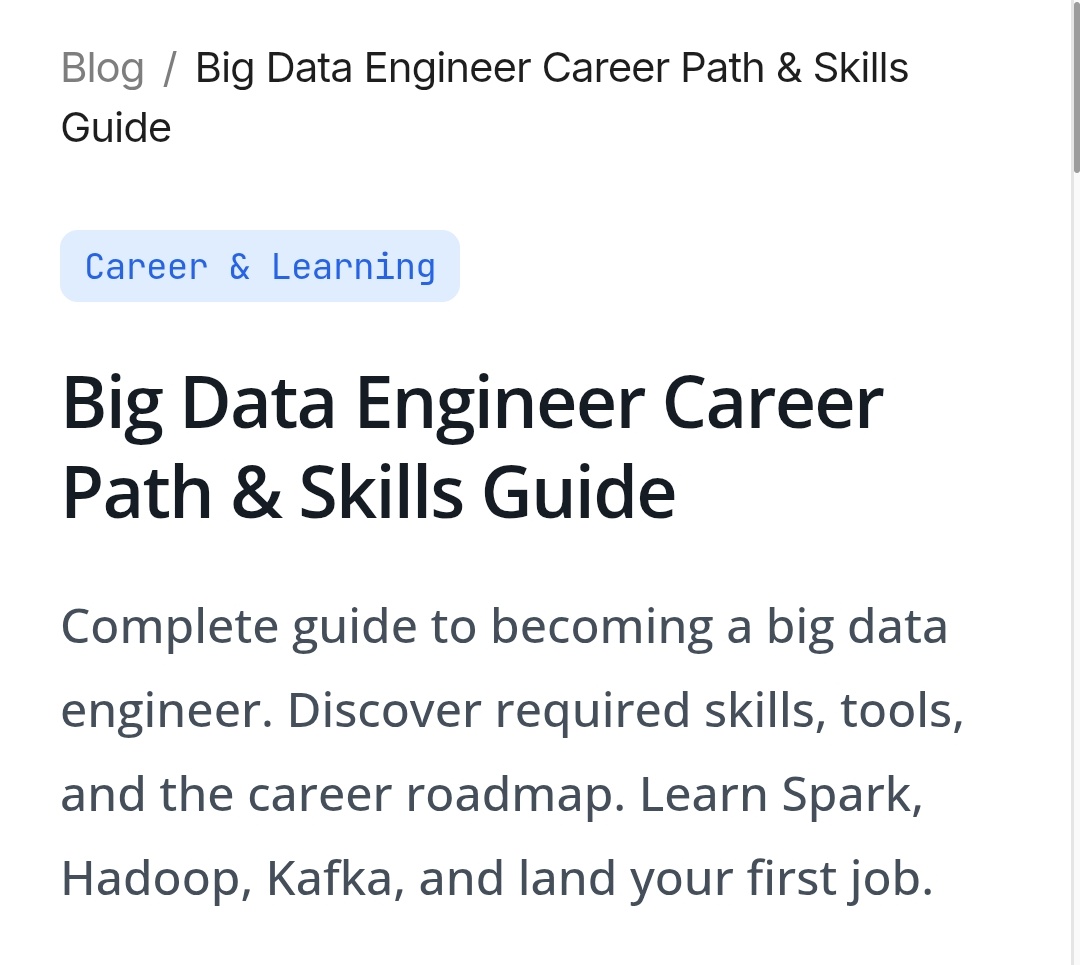
> Big Data Engineer isn’t just a job. It’s the backbone of modern tech.
- Here’s the real roadmap
→ What you actually do
- Build systems that collect, clean, and move massive data
Not dashboards. The pipelines behind them
→ The “Big” in Big Data
- Volume: TBs & PBs of data
- Velocity: real-time streams (millions of events)
- Variety: tables, logs, videos, sensors
→ Core skills
- Python: automation & pipelines
- SQL: non-negotiable foundation
- Java/Scala: understand systems deeply
→ Tools that matter
- Hadoop: distributed storage (HDFS, Hive)
- Spark: fast large-scale processing
- Kafka: real-time data streaming
→ Big Data Engineer vs Data Engineer
- Scale is the difference
- Data Engineer → GBs, structured data
- Big Data Engineer → PBs, distributed systems
→ What companies expect
Not theory. Systems that scale
You should handle real datasets, not tutorials
→ How to start
- Master Python + SQL
- Learn Spark + Kafka
- Use cloud (AWS / GCP / Azure)
- Build 2–3 strong projects with large datasets
→ What makes you stand out
- Proof of handling “big” data
- End-to-end pipelines
- Real-world problem solving
Data Engineering free courses
Linked Data Engineering
🎬 Video Lessons
Rating ⭐️: 5 out of 5
Students 👨🎓: 9,973
Duration ⏰: 8 weeks long
Source: openHPI
🔗 https://t.co/otX44YpkL7
Data Engineering Essentials using Spark, Python and SQL
🎬 402 video lesson
🏃♂️ Self paced
Teacher: itversity
Resource: Youtube
🔗 https://t.co/JEbmLDSaGp
Data engineering with Azure Databricks
Modules ⏳: 5
Duration ⏰: 4-5 hours worth of material
🏃♂️ Self paced
Source: Microsoft ignite
🔗 https://t.co/51OrNbt5A0
Perform data engineering with Azure Synapse Apache Spark Pools
Modules ⏳: 5
Duration ⏰: 2-3 hours worth of material
🏃♂️ Self paced
Source: Microsoft Learn
🔗 https://t.co/MmZXpzHXmQ
Build a professional personal website in minutes using Markdown and GitHub Pages — no HTML required!
In this step-by-step tutorial, you’ll learn how to create a modern, responsive website using a simple Markdown-based template. Perfect for developers, researchers, and anyone who wants a clean portfolio or project site without the hassle of complex coding.
Video tutorial: https://t.co/FK1jsdG8h7
Website template: https://t.co/D6HdiMMfC3
Live demo: https://t.co/IzcNThiyNh
My new personal website was built using the same template: https://t.co/EgbGzCARAK
#opensource #mystmd #jupyter