Piacere di aver discusso con @GiorgiaMeloni del nostro investimento da 1 miliardo di dollari in Italia. 🇮🇹 Acceleriamo l’Agentic AI, alimentiamo l’innovazione locale e promuoviamo una crescita sostenibile a lungo termine. Pronti a costruire insieme il futuro del Paese! ❤️🇮🇹
https://t.co/klyAODNNiC
Salesforce is investing €2 billion to accelerate AI transformation across France. Our strong team of 1,800 employees in France (and growing!), is more committed than ever to driving innovation & agentic growth across the country. ❤️🇫🇷
https://t.co/olbQFT4lWB
As agents become the biggest users of software, then all software has to be available in a headless fashion. Agents won’t be using your UI, they’ll be talking to your APIs.
So the question becomes what is the business model of software and this headless approach in the future?
Here are a few thoughts on how everything plays out based on what we’re seeing and doing at Box, but also conversation with other platforms.
1) Seats don’t go away for *people*. Seats are still a convenient and efficient way to have a customer use technology predictably for a set of users within a baseline set of usage. The key, though, is that when the customer pays for a seat, it has to come with a set of usage of APIs on behalf of that user that the agent can use on their behalf.
The user will need to be able to interact with their data and the underlying tool via any agent they work with, and an embedded amount of usage will come with the seat. I would imagine most software -Box included- will enable seats to work with their data at a relatively high volume via systems like ChatGPT, Codex, Claude, Gemini, Cursor, Copilot, Perplexity, Factory, Cogniton, et al. quite seamlessly. If you don’t do this, you’re DOA.
2) Agents may have “seats” if they are doing stateful work in the system, but they will be priced very differently than people. Seats (or the equivalent) can make sense when you have an agent that has its own workspace, stores its own data, needs a different set of permissions compared to the user, and so on.
If a company wants this agent to be around for long period of time, that may very well look like another “user” in the system. Openclaw-style agents highlight what this future could look like.
The only issue on pricing here is that one customer could decide to do all their work in 1 agent, and another might split it into 1,000 agents. So pricing like a human seat is nearly impossible and impractical; each company will have a different approach for this as it gets tricky perfectly trying to capture all the value within an agent seat.
3) The dominant pricing for headless use that goes above the seat allotment, or when an agent is firmly acting on their own, will be a consumption model. Many enterprises software platforms have previously operated like this with PaaS options, and agents will look like another machine user of their system.
In some cases the APIs might get priced just as they did previously, but in other cases there may need to be new types of APIs that represent the work an agent would do in one go -more akin to an outcome- instead of a series of API calls. This is especially germane when the headless software also has an agentic use-case embedded within in, such as orchestrating the process within their own system via AI.
Overall the growth of this usage pattern is effectively unbounded as the use-cases for agents operating on data in these systems will dramatically exceed what people do with their data and tools today. Every platform that goes headless (which will be anyone that wants to take advantage of agents) will need to adopt a model like this. Some may fight it initially but it’s an inevitably as there will always be more and more agents outside your platform than people.
Overall, there’s a lot of really interesting changes left to come in software due to headless use of these systems. Early days.
Call to action: The nation's prosperity.
I'm sharing the letter I wrote to the Prime Minister, Sir Keir Starmer. It's time for a level playing field for UK businesses and the government must do more to drive the nation's growth.
#Good4UKjobs#BackUKTech#UKTechpaysUKtaxes
Scam Altman and Greg Stockman stole a charity. Full stop.
Greg got tens of billions of stock for himself and Scam got dozens of OpenAI side deals with a piece of the action for himself, Y Combinator style. After this lawsuit, Scam will also be awarded tens of billions in stock directly.
The fundamental question is simply this:
Do you want to set legal precedent in the United States that it is ok to loot a charity? If so, you undermine all charitable giving in the United States forever.
I could have started OpenAI as a for-profit corporation. Instead, I started it, funded it, recruited critical talent and taught them everything I know about how to make a startup successful FOR THE PUBLIC GOOD.
Then they stole the charity.
Cirata Symphony is the data orchestration foundation for enterprise AI.
See it in action with curated demo videos from our CTO, Paul Scott-Murphy. Interested in learning more? Schedule a meeting with Paul to get a personalized 1:1 demo on Cirata Symphony.
https://t.co/ocAozGko4v
Marc Benioff is the apex cloud founder. He and Salesforce have turned every previous technology wave to their advantage. Cloud, social, mobile, big data. I predict AI will be no different.
I’m locked on, @DavidSacks! We’re hiring 1,000 new grads & interns right now to ride the AI exponential. You are right they said AI would kill entry-level jobs. Meanwhile these grads & interns are building it — powering Agentforce & Headless360 at Salesforce. 🚀 New grads: Drop your resume to @salesforcejobs or [email protected]
#FutureForce #AI
No browser required. Our API is the UI. 🔓 Salesforce Headless 360 just exposed our entire platform — apps, workflows, metadata, Agentforce & Slack — as unified APIs, MCP tools & CLI. Build on any surface. Give Agentforce deep, trusted context. Stop just using Salesforce. Start building with it. 🚀
https://t.co/8po9KM75RH
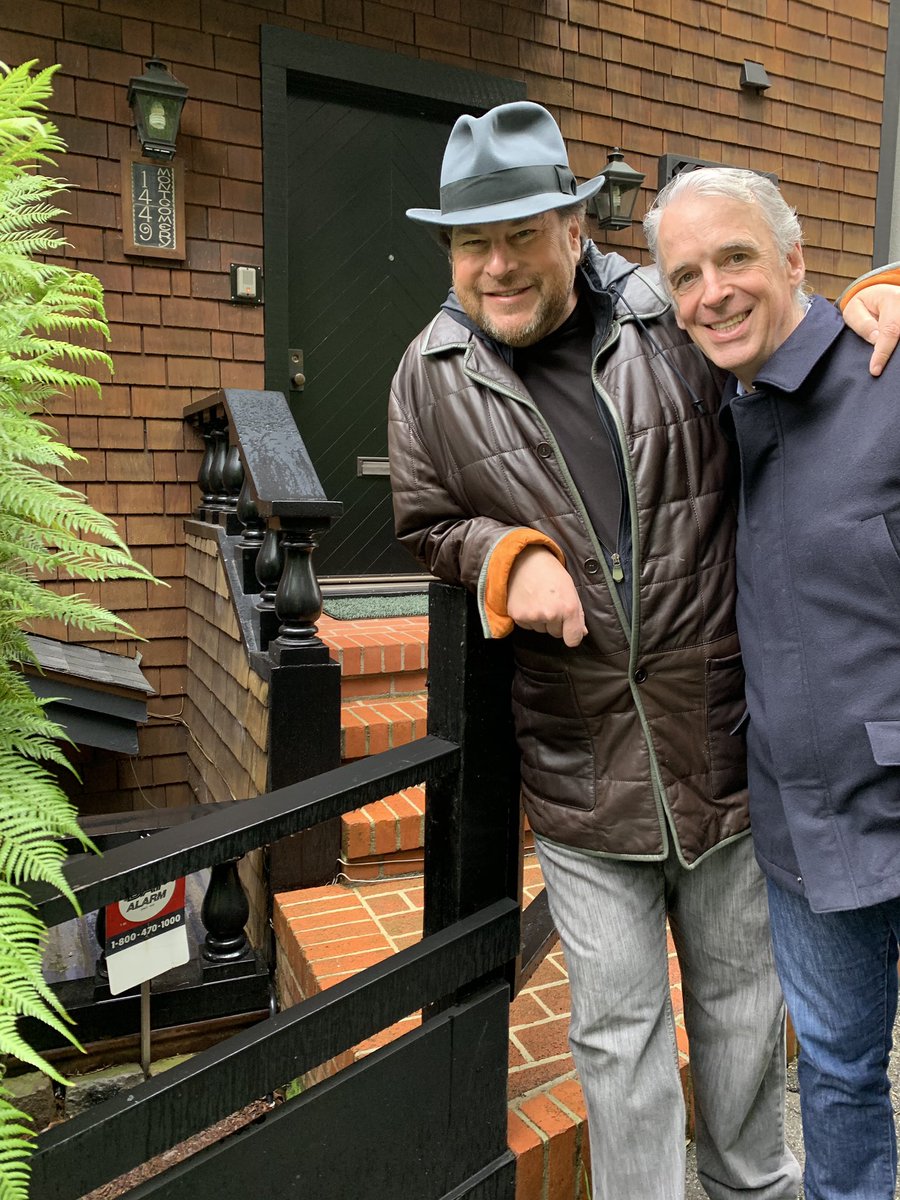
20 years ago, March 8 1999 Parker Harris, Dave Moellenhoff, Frank Dominguez, & I showed up at 1449 Montgomery Street & started a company called https://t.co/GcJjXaxGXz & introduced the end of software (now called the the cloud). Congratulations @parkerharris on 20 amazing years!
This is one banger of an explanation of the time-slit experiments. What I find interesting is that #NotebookLM introduced additional explanation to the original source material. Very impressive indeed!
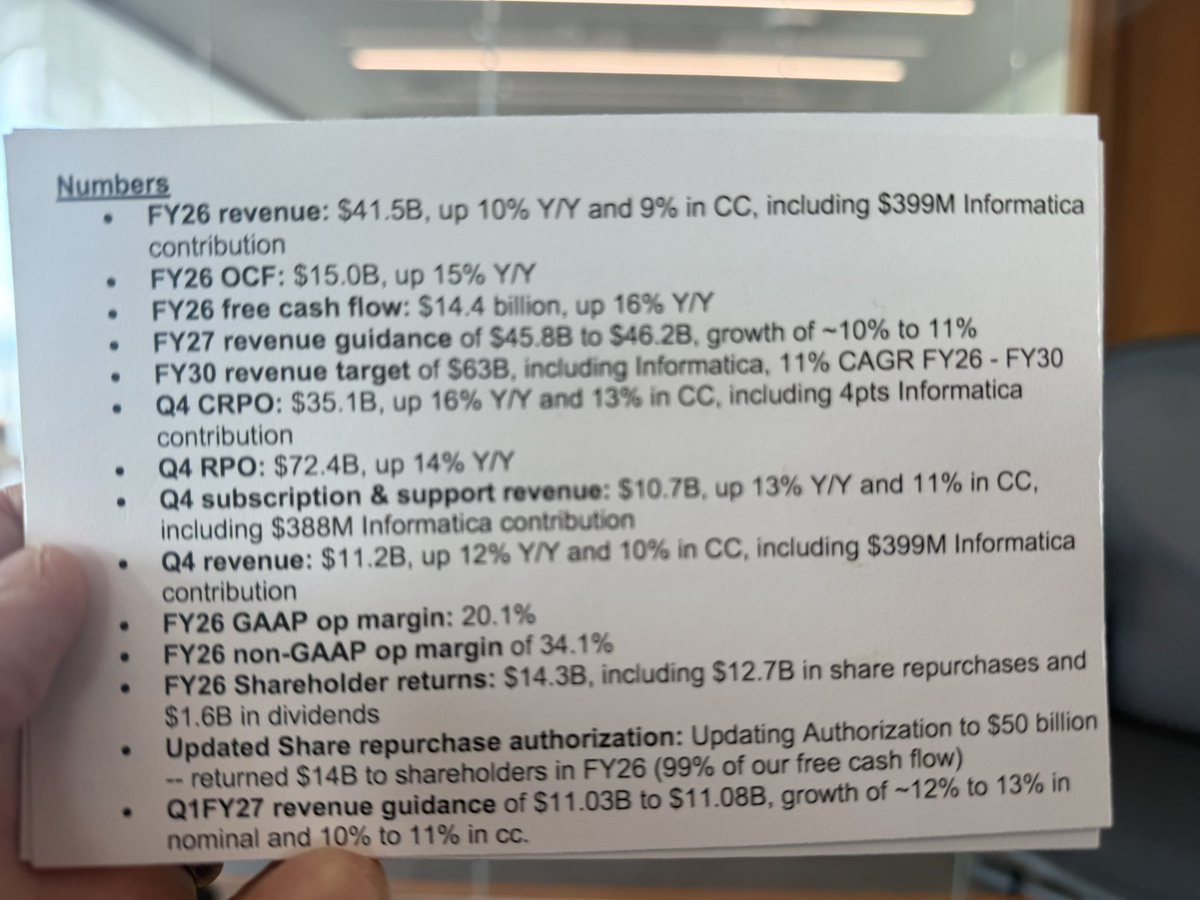
We just closed FY26, the biggest year in Salesforce history, and favor FY27 Guidance ! 🚀
FY27 Guidance: $46.2B revenue, 34.3% Non-GAAP Operating Margin, 20.9% GAAP Operating Margin
- $41.5B revenue (+10% Y/Y) - 34.1% Non-GAAP (+110 bps y/y) & 20.1% GAAP operating margin
- $15B Operating cash flow (+15% y/y)
- $72.4B Total RPO (+14% y/y)
Here's the thing: every AI agent needs somewhere to land. The data, business rules, and a conversational layer for humans & agents.
That place is Salesforce. No one is delivering more agents for the enterprise than us.
Let me tell you what's happening 🧵
Check out the full results: https://t.co/Nbofi6JUos
P.S. This isn’t my first SaaSpocalypse
The voice of the girl is so powerful and the skill that he has is just amazing👏👏
🎶🎸HOTEL CALIFORNIA by the EAGLES | Fabio Rodrigues & Allie Sherlock Cover
SpaceX standard policy is to make Starlink free whenever there is a natural disaster somewhere in the world.
It would not be right to profit from misfortune.