🚨 STATUS EPILEPTICUS – ER MANAGEMENT PROTOCOL
1. Recognize Status Epilepticus
- Continuous seizure lasting more than 5 minutes.
- OR ≥2 seizures without complete recovery of consciousness between episodes.
2. First-line Treatment – Benzodiazepines
- IV Lorazepam.
- In the video: another 2 mg of lorazepam is administered, bringing the cumulative dose to 10 mg.
- Reassess seizure activity and response.
3. Prepare for Airway Management
- Call the respiratory team.
- Prepare the intubation tray.
- Monitor oxygen saturation, breathing and vital signs.
- Be ready for airway support if ventilation or oxygenation is inadequate.
4. Assess Response
- Confirm whether seizure activity has stopped.
- Assess spontaneous breathing and tidal volume.
- Monitor oxygen saturation.
5. Second-line Antiseizure Treatment
- Once the seizure is controlled, proceed with a Levetiracetam (Keppra) loading dose.
- Administer according to the appropriate clinical protocol.
KEY TAKEAWAY:
⏱️ Recognize early → Benzodiazepine → Airway preparation → Control seizure → Levetiracetam loading.
#StatusEpilepticus #EmergencyMedicine #ThePitt #Neurology #USMLE #NEETPG
#2026MAMA #Fmge #viral #MedTwitter #doctor #mbbs
Want to learn more about our Tropical Medicine Curriculum? 🌎
The curriculum’s architect, Jorge Cardenas, will be presenting at ASTMH’s Poster Session B, between 12pm and 1:45pm, in the Poster Hall here at the ASTMH Annual TropMed26 Meeting.
Visit Poster #6546 to learn more about tropical medicine and the free resources we offer.
Residents!!!!
🩸 Never interpret a CBC by looking at WBC alone. Always check the differential!
One of the most important parameters is the Absolute Neutrophil Count (ANC).
How to calculate ANC?
ANC = WBC × (% Neutrophils + % Bands) / 100
Example:
WBC = 1,000/µL
Neutrophils = 30%
Bands = 5%
ANC = 350/µL → Severe neutropenia.
Why is ANC important?
🔹 Detects neutropenia that may be missed by looking at total WBC alone.
🔹 Assesses infection risk, particularly in patients receiving chemotherapy.
🔹 Helps guide chemotherapy delays, dose modifications and G-CSF use.
🔹 Identifies patients at risk of febrile neutropenia.
ANC interpretation:
- 1,000–1,500: Mild
- 500–999: Moderate
- <500: Severe neutropenia.
🩸 Clinical pearl: A normal WBC does not exclude severe neutropenia.
Always review the differential count when interpreting a CBC, particularly in patients receiving chemotherapy.
#Hematology #Oncology #MedicalEducation
I’m a doctor, not a software engineer.
Reading CT scans used to terrify me in medical school.
So I built an interactive 3D CT anatomy atlas using AI-assisted coding.
Real scans. Clickable anatomy. Free to explore.
https://t.co/gGfbsHmtiZ
Would you use this to learn anatomy? 🩻
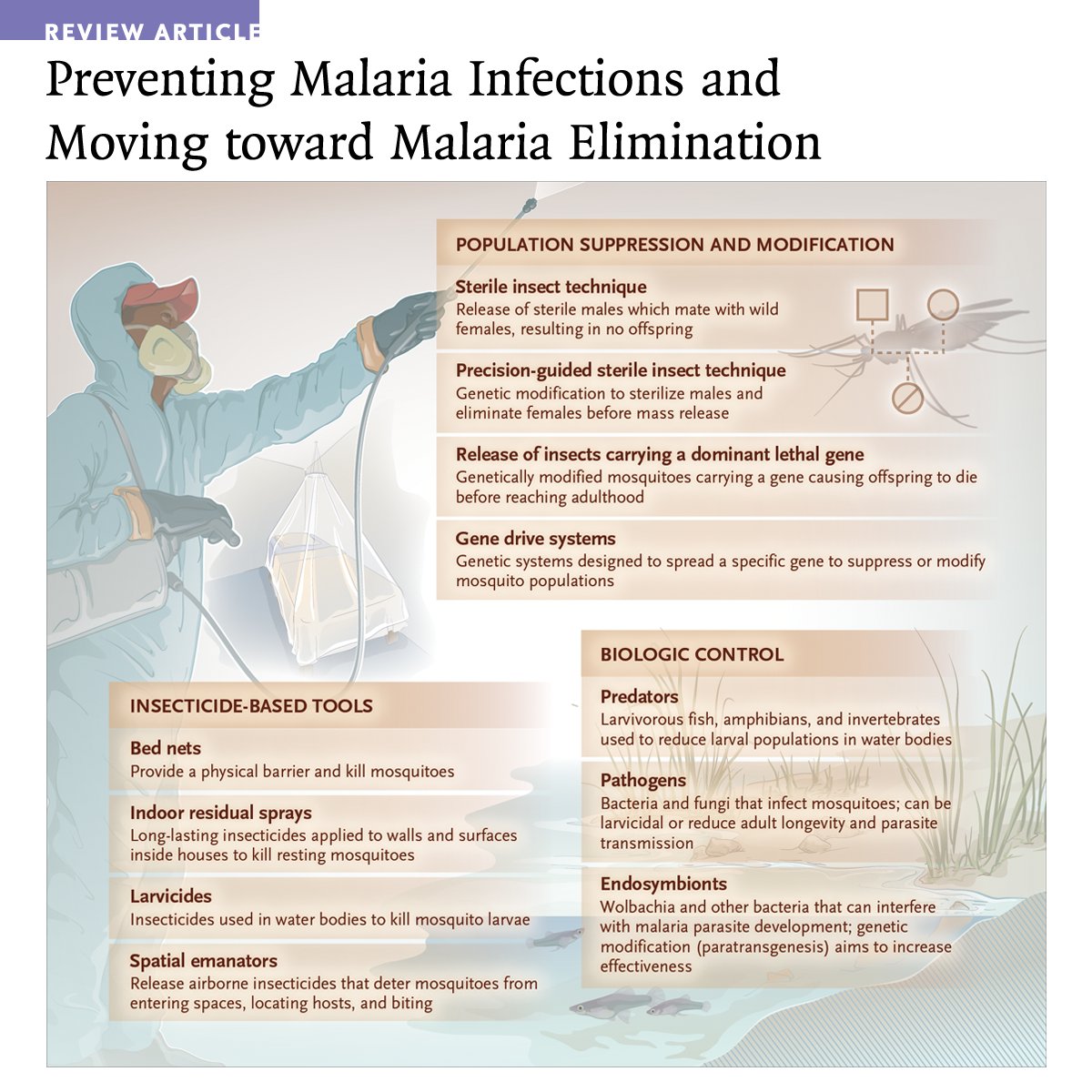
Anopheles mosquitoes transmit malaria. Vector control involves strategies to reduce or eliminate mosquito populations to prevent bites and disrupt transmission (seen in figure). Conventionally, this effort includes insecticide-based interventions that involve bed nets, indoor residual spraying, and larval source management. Environmental management and improvements in house design, such as closed eaves, window screening, and metal roofing, have also contributed historically to malaria elimination and are regaining interest as complementary, sustainable control measures.
Read more about vector control and other approaches to prevent malaria infections in a new review: https://t.co/QiQHbasVRd
Tuberculosis (TB) is preventable and curable.
Yet, it remains one of the world’s deadliest infectious killers. An estimated 10.6 million people developed TB in 2025, and 1.1 million lost their lives to it.
Read the WHO Global Tuberculosis Report 2026 to learn more: https://t.co/kFsWfz16aP
𝗥𝗲𝘃𝗶𝗲𝘄 𝗔𝗿𝘁𝗶𝗰𝗹𝗲: 𝗣𝗿𝗲𝘃𝗲𝗻𝘁𝗶𝗻𝗴 𝗠𝗮𝗹𝗮𝗿𝗶𝗮 𝗜𝗻𝗳𝗲𝗰𝘁𝗶𝗼𝗻𝘀 𝗮𝗻𝗱 𝗠𝗼𝘃𝗶𝗻𝗴 𝘁𝗼𝘄𝗮𝗿𝗱 𝗠𝗮𝗹𝗮𝗿𝗶𝗮 𝗘𝗹𝗶𝗺𝗶𝗻𝗮𝘁𝗶𝗼𝗻
Malaria continues to be a major health challenge worldwide, causing an estimated 282 million cases of illness and 610,000 deaths in 2024, predominantly among African children. Despite recent stagnation in the progress of malaria prevention, the landscape is undergoing rapid
transformation. A new review examines current and emerging approaches to preventing malaria infection and supporting malaria elimination, including vector control, transmission-blocking interventions, chemoprevention, monoclonal antibodies, and vaccines. Next-generation insecticide-treated nets, expanded use of seasonal malaria chemoprevention, and the introduction of RTS,S/AS01 and R21/Matrix-M vaccines are already reshaping control strategies. Looking ahead, long-acting injectable chemoprevention, transmission-blocking medicines and vaccines, and improved surveillance-driven deployment may further accelerate progress. As funding becomes constrained and decision making shifts increasingly to countries where malaria is endemic, effective malaria prevention will depend on locally tailored, integrated combinations of interventions supported by strong surveillance, regulatory capacity, and national leadership.
Read more about these approaches in the Review Article “Preventing Malaria Infections and Moving toward Malaria Elimination” by Andre Marie Tchouatieu, MD, Timothy N.C. Wells, ScD, and Jane Achan, MD: https://t.co/QiQHbasVRd
TWiP 291: The 3 Foot Parasite That Lives Inside You for a Year 🪱 TWiP explains the results of a two-year study in dogs in Chad showing that the drug Flubendazole reduces emerging Dracunculus medinensis, the agent of Guinea worm disease. Hosts: Vincent Racaniello and Daniel Griffin. 📺 https://t.co/itWVNcAZUc