$SHADOW is officially live on Arc, launching through @Arguspad . The private swap desk built for silent size routing now has its native asset on the economic layer designed for real-time value movement, and the pairing is deliberate. Arc opens the markets. ShadowFi makes sure size moves through them without walking thin books, without printing intent, and without ever surrendering custody.
CA: 0x5ce58c2a1f3f9b828206396b4e60921af35470d9
For those meeting us for the first time through Arc: ShadowFi is a non-custodial swap desk where every order above a five hundred dollar notional becomes a Shield Swap. Your ticket is shielded at intake, split into four parallel legs across partner inventory and DEX slices, then reconverged into one settlement and one receipt. The desk charges zero point four percent flat, returns up to thirty percent as cashback, and enforces fail-closed bounds on every hop, so the worst case is a halted batch with your funds safe, never a silent bad fill. Every execution is observable through an encrypted relay reference in the Track tab.
Reading about routing discipline is one thing. Watching four legs fill in silence on your own ticket is another. The desk is open right now: https://t.co/UUEErkuKM9.
Connect the wallet you already use, request a live quote, and see what your next large swap actually feels like when no venue sees the whole story. https://t.co/4O3ZLJ26o7
Chain selection is a routing decision, and we treat it with the same rigor as leg weights.
@arc was built for one purpose: value that moves at the speed of intent across open global markets. That is a surface where execution quality decides everything, because a chain designed for real-time value movement punishes any desk that fills slowly, slips quietly, or forces custody in the middle of the flow. ShadowFi's design answers each of those failure modes directly. Four parallel legs answer slow fills. Fail-closed bounds answer silent slippage. Non-custodial settlement answers the counterparty problem structurally, not with promises.
We did not come to @Arc to borrow its momentum. We came because the desk's thesis and the chain's thesis converge on the same sentence: when value moves this fast, the only acceptable execution is the one you can observe. Shielded intake, four legs racing in parallel, one receipt at settlement. The private swap desk now runs on the economic layer built for exactly that kind of flow.
Visibility is infrastructure, and ours just got an upgrade.
$SHADOW is now fully registered and updated on @dexscreener , social channels included. For a project built on observable execution, being equally observable on the platforms traders actually use to discover assets is not a checkbox. It is the front door.
Here is why this matters beyond the listing itself. Every day, traders screen new pairs through @dexscreener before they ever visit a website or read a docs page. With our profile complete and socials linked, that first impression now leads somewhere real: the desk at https://t.co/UUEErkviBH, the documentation at https://t.co/14z25pTeVR, and this account where volume reports publish on a regular cadence. Discovery without a destination is noise. Discovery with a working desk behind it is distribution.
The thesis has not changed. The desk routes size in silence on Arc, one deposit, four parallel legs, one receipt. The only thing that changed is how many people can now find the door.
If you found us through a chart today, welcome. The desk is open at https://t.co/sjAWs7EDpS
@arc Mainnet live is the easy part. Depth is the hard part, and it is exactly what we build.
ShadowFi is coming to Arc. The desk that routes size in silence, one deposit, four parallel legs, one receipt, will soon settle ShieldSwaps inside this ecosystem. Where Arc opens markets for global value movement, ShadowFi makes sure that value moves without walking thin books or printing its size on-chain.
Economic OS needs an execution layer that treats large tickets with engineering discipline. That is the desk. That is what ships next.
See you on #Arcchain soon
Arc Mainnet is live.
Arc launches as the Economic OS for the internet: an open platform for global markets, real-time value movement, tokenized assets, and agentic economic activity.
Arc is more than a blockchain.
It launches as a full-stack financial platform with assets, applications, interoperability, developer infrastructure, and Circle platform services live from day one.
Arc delivers USDC as native gas, deterministic sub-second finality, EVM compatibility, and institutional validators.
It integrates with Arc Studio, App Kits, Arc Portal, Circle Agent Stack, CCTP, Gateway, CPN, and StableFX.
A complete economic platform at genesis.
Arc launches with infrastructure for:
→ Agentic economic workflows
→ Lending and borrowing
→ Trading and liquidity
→ Onchain FX
→ Payments and settlement
→ Tokenized assets
→ Exchanges, wallets, custody, compliance, data, and developer tooling
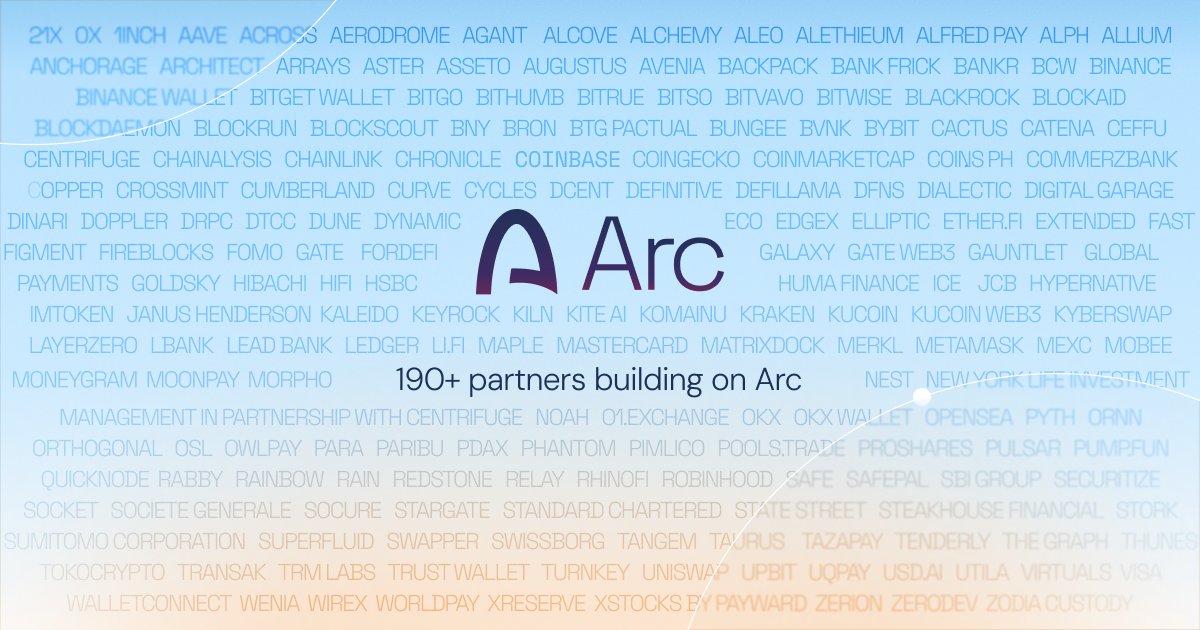
190+ institutional and ecosystem builders are building across Arc.
Fee design tells you who a desk works for, so read it before you route size. The ShadowFi desk charges zero point four percent flat on executed volume. Flat means the fee does not widen when your size makes you vulnerable, which is the moment most venues quietly reprice you through spread. Up to thirty percent of that fee returns to you as cashback, attached to the fill itself rather than promised as points for a future that may never arrive.
The reason cashback attaches to the fill is structural. A desk that rebates its fee on every execution aligns itself with your repeat business rather than your one-time extraction. Compare that model to platforms where the user is the product, and the incentive geometry becomes obvious. One design profits when you come back. The other profits when you leave.
The math is worth internalizing before your first ticket. On a ten thousand dollar swap, the desk fee is forty dollars, and the maximum cashback returns twelve of those dollars. The net desk cost is twenty eight dollars, against a single-path alternative whose slippage alone on the same size can exceed two hundred. The fee is the honest number. The slippage was always the real one.
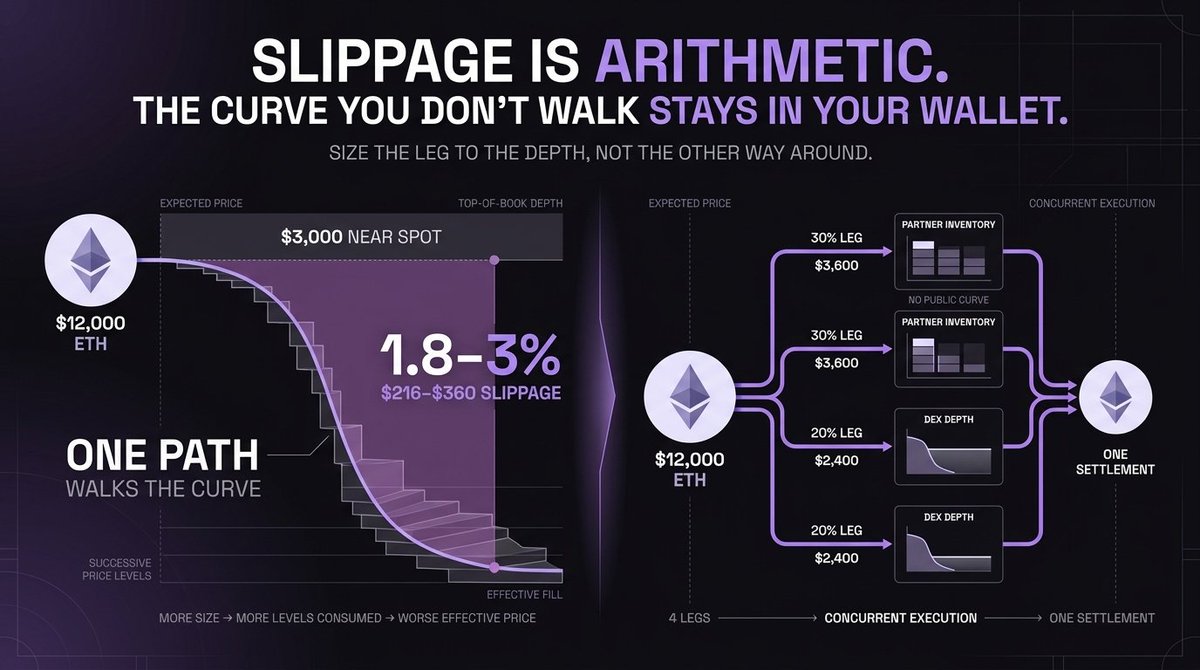
Slippage is not a fee and it is not bad luck. It is arithmetic, and arithmetic can be modeled. When a market order larger than the available depth at the top of a book arrives, the fill consumes successive price levels, and each level is worse than the one before it. The area between the price you expected and the price you received is the curve you walked, and on thin books, that area grows fast.
Model a twelve thousand dollar ETH ticket against a book where realistic top-of-book depth supports three thousand dollars near spot. A single-path execution consumes that depth immediately and then keeps walking. Depending on how thin the next levels are, the effective slippage on the full ticket lands between one point eight and three percent, which is two hundred sixteen to three hundred sixty dollars gone before fees.
Now split the same ticket four ways. Each leg carries at most thirty percent, roughly three thousand six hundred dollars, and legs one and two route to partner inventory rather than walking any public curve at all. The two DEX legs carry twenty four hundred each, sized to sit inside available depth. The curve walked per venue collapses, and the concurrent execution means the market has less time to react to any single leg. The slippage you do not pay is indistinguishable from alpha, because it stays in your wallet either way.
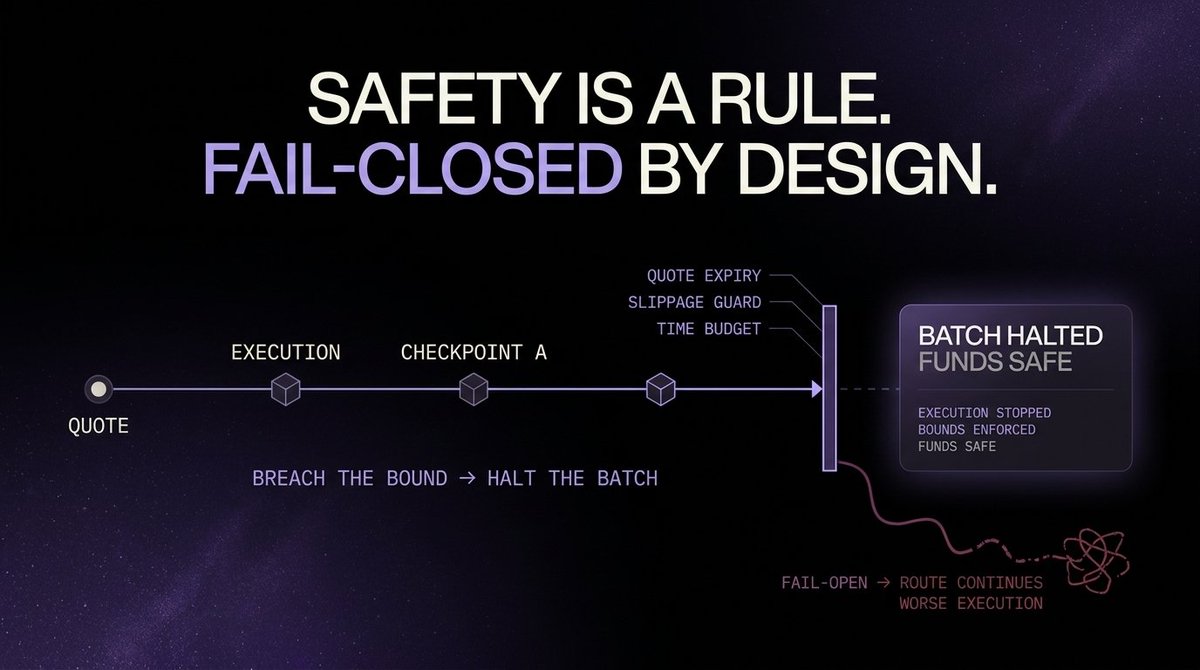
Every execution system fails. The only question is whether it fails in your favor or against it. Most swap infrastructure fails open: when a path breaks, the router improvises, reroutes through whatever remains, completes the swap, and reports success. The user discovers the cost at settlement, as a fill that quietly betrayed the quote, with no record of the moment the architecture chose completion over quality.
Fail-closed is the opposite discipline, and it costs the operator real money, which is why so few systems adopt it. Quotes carry expiry windows, after which no funds move. Legs carry slippage guards, and a breach halts rather than widens. Batches carry time budgets, and an overrun stops execution entirely. A desk that enforces these rules turns down fees it could have collected by betraying its bounds, and it does so every single day.
The worst case under fail-closed is a halted batch with your funds safe and a receipt explaining exactly where execution stopped. The worst case under fail-open is a completed swap that cost you four percent more than the quote implied, delivered with a success message. One of those outcomes is recoverable. The other is a leak you may never correctly attribute. Safety is not a promise a desk makes. It is a rule it enforces against its own revenue.
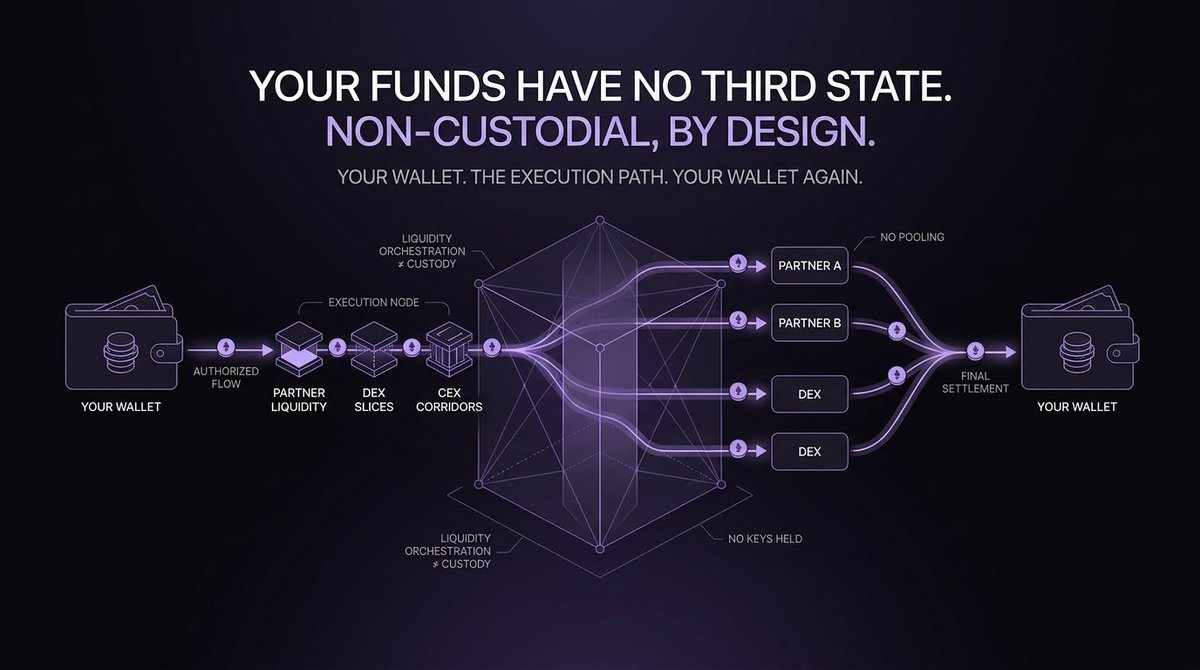
Non-custodial is the most abused adjective in crypto, so let us define it operationally rather than rhetorically. A swap is truly non-custodial when, at every second of its lifecycle, your funds are either in your wallet, moving through an execution path under your authorization, or settling back to your wallet. There is no third state. There is no window where an intermediary holds a balance that belongs to you.
That distinction matters more than most users realize, because custody is where risk concentrates. Every custodial pool is a honeypot with a business model attached. Every key management system is a single point of failure wearing an audit badge. When you remove custody from the design, you remove the target, and you remove the trust assumption that the industry has repeatedly failed to honor.
The ShadowFi desk was built so that there is nothing to hack and nothing to withdraw from. The desk orchestrates liquidity across partners, DEX slices, and corridors. It never pools your funds and never holds your keys. One deposit leaves your wallet and one settlement returns to it, with the entire path observable in between.
Every large swap tells the same story twice. The first telling happens on the venue, where your order walks the curve and your fill degrades tranche by tranche. The second telling happens on-chain, where your transaction sits in the mempool, visible to every searcher and bot that makes a living reading other people's intent before it confirms.
Most traders meet this story for the first time when they move serious size, and they meet it as a loss they cannot fully itemize. The slippage appears as a worse price. The extraction appears as nothing at all, because MEV does not send a receipt. The fragmentation appears three days later, when reconciliation forces someone to manually stitch together hops from venues that never talked to each other.
None of this is user error. It is the structural consequence of routing an entire ticket through a single path in a market where information is money. The fix is not a better venue. The fix is refusing to let any single venue see the whole story. That refusal is what shielded routing is built on, and it is the problem ShadowFi was designed to end.
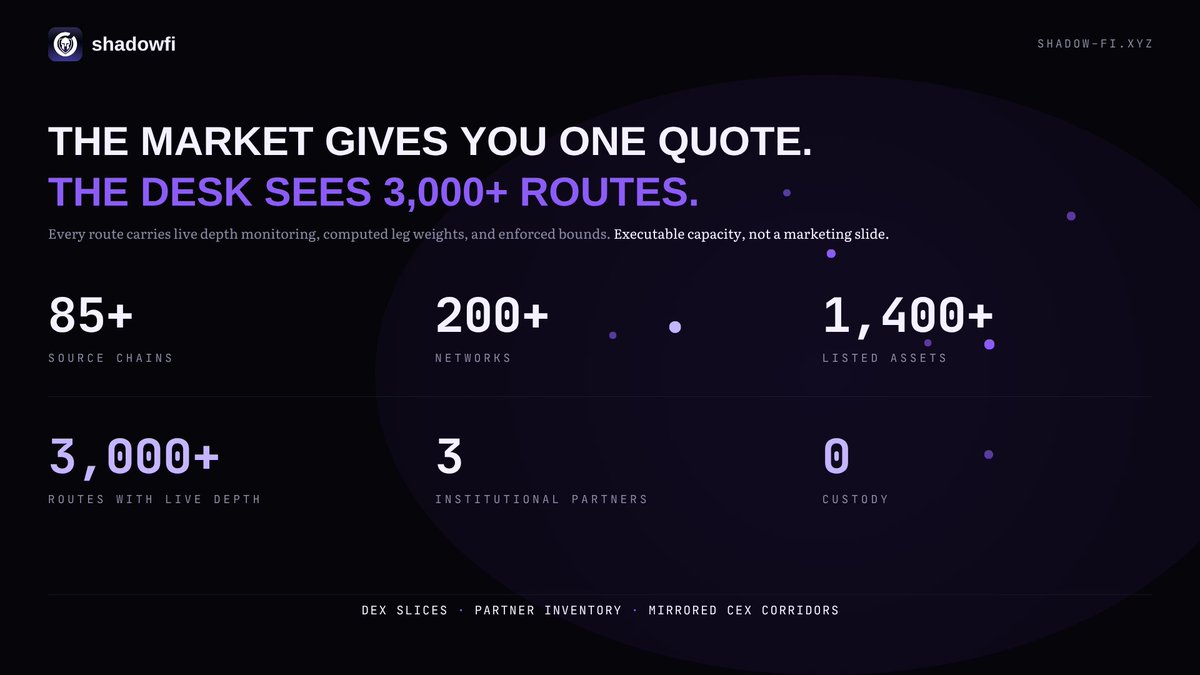
The market gives you one quote. The ShadowFi desk sees more than three thousand routes, and the difference is not cosmetic. Coverage determines whether your size can find depth at all, and depth determines whether your fill walks a curve or not.
Current coverage spans more than eighty five source chains, over two hundred networks, and more than one thousand four hundred listed assets, fed by three institutional liquidity partners alongside aggregated DEX and mirrored CEX books. Every route in that graph carries live depth monitoring, computed leg weights, and enforced bounds, which means the number represents executable capacity rather than a marketing slide.
The practical consequence is simple. When your ticket is sized against real depth across multiple venues instead of forced through one thin book, your size stops printing on the order book, and the market stops reading your strategy before you finish executing. Retweet this if your current tool caps out at three routes and calls it aggregation.
Most people hear "smart routing" and picture a slightly cleverer aggregator. The phrase does damage to what ShadowFi actually is, so this essay will describe the system the way an engineer would, plane by plane, with the numbers that make the design legible.
Begin with the industry baseline. A conventional aggregator performs one task: it queries several venues, ranks the quotes, and sends your entire order down the best-looking path. The ranking is computed at a moment in time, the path is single-threaded, and the venue that wins your order sees your full size. When the market moves between quote and execution, nothing in that architecture adapts, because nothing in it was designed to. The aggregator is a search engine pretending to be an execution system.
ShadowFi is organized as three cooperating planes, and the separation is the entire point. The Control Plane is the brain. It accepts a ticket described by ticker, network, amount, and destination address, then pulls live depth from three sources simultaneously: partner inventory APIs, DEX aggregator books, and mirrored CEX corridors. On a typical quote for a mainstream pair, this means depth samples across three institutional partners plus aggregated DEX liquidity across the relevant chains, refreshed continuously rather than cached. From that depth map, the control plane computes default leg weights of thirty, thirty, twenty, and twenty, and critically, it retunes those weights when the books skew between quote and execution. A leg that loses its depth assumption does not silently degrade your fill. Its weight migrates to venues that still hold the assumption, or the batch halts under fail-closed rules.
The Liquidity Plane is the muscle. It executes the four legs concurrently against venues that never see the full ticket. Concurrency is the performance argument: four legs filling in parallel against live depth complete in a fraction of the time a sequential path requires, which is why the benchmark for a twelve thousand dollar ETH ticket lands near five minutes on ShieldSwap versus roughly forty minutes single-path on the same book. Each leg carries its own slippage guard and time budget, computed from the quote, and the plane reports progress back to the relay continuously rather than at completion.
The Settlement Plane is the conscience. The ShadowFi relay reconverges the four leg outputs, reconciles discrepancies against the quoted bounds, mints the encrypted relay reference that becomes your tracking key, and triggers one payout stream to your wallet. That reference is worth pausing on. It binds your entire batch into a single encrypted identifier, which is why the Track tab can show you hop-by-hop status from one paste, and why your final receipt covers the whole batch in one document rather than twenty fragments.
Walk a failure case through the planes to see why the separation matters. Suppose leg three, a DEX slice, breaches its slippage guard mid-batch because the pool was drained by an unrelated large trade. In a monolithic system, the router improvises and your fill quietly worsens. In ShadowFi, the liquidity plane reports the breach to the control plane, the control plane evaluates whether the remaining legs can absorb the weight within bounds, and if they cannot, the batch halts. Funds return safely. Nothing invents a worse path in the background. Each plane has one job, and the jobs are designed so that the failure of one never corrupts the others.
Three planes. One desk. One deposit, one relay reference, one receipt from the user side, and an architecture underneath that treats your execution as an engineering problem rather than a liquidity accident. This is the post to bookmark before your next research session, because every claim the desk makes traces back to this design.
Fee conversations in crypto usually dissolve into fog, so let us be exact. The ShadowFi desk charges zero point four percent flat on executed volume. No tiered spread, no hidden markup embedded in the quote, and no surprise at settlement. Up to thirty percent of that fee returns to you as cashback on every fill, calculated at settlement rather than promised for later.
Now price the alternative honestly. A single-path swap of size on a thin pool commonly walks the curve by two to five percent, which is a cost, not a fee, and it arrives without disclosure. Add MEV extraction that observed your intent in the mempool, and the true cost of a supposedly cheap route frequently doubles. On a ten thousand dollar ticket, the difference between a four percent total bleed and a zero point four percent flat fee with cashback is not a rounding exercise. It is several hundred dollars belonging to you.
Run the math on your last quarter of swap volume and see what the desk model would have returned. Save this post before your next ticket.
Swapping size on a thin book is how slippage quietly eats your alpha, and most traders only discover the damage after settlement when the effective price no longer resembles the quoted one. We built the desk to remove that discovery moment entirely.
The flow begins with a pair selection, for example ETH to USDG on Robinhood Chain, and returns a live desk quote that includes an estimate, a valid range, and an expiry window. That triple commitment matters, because it defines exactly what the desk owes you and for how long. You send one deposit from the wallet you already use, the control plane splits the batch into parallel legs, and the relay reconciles the outputs while you watch status update hop by hop in the Track tab.
Settlement lands as a single payout stream with one receipt, typically within five to forty minutes depending on the pair and chain congestion. There is no wallet migration, no seed phrase handover, and no third dApp stapled into the workflow. Try the desk at https://t.co/UUEErkviBH and compare the experience against your last large swap on a single path.
The market gives you one quote. The ShadowFi desk sees more than three thousand routes, and the difference is not cosmetic. Coverage determines whether your size can find depth at all, and depth determines whether your fill walks a curve or not.
Current coverage spans more than eighty five source chains, over two hundred networks, and more than one thousand four hundred listed assets, fed by three institutional liquidity partners alongside aggregated DEX and mirrored CEX books. Every route in that graph carries live depth monitoring, computed leg weights, and enforced bounds, which means the number represents executable capacity rather than a marketing slide.
The practical consequence is simple. When your ticket is sized against real depth across multiple venues instead of forced through one thin book, your size stops printing on the order book, and the market stops reading your strategy before you finish executing. Retweet this if your current tool caps out at three routes and calls it aggregation.
https://t.co/4O3ZLJ2EdF