You have to prepare to be rich long before you are.
Remember when I was in private equity my boss pulled me aside after our holiday party. He said:
"Spend whatever you make when you're young. You're smart & talented, you'll make far more in the future."
What you spend on a vacation today will be a rounding error when you're 50 with millions in the bank
WARNING: Longer post (but worth reading or bookmarking for later).
Your life has seasons.
Each one is unique. Characterized by its own distinct desires, struggles, opportunities, and identity.
But one reflection I've had recently is just how easy it is to completely disassociate with the present season.
To give all your time and energy toward a longing for some nostalgic memory of a prior season or an anticipation for some beautiful state of a future season.
You look back at the past and all you see is sunshine. Because it all worked out. You forget (or glaze over) the struggle you endured. You're here today. You made it. You're alive. You're doing fine.
You look forward at the future and dream on what could be. You'll have so much more. More freedom. More purpose. More health. More deep connection. More everything.
The past is beautiful and the future feels limitless. So, logically, you slowly start to treat everything about the present as the bridge. A dash connecting your past and your future. A gap to be crossed as quickly as possible.
Everything you do today is in anticipation of some eventual end state.
I'm doing this now, so that I can have that later.
Unfortunately, the danger of that dissociation with the present is significant. You may spend your entire life living for a future that has a decidedly mirage-like property. You inch closer, but when it's right in front of you, it disappears and reappears on the horizon.
You may spend your entire life skipping through the present, deferring your presence, your joy, and your very humanity to a future that never comes.
In a classic French fable, a young boy is gifted with a magic ball of golden thread. He's told that if he simply pulls on the thread, time will leap forward. The catch, of course, is that once it's pulled, it can never be put back.
The young boy takes advantage of the newfound powers. Each time he's faced with a boring day at school, a frustrating set of chores, or a scolding from his parents, he pulls the thread, skipping through to the good parts.
As an adult, he continues, leaping through mundane struggles in his marriage, the friction of having a newborn, and the boredom at work. He finds himself pulling on the thread more and more, avoiding even the most minor inconveniences of his life.
But when he wakes up one day and sees an old man looking back at him in the mirror, he's filled with regret. He realizes in that moment that as he chose to skip through the boredom, struggles, and friction, so too did he miss the real texture of being alive.
How often do we all do the same? How easily do we default into this disassociation? Disconnecting from the present in anticipation of some future.
A mentor recently asked me this:
"Where are you going and why are you in such a rush?"
It hit me hard.
And to be honest, I haven't stopped replaying those words since he said them.
Why are you in such a rush?
The world wants you to rush into everything. Rushed decisions. Rushed conversations. Rushed relationships. Rushed timelines.
In doing so, you slowly relinquish your agency. You give up your claim on your own life. Surrender authorship to a pen that was never even yours.
In a world that wants you to rush, the ultimate act of rebellion is presence.
Be in the season you're in. Don't romanticize the past, don't fantasize the future. Be here. Be now. Be in this. All of its texture, depth, and struggle. All of its joy, tension, and pain. Sit with the uncertainty. Become friends with it. Fall in love with it.
Because every single thing you do today is something your younger self dreamed of and something your older self will wish they could go back and do.
The good old days are happening, right now.
And the next time you find yourself skipping through the present, remember these words:
Where are you going and why are you in such a rush?
Constantly talking about your past struggles becomes an excuse to avoid taking responsibility for your future. It feels safe to blame your upbringing or your environment because fixing your current reality requires effort. Your history is data, stop using it as an anchor.
My favorite line from Atomic Habits has been living in my head rent-free:
“It doesn’t make sense to continue wanting something if you’re not willing to do what it takes to get it. If you don’t want to live the lifestyle, then release yourself from the desire. To crave the result but not the process is to guarantee disappointment.”
Skills that have nothing to do with money but are worth dedicating an immense amount of practice to:
- Charisma
- Metacognition
- Critical thinking
- Sitting with discomfort
- Articulating what you believe and why
- Changing your beliefs when presented with new information
Almost nobody actually practices these and it shows.
In a world full of boys chasing women, drugs, and sex.
Be a man who is busy fixing his finances, body, mind, and a strong relationship with God. Trust me, You'll go far in life.
I fell in love with this quote:
No matter how old you are, you will always regret not having started sooner.
But today is the youngest day you have left.
So start today.
Must read Crunchbase interview with ex-Meta CTO and now VC, Mike Schroepfer (link in comment):
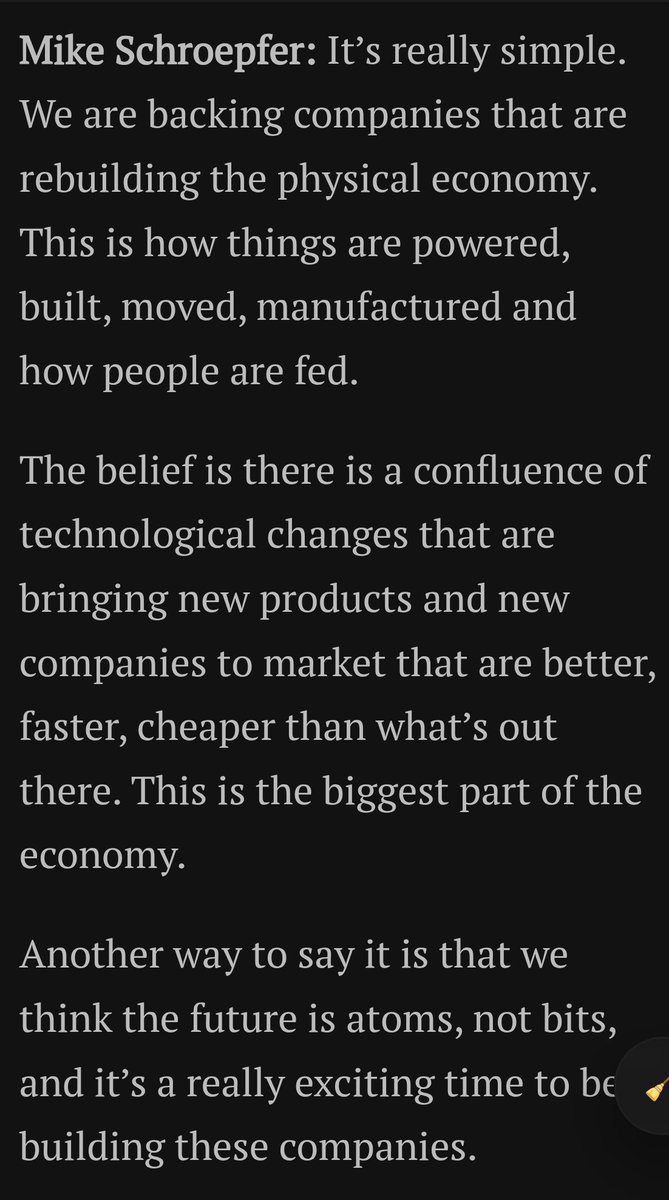
"We are backing companies that are rebuilding the physical economy. This is how things are powered, built, moved, manufactured and how people are fed."
"we think the future is atoms, not bits"
I agree with him. Bits are important but atoms are equally important. The future is bits and atoms made to play together. That is where a lot of innovation is coming.
Zoho is investing in R&D driven manufacturing with this same thesis.
Productivity is driven either by curiosity or by fear.
If you think you are highly unproductive, pick up something you are curious about or induce an artificial fear - e.g., deadlines, irrelevance, or failure. It's not always comfortable, but fear can be a powerful motivator.
I’m increasingly convinced that the ultimate sign of growth is faster recovery. You still get upset. You still make mistakes. You still have bad days. But you return to center faster. Apologize faster. Reset faster. Learn faster. Fast recovery compounds.
What we call talent is often just the combination of:
A deep need to win and high agency
The ability to learn fast from mistakes
A beginner’s mind that never disappears
The common thread: an unusually high rate of learning.
In 2020 when I joined @kunalb11 at CRED, I was drawn to the incredible team and a contrarian idea – “not everyone gets it”
we had ~1M members & $750M TPV
fast forward to 2026, CRED’s impact among India’s most creditworthy is clear, we now serve 17M members & process $100B in TPV
we’ve built with taste, always keeping our members' trust & financial progress as our north star
this momentum is the outcome of ambition, craft, ownership and relentless standards of our team at CRED.
Meta’s $900M minority investment is a booster in our plans to build an enduring institution with an eventual public listing. Meta will be a passive financial investor with no-access to customer data.
Kunal: thanks for being thankless and always 5x-ing each target.
proud to build the next phase of CRED with the best team in Indian fintech.
back to work 🚀
Your entire life will change when you realize preparation always beats planning. Planning is based on the expectation of order. Preparation is based on the expectation of chaos. Plan for order and you'll be destroyed by chaos. Prepare for chaos and you'll thrive in any condition.
Most software engineers are facing an identity crisis bordering on depression.
As CTOs aggressively evangelize tokenmaxxing, a class divide ensues.
The lazy. The lazy push code. They don't write it. They don't manually test it. They don't even read it. They're on autopilot. See Jira ticket, prompt for task, submit code. Many of them are barely on their computer the whole day. A comment on the PR asking why they did this? The lazy ask AI. A Slack message? The lazy ask AI. Need to prepare for standup? The lazy ask AI. As long as it sounds enough like them and isn't detected. Some of the lazy are even overemployed, and work multiple jobs. The lazy smart ones get away with this, and even rewarded. After all, software engineering for the lazy is just a dance to convince your colleagues you're smart and hard working.
The craftsmen. The craftsmen are tired. Very tired. 15 PRs in queue. Slack blowing up. The entire burden of review falls on the craftsman. The burden of understanding. They try. They work their way through the code, thoughtfully commenting to improve what ships. The response? A lazy: "That's a clever idea! You're absolutely right." with an incorrect change. It's fine, the craftsman says. I can fix them. They write a doc urging his colleagues to be better. The next day? 20,000 line PR to review. Day after day, their workload grows. Bugs seep into production. No one seems to care. Another round of AI is thrown at it. Their animosity to their colleagues rises. Eventually, they give up. It's just not what it used to be. The craft they loved is dead. They eventually wake up, a lazy.
This isn't all companies. Many companies are genuinely more productive, adopt the right set of principles and practices around AI development and have highly talented teams that trust each other. It tends to happen in bigger companies that are 10+yrs old with a higher talent variance. But it happens. A lot.