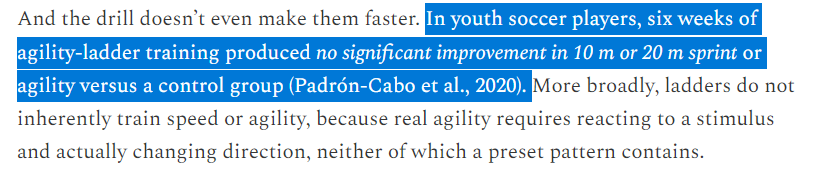
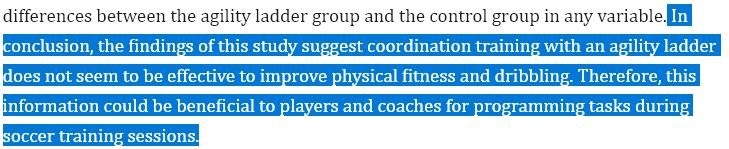
My research on bags in training led me to this study on agility ladders
"In youth soccer players, 6 weeks of agility-ladder training produced no significant improvement in 10 m or 20 m sprint or agility versus a control group (Padrón-Cabo et al., 2020)."
https://t.co/KHY0DHoiAj
Losing the Fun: The Psychology of the USMNT Collapse
The USMNT crashed back down to earth. After a promising start that showed a style and brand of soccer that we haven’t seen much of in the men’s World Cup for our team, we went back to looking like we have for the past 20 years: over matched and out of sorts. Belgium dominated the game.
What went wrong? I’m not a soccer expert so we’ll leave tactics to someone else, but what I’d love to focus on is the mental side.
First, what gave folks hope is that the US manager Pochettino seemed to give this team a shot in the arm of confidence and creativity. The opening match against Paraguay showed an attacking team that could solve a team’s defense and break it down. That continued against Australia and Bosnia. Sure, those weren’t top 15 teams, but it was a Paraguay squad that only lost 1-0 to France thanks to a PK, and an Australian team that only lost to Egypt in a penalty shootout.
The Americans were playing free. They were the spunky home team underdogs. Pochettino’s refrains were “Why not us?” and “We want to touch the moon.” They had an Argentinean coach who blasted country music in his office and embraced American culture. And you were met with stories of Europeans traveling around the US, surprised by American culture. It’s the power of the underdog, the power of having fun and playing free. And as we’ll see, research backs it up.
But then it all changed. Balogun goes off with a shaky red card. There was no way to appeal (which, as an aside, any legitimate pro sport should have a clear appeal process for suspensions. It’s part of good governance). But Donald Trump couldn’t resist being center stage. He called FIFA president Gianni Infantino personally to ask for a review, and FIFA did what FIFA does: they suspended the ban, fined Balogun $40,000, and let him play. It was the first time since 1962 that a red card at a World Cup didn’t produce a suspension. UEFA released a statement declaring that “when the certainty of rules is no longer guaranteed by its guardians, the integrity of the game is at stake.” Belgium’s coach compared the decision to an April Fool’s joke.
And the narrative flips. The US goes from good vibes to villains. Belgium is incensed and uses it to create a narrative that Belgium isn’t just playing for their country, but as their coach framed it “the integrity of football.” Now, the experienced squad has a purpose greater than themselves.
The US went from playing with nothing to lose and everything to gain, to now being put on the defensive. And it showed.
From the first touch, you saw a team that was hesitant and avoidant. Gone was the aggression that capitalized on their athleticism. In its place was a situation where on one goal, three Americans stood around watching a ball come down from the air, hesitating, inwardly hoping and thinking that one of the others would get it, when a Belgian player swooped in and took care of business.
Pochettino described the potential issue weeks ago: “Your strategy can be brilliant. But if you don’t have the energy, the commitment, the trust, the confidence... it’s impossible to play well.”
For the Americans, it looked impossible.
Even Pochettino couldn’t explain it afterward: “We need to assess that game and see why we didn’t approach that game in the same way [we did] the rest of the World Cup... it wasn’t the way we normally play.” Listen to the language. Not our tactics. Not our fitness. Our approach.
The Psychology of Playing Free or Tight
How we frame the competition sets the stage. It primes our brain to either approach or avoid, to protect or attack, to play out of fear or fun.
When we’re underdogs, research shows we give more effort, have higher levels of commitment, take more calculated risks, and have a reduced fear of failure. The reason is simple: the framing shifts our brain’s inner calculus on risks versus rewards. As underdogs, expectations are relatively low, while the payoff is huge. It’s like playing with house money. You can bet big, and if you fall relatively short, it’s not a huge deal.
On the other end, when we’re heavy favorites, we tend to adopt a protective stance. We’re already on top of the mountain, high in status. The only place to go is to meet expectations or lose our spot. That pushes us toward protection. We can even see this at the individual level. In an analysis of world-class soccer players, psychologist Geir Jordet found that players who had won major individual awards converted fewer penalties after winning them. And they showed more avoidance behaviors: rushing their preparation, turning away from the keeper, hurrying the walk. Status raises the price of failure. A miss is no longer a bad kick, it’s an assault on our identity.
Of course, this American team had expectations. But this framing isn’t determined by some concrete evidence. It’s shaped by the story you tell yourself and how you’re interpreting information. It’s why we’ve seen heavy favorites in the Super Bowl or NBA Finals who talk about how “no one expected us to do this... everyone discounted us... the media said we couldn’t do it.” Coaches and teams strategically use information to create the right team-wide framework. Sometimes using bulletin board material of quotes from the other team to do so.
We can see this in our biology. When we see a game as a challenge, we tend to have more testosterone and adrenaline as part of our stress response. When we see the game as a threat, when our status is on the line, we have more cortisol and less testosterone. Our biology impacts our psychology, and when in threat mode, we start hesitating and avoiding.
Before Paraguay, Australia, and Bosnia, it was clear we were in a challenge state. For Belgium, threat it was.
Now, once again, it’s not as simple as favorites bad psychology, underdogs good. It’s all about whether your frame supports your psychology. Psychologists Philip Gable and Eddie Harmon-Jones found that when it comes to emotions, it’s not whether they feel good or bad that shifts how they impact performance. It’s whether that emotion pushes you toward or away from action. High-approach states (desire, even anger) narrow attention onto the goal. Avoidance states (anxiety) scatter it, and pleasant-but-low-drive states (amusement) broaden it. For three weeks the US played on desire that pulled toward action. Against Belgium they played on anxiety that pulled toward hesitation.
Does the framing push you to see the situation as a challenge? Does it activate approach motivation instead of avoidance? The bad boys Detroit Pistons embraced the villain role. They took it on to amplify their effort and aggression. Paraguay embraced it after the US dismantled them, shifting their strategy to be the antithesis of the “beautiful game” the Europeans dream about. And it got them all the way to a 1-0 loss against the #1 seed France.
But there’s a difference between choosing the black hat and having it slapped on your head. This US team was set up for fun, for spunky dreamers trying to show the world. They were after vibes and joy. When we talk about approach vs. avoidance strategies, it’s not that one is inherently better or worse. It’s that your frame needs to match your style of play and psychology.
And then... that frame got thrown into turmoil thanks to politics the players had no say in. As Pochettino said, “you need to connect with the energy to express your talent.”
That connection was lost against Belgium. They won the appeal but lost the frame.
Losing the Fun
We can see the same approach to fun in Norway, who just advanced to play England in the quarterfinals. Instead of country music, they had a Viking row and beating drums after their wins. Their star player, Haaland, said “Everyone just needs to enjoy themselves... Just enjoy it. Embrace it and enjoy the moment.” And as they won, he deliberately downplayed the moment, going so far as declaring that the next teams they faced were the favorites. Before facing France in the group stage he said, “Honestly I don’t care too much [about the France game]. They [France] are probably going to win against us, they’re probably going to win the whole tournament.” And then after knocking out Brazil: “No matter what happens next, nobody can ever take this feeling, these tears, or this piece of history away from us.”
He’s keeping the underdog mystique alive. He’s keeping the stakes low and the game enjoyable, putting the onus on the more established teams to show up. Bank the win, release the future. There’s nothing left to protect, so there’s nothing to play tight over.
The US had a bit of this magic. But then it all went away. And it wasn’t their fault. Balogun handled the controversy like a champ, shaking the hand of the referee who gave him the red card and never complaining. Even after the Belgium lost, he went out to seek out the Belgium coach. He didn’t ask for this controversy, it was thrust upon them.
This isn’t to say the politics made the US lose. Great teams have to show up and play no matter what. And Belgium was clearly better that day. But what it shows is how fragile a frame can be, and how fast it can flip.
It’s fragile, but as Pochettino pointed out, the key to unlocking our potential. It’s why the best coaches get paid the big bucks. It’s an art more than a science. But getting your team in the right psychological state, with the right framing, and more so in a long tournament, keeping us there is vital.
When the story flips on you, and it will, you don't get to keep the old psychology by default. You've got to sit down and write the next chapter on purpose. Before someone else writes it for you.
-Steve
For everyone complaining about offside as a rule in soccer, think of it as a cherry picking stopper. That's what it was designed to do. The game would be boring if an offensive player could just sit in the box all day
I still can't believe that was a red card. It was so clearly accidental and just a normal step to make when you're off balance. After multiple missed obvious yellow cards on Bosnia it's really suspect he issues a red there
There is a better way.
Play the penalty shootout straight after 90 mins.
The winner of the shootout gets a 0.5 goal lead going into 30 mins of extra time.
Now the team that lost the pens has a chance to win and crucially, no matter score, there is one team that has to go for it at all times, making extra time fun too.
The 73-win Warriors entered the Finals as the winningest team in NBA history, while Cleveland carried a 52-year championship drought.
On this day in 2016, Cleveland completed the first 3-1 comeback in NBA Finals history, winning three straight to capture its first championship 🏆
This is why I'd like to see them try Thomas Bryant. Idk if he can guard, but he would allow us to play the 2 big lineup more often that's been so successful
Charles Barkley for head coach.
"I think they can make their lives easier if they play inside-out. Because you see Mobley and Allen have a huge advantage. That would free up Donovan and James instead of them going one-on-one trying to get their own shot."
🗣️PREACH
Under preparation is a coping strategy for stress. It allows you to protect your ego because you didn't 'try.'
Actually putting forth effort, requires being okay confronting your limits.







![stevemagness's tweet photo. Losing the Fun: The Psychology of the USMNT Collapse
The USMNT crashed back down to earth. After a promising start that showed a style and brand of soccer that we haven’t seen much of in the men’s World Cup for our team, we went back to looking like we have for the past 20 years: over matched and out of sorts. Belgium dominated the game.
What went wrong? I’m not a soccer expert so we’ll leave tactics to someone else, but what I’d love to focus on is the mental side.
First, what gave folks hope is that the US manager Pochettino seemed to give this team a shot in the arm of confidence and creativity. The opening match against Paraguay showed an attacking team that could solve a team’s defense and break it down. That continued against Australia and Bosnia. Sure, those weren’t top 15 teams, but it was a Paraguay squad that only lost 1-0 to France thanks to a PK, and an Australian team that only lost to Egypt in a penalty shootout.
The Americans were playing free. They were the spunky home team underdogs. Pochettino’s refrains were “Why not us?” and “We want to touch the moon.” They had an Argentinean coach who blasted country music in his office and embraced American culture. And you were met with stories of Europeans traveling around the US, surprised by American culture. It’s the power of the underdog, the power of having fun and playing free. And as we’ll see, research backs it up.
But then it all changed. Balogun goes off with a shaky red card. There was no way to appeal (which, as an aside, any legitimate pro sport should have a clear appeal process for suspensions. It’s part of good governance). But Donald Trump couldn’t resist being center stage. He called FIFA president Gianni Infantino personally to ask for a review, and FIFA did what FIFA does: they suspended the ban, fined Balogun $40,000, and let him play. It was the first time since 1962 that a red card at a World Cup didn’t produce a suspension. UEFA released a statement declaring that “when the certainty of rules is no longer guaranteed by its guardians, the integrity of the game is at stake.” Belgium’s coach compared the decision to an April Fool’s joke.
And the narrative flips. The US goes from good vibes to villains. Belgium is incensed and uses it to create a narrative that Belgium isn’t just playing for their country, but as their coach framed it “the integrity of football.” Now, the experienced squad has a purpose greater than themselves.
The US went from playing with nothing to lose and everything to gain, to now being put on the defensive. And it showed.
From the first touch, you saw a team that was hesitant and avoidant. Gone was the aggression that capitalized on their athleticism. In its place was a situation where on one goal, three Americans stood around watching a ball come down from the air, hesitating, inwardly hoping and thinking that one of the others would get it, when a Belgian player swooped in and took care of business.
Pochettino described the potential issue weeks ago: “Your strategy can be brilliant. But if you don’t have the energy, the commitment, the trust, the confidence... it’s impossible to play well.”
For the Americans, it looked impossible.
Even Pochettino couldn’t explain it afterward: “We need to assess that game and see why we didn’t approach that game in the same way [we did] the rest of the World Cup... it wasn’t the way we normally play.” Listen to the language. Not our tactics. Not our fitness. Our approach.
The Psychology of Playing Free or Tight
How we frame the competition sets the stage. It primes our brain to either approach or avoid, to protect or attack, to play out of fear or fun.
When we’re underdogs, research shows we give more effort, have higher levels of commitment, take more calculated risks, and have a reduced fear of failure. The reason is simple: the framing shifts our brain’s inner calculus on risks versus rewards. As underdogs, expectations are relatively low, while the payoff is huge. It’s like playing with house money. You can bet big, and if you fall relatively short, it’s not a huge deal.
On the other end, when we’re heavy favorites, we tend to adopt a protective stance. We’re already on top of the mountain, high in status. The only place to go is to meet expectations or lose our spot. That pushes us toward protection. We can even see this at the individual level. In an analysis of world-class soccer players, psychologist Geir Jordet found that players who had won major individual awards converted fewer penalties after winning them. And they showed more avoidance behaviors: rushing their preparation, turning away from the keeper, hurrying the walk. Status raises the price of failure. A miss is no longer a bad kick, it’s an assault on our identity.
Of course, this American team had expectations. But this framing isn’t determined by some concrete evidence. It’s shaped by the story you tell yourself and how you’re interpreting information. It’s why we’ve seen heavy favorites in the Super Bowl or NBA Finals who talk about how “no one expected us to do this... everyone discounted us... the media said we couldn’t do it.” Coaches and teams strategically use information to create the right team-wide framework. Sometimes using bulletin board material of quotes from the other team to do so.
We can see this in our biology. When we see a game as a challenge, we tend to have more testosterone and adrenaline as part of our stress response. When we see the game as a threat, when our status is on the line, we have more cortisol and less testosterone. Our biology impacts our psychology, and when in threat mode, we start hesitating and avoiding.
Before Paraguay, Australia, and Bosnia, it was clear we were in a challenge state. For Belgium, threat it was.
Now, once again, it’s not as simple as favorites bad psychology, underdogs good. It’s all about whether your frame supports your psychology. Psychologists Philip Gable and Eddie Harmon-Jones found that when it comes to emotions, it’s not whether they feel good or bad that shifts how they impact performance. It’s whether that emotion pushes you toward or away from action. High-approach states (desire, even anger) narrow attention onto the goal. Avoidance states (anxiety) scatter it, and pleasant-but-low-drive states (amusement) broaden it. For three weeks the US played on desire that pulled toward action. Against Belgium they played on anxiety that pulled toward hesitation.
Does the framing push you to see the situation as a challenge? Does it activate approach motivation instead of avoidance? The bad boys Detroit Pistons embraced the villain role. They took it on to amplify their effort and aggression. Paraguay embraced it after the US dismantled them, shifting their strategy to be the antithesis of the “beautiful game” the Europeans dream about. And it got them all the way to a 1-0 loss against the #1 seed France.
But there’s a difference between choosing the black hat and having it slapped on your head. This US team was set up for fun, for spunky dreamers trying to show the world. They were after vibes and joy. When we talk about approach vs. avoidance strategies, it’s not that one is inherently better or worse. It’s that your frame needs to match your style of play and psychology.
And then... that frame got thrown into turmoil thanks to politics the players had no say in. As Pochettino said, “you need to connect with the energy to express your talent.”
That connection was lost against Belgium. They won the appeal but lost the frame.
Losing the Fun
We can see the same approach to fun in Norway, who just advanced to play England in the quarterfinals. Instead of country music, they had a Viking row and beating drums after their wins. Their star player, Haaland, said “Everyone just needs to enjoy themselves... Just enjoy it. Embrace it and enjoy the moment.” And as they won, he deliberately downplayed the moment, going so far as declaring that the next teams they faced were the favorites. Before facing France in the group stage he said, “Honestly I don’t care too much [about the France game]. They [France] are probably going to win against us, they’re probably going to win the whole tournament.” And then after knocking out Brazil: “No matter what happens next, nobody can ever take this feeling, these tears, or this piece of history away from us.”
He’s keeping the underdog mystique alive. He’s keeping the stakes low and the game enjoyable, putting the onus on the more established teams to show up. Bank the win, release the future. There’s nothing left to protect, so there’s nothing to play tight over.
The US had a bit of this magic. But then it all went away. And it wasn’t their fault. Balogun handled the controversy like a champ, shaking the hand of the referee who gave him the red card and never complaining. Even after the Belgium lost, he went out to seek out the Belgium coach. He didn’t ask for this controversy, it was thrust upon them.
This isn’t to say the politics made the US lose. Great teams have to show up and play no matter what. And Belgium was clearly better that day. But what it shows is how fragile a frame can be, and how fast it can flip.
It’s fragile, but as Pochettino pointed out, the key to unlocking our potential. It’s why the best coaches get paid the big bucks. It’s an art more than a science. But getting your team in the right psychological state, with the right framing, and more so in a long tournament, keeping us there is vital.
When the story flips on you, and it will, you don't get to keep the old psychology by default. You've got to sit down and write the next chapter on purpose. Before someone else writes it for you.
-Steve](https://pbs.twimg.com/media/HMpA_qCXoAA28uT.jpg)


