Russia-Ukraine war is caught in a deadlock. A long-term ceasefire is possible if Russia and Europe initiate direct talks. (The Indian Express)
#RussiaUkraineWar#Putin#Zelenskyy#PeaceAndHarmony
https://t.co/BZ5acrtpDY
The United States is now a predatory hegemon—a dominant great power that “views all bilateral relations as inherently zero-sum and seeks to extract the greatest possible benefits from each one,” writes Stephen Walt.
https://t.co/70KAjZPpuQ
France, Germany and the UK have issued a statement condemning Iran's "disproportionate" response. I want to know what they think is a "proportionate" response when invaders assassinate your head of state and civilian leaders in an explicit campaign to destroy your government.
Wars are always sold to the public as being quick and easy. Here is Dick Cheney explaining in 2003 that the Iraq War would be over in weeks, not months.
Seems a bit crazy that nations are out with a vengeance to destroy all that took several decades to build -- order, norms, relationships, buildings, weapon systems! And none knows the end game!!
India Pays for the Trump-Netanyahu War
India’s economic growth and energy security are now exposed to the volatile front lines of the Middle East conflict. By slashing imports of discounted Russian oil to their lowest level since March 2022 and ramping up purchases of higher-priced Middle Eastern and U.S. crude, India has made itself acutely vulnerable to rising oil prices and to disruptions of tanker traffic through the Strait of Hormuz in the wake of the Trump-Netanyahu war on Iran.
Roughly 50% of India’s oil imports and 60% of its LNG purchases now pass through Hormuz. The vulnerability is even more pronounced for cooking gas (LPG): nearly 80-85% of India’s LPG is sourced from the Gulf and must transit the strait. Unlike crude, India maintains no strategic reserves of LPG, meaning any disruption would quickly hit households directly.
In effect, the Trump-Netanyahu war has turned the Strait of Hormuz into a massive single point of failure for India. By aligning more closely with the U.S.-Israel axis against Iran, India has traded a price risk (the loss of Russian discounts) for a supply risk (deepened dependence on Hormuz).
The economic consequences of Modi’s costly bet are significant. Every $10 increase in oil prices adds roughly $13-14 billion to India’s annual import bill, putting upward pressure on inflation and widening its overall trade deficit. Simply put, India will pay a steep price for the war — even as Trump calls Modi a “very close friend” and Netanyahu describes him as a “brother.” Under pressure from the Trump administration, India agreed to curb Russian purchases in exchange for relief from punitive U.S. tariffs, which had reached as high as 50%.
China, by contrast, can mitigate the Hormuz risk by simply stepping up purchases of Russian oil and gas via overland routes. In effect, India’s decision to curb Russian imports has handed its principal adversary an advantage: Beijing can absorb additional Russian supplies at a critical juncture, insulating itself from Gulf disruptions while New Delhi becomes more exposed to them.
UNESCO says the bombing of a girls' primary school during the US and Israeli military attacks on Iran on Saturday "constitutes a grave violation of humanitarian law." Around 150 were reported killed and almost 100 wounded.
https://t.co/oDtoNRB4fQ
It cannot be legal for Trump to bomb Iran but illegal for him to threaten to seize Greenland. International law matters, but it is weakened if applied selectively.
People should understand why their expert class is always wrong: Experts are selected by their loyalty to government narratives and their war enthusiasm.
I will continue repeating this since so many of the OSINT BRO accounts are clearly manned by the C-Teams at the Pentagon and Langley: the US strategic objectives in this war, thus far, are either impossible to meet or have not yet been met. Whereas Iran objective is simple: SURVIVAL. Thus far, the Iranian regime is defeating us.
Sorry to burst your insane bubble.
What is the mission in Iran? Nuclear containment? Regime change? Supporting the protesters? Helping Israel? Getting access to the oil? It's hard to negotiate when you don't know what you're negotiating for. https://t.co/qJ6ZlDfdXU
1. We invaded not because the threat was imminent, but because it was not. Iran was weak.
2. The negotiations were a pretext.
3. There was no day after plan. This is, after all, the "let's-see-what-happens" presidency.
4. Hoping the Iranian people will rise up is not a strategy.
5. This is a giant step toward getting more embroiled in the Middle East, exactly what he promised not to do.
The war on Iran has little to do with nuclear or missile proliferation or state-sponsored terrorism. If those were the real concerns, the more obvious U.S. target would be Pakistan: a declared nuclear-armed state with an estimated 170+ warheads; a country that U.S. intelligence assesses is developing intercontinental-range ballistic missile capabilities that could reach the United States; and one whose state-backed terror networks have been linked to major transnational terrorist attacks, including in the West. The principal architects of 9/11 were ultimately found in Pakistan, among them Osama bin Laden and Khalid Sheikh Mohammed.
Iran, by contrast, remains a signatory to the Nuclear Non-Proliferation Treaty and, although it enriched uranium up to 60% (just below the 90% weapons-grade level), is still widely assessed to be far away from building a functional nuclear weapon. Yet Washington has chosen to wage war on Tehran while effectively mollycoddling Pakistan — justifying its actions with claims that Iran poses an existential threat to the U.S.
The logic of this war is therefore geopolitical, not defensive. It is about reshaping the regional balance of power, installing a pliable regime in Tehran, and weakening Iran’s network of regional influence. Control over the Strait of Hormuz — through which roughly a fifth of the world’s traded oil passes — and the broader project of rolling back Iran’s strategic reach are integral to this regime-change agenda.
The killing of #Khamenei is not only an event. It is a signal. #Iran
When targeted force is framed as a “defining moment,” the vocabulary of international conduct shifts. Norms that once held the centre/rules-based order begin to loosen. When assassination is reframed as emancipation, the rules of the international system quietly mutate. What was once extraordinary becomes arguable. What was once taboo becomes tactical.
Yeats wrote of a widening gyre — a spiral in which order thins and the centre struggles to hold. We should resist the temptation to see this as distant turbulence. The spiral touches us too.
For India, the implications are immediate.
Energy (for India a good proportion)
passes through Hormuz.
Millions of Indians live and work in the Gulf.
Connectivity initiatives such as Chabahar sit in an increasingly uncertain environment.
Oil volatility quickly becomes domestic economic volatility.
Strategic autonomy, in such moments, is not detachment. It is steadiness within the gyre. It is the ability to safeguard national interests while avoiding alignment with language or actions that deepen instability.
India’s voice must favour restraint, sovereignty, maritime stability, and protection of civilians. The language we use matters. It shapes what becomes acceptable.
History does not announce its turning points with fanfare. Often, the spiral simply widens — and we realise too late that the centre has shifted. The real question is not who fell. It is what just became permissible. The global centre does not collapse in a day. It erodes when violence is normalised and language sanitises it.
We live in a hinge moment. The chapter on benign unipolarity is closed. We are climbing into rarefied geopolitical high altitude . The system is under strain . We can sense the compression and the margin for error has narrowed.
#IndiaForeignPolicy #StrategicAutonomy #WestAsia #GlobalOrder
With the latest attack on Iran, Trump is building his own brand of world order - The Trump World Order- one that is based not on geopolitical retreat or selectivity as HE had initially promised but on a major expansion of scope and aims. The TWO embraces preventive war, regime change, further contempt for multilateralism, coercive disregard for traditional allies -excluding Israel but including Gulf and European allies- and dismissal of domestic opinion. This Trump World Order might be shorter-lived but could be far more chaotic than any previous stages in the US-led order, which should add to arguments -as I have made- that challenge the alleged benefits of a hegemonic world order.
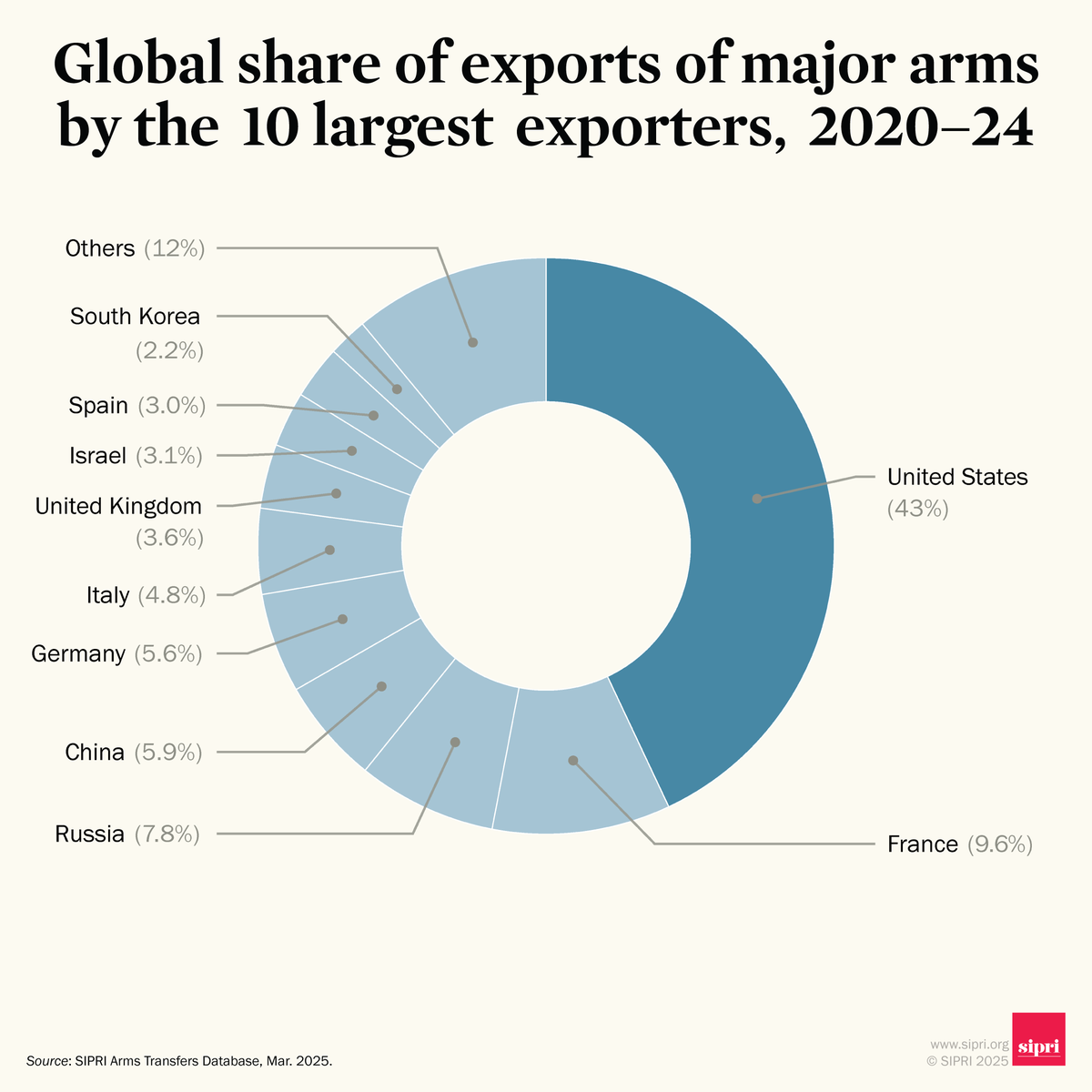
#FactFriday ➡️ The five largest arms exporters in 2020–24 were: 🇺🇸 USA, 🇫🇷 France, 🇷🇺 Russia, 🇨🇳 China, and 🇩🇪 Germany. Database: https://t.co/jFXoUB0lmK
Accurate, dependable information matters more than ever. Invest in the facts. Support #SIPRI: https://t.co/WThxhwaZvC