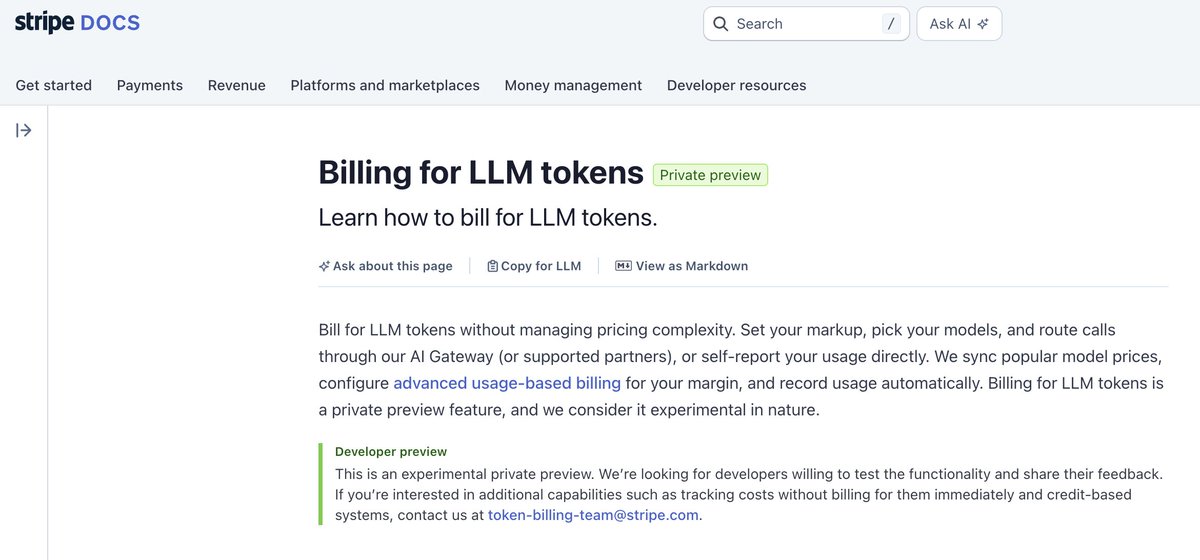
I think @stripe just mass produced a business model for every AI startup on earth and increased their TAM exponentially.
Customer buys a shirt for $40, Stripe takes 2.9% + 30 cents. It's a simple formula, but token billing is completely different.
AI costs are variable. They shift by model, by provider, by week. A startup using Claude for 40% of inference and GPT-4o for 60% has a blended cost structure that changes every time Anthropic or OpenAI adjusts pricing... which is constantly.
Stripe is now ingesting those real-time model prices, applying the startup's target markup, metering per-customer usage, and generating the invoice automatically.
That's constructing unit economics at a scale and complexity far beyond anything in traditional payments.
And the data asset being created by them is a massive moat.
OpenAI knows what OpenAI charges, and Anthropic knows what Anthropic charges. But Stripe will know what every model charges, what every startup pays, what every startup marks up, and what every end customer actually consumes.
But the gateway is where this gets really interesting.
Stripe's AI gateway routes inference, returns the response, and attributes tokens to the customer in one API call.
Today it's "pick the best model."
Tomorrow it's "Stripe recommends the model that optimizes your target margin across 12 providers in real time."
The moment that recommendation engine turns on, model providers start competing on Stripe's terms. Pricing power inverts from provider to platform.
This is AWS turned sideways (or i guess diagonally).
Amazon didn't build apps... they built the infrastructure every app depended on, then used the data to optimize the infrastructure itself.
Stripe is running the same playbook on AI economics instead of AI compute.
I truly believe that token billing will make Stripe the most strategically important company in tech that doesn't train a model.
I found a way to sell AI infrastructure to companies doing $2M-$50M/year.
ALL with no sales team, enterprise connections or cold calls.
Businesses are desperate for Ai implementation right now and anyone can do this.
But most people get it wrong and that's why they fail.
They lead with tools, ex) "we build automations" or "we integrate AI."
That means nothing to a CEO managing 40 people and $5M in revenue.
They pitch features instead of showing the cost of doing nothing.
And they price hourly, so the buyer treats them like a freelancer instead of a partner.
Mid-market and enterprise companies are bleeding $100K-$500K/year on broken processes, bloated SaaS stacks, and manual work they don't even realize they're paying for.
They WANT to buy AI infrastructure, they just don't trust most people selling it.
Because most people selling it sound like every other agency.
I created a guide breaking down exactly:
→ How to position AI infrastructure so executives actually listen
→ The discovery framework that turns a 30-min call into a $25K-$100K project
→ How to calculate ROI so the price sells itself
→ The 3-pillar strategy process that closes 60%+ of qualified prospects
→ Why "sell the map before you sell the build" changes everything
RT + reply "INFRA" and I'll send you the FULL guide (must follow so I can DM)
@JacobKinge@grok is the image true? What does it mean if lots of Long term holders are dumping at every major upside in the market? Does it mean the Bitcoin system is destined to fail? Or will other smaller holders take their place?
I’ve created a 29-page guide on how to build an AI Agent that manages your entire chat workflow automatically
It handles messages, transcribes audio, and sends emails while you sleep
- Processes 100+ messages daily without you
- Transcribes voice notes instantly
- Triggers Gmail responses automatically
- Remembers client preferences
Value: $12K, but if you want it FREE
👉 RT + Like & Comment "Agent" and I’ll DM the guide to you for FREE
No-opt in, no BS
(Must be following)