@TeksEdge I did the same offload with llamacpp ages ago and tried freetoken, it's slower and I can't control the layers offload for a better fit, for now, not worth, 40tps qwen 3.6 35b on my rtx 4060 8gb with llamacpp, 18tps on freetoken
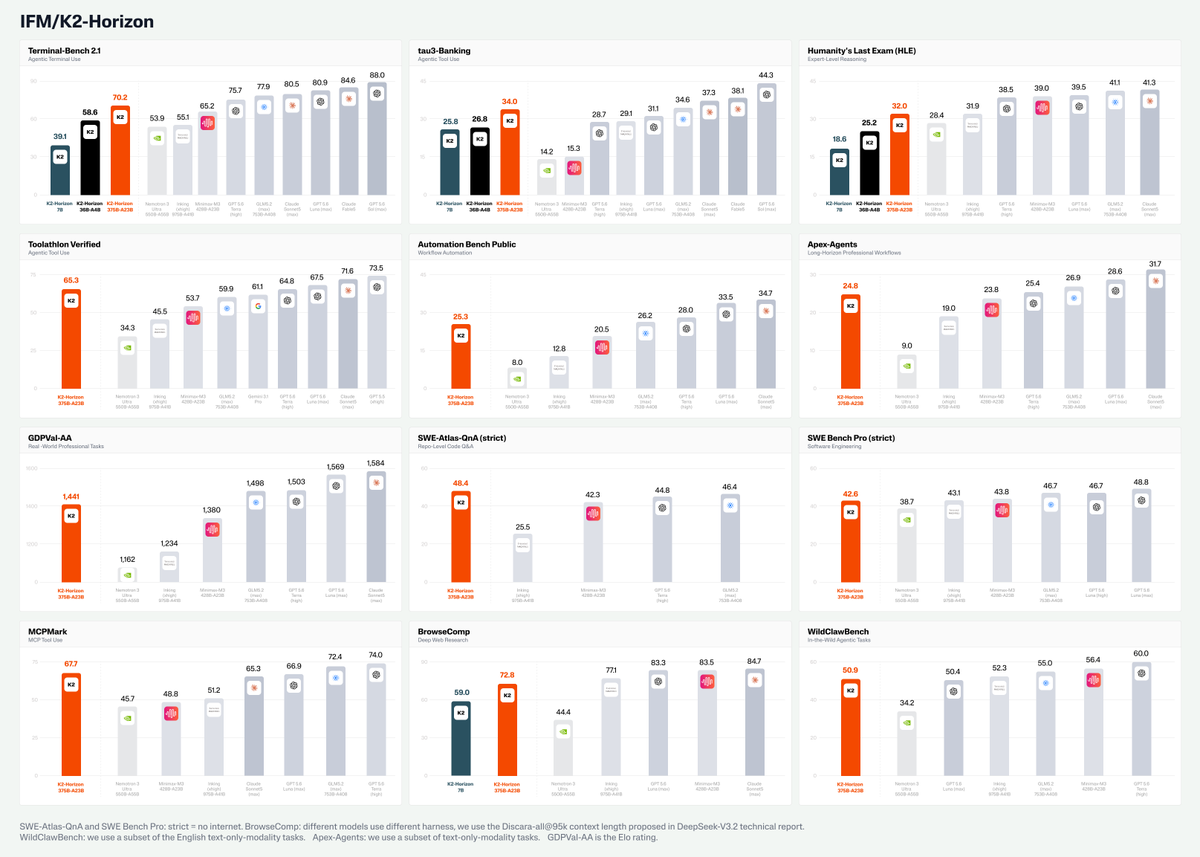
Introducing K2 Horizon: a connected fleet of six foundation models ranging from 0.9 billion to 375 billion parameters.
- Frontier performance: Across coding and agentic tasks, K2 Horizon delivers top-tier performance in every size class—with the 0.9B, 3.7B and 7B models setting new state of the art at their respective scales.
- Radical openness: K2 Horizon represents the largest fully open-source model launch in AI history. The fully open code, training data and recipes are a significant step forward in transparency.
Launch page: https://t.co/gg0k803SbL
Tech blog: https://t.co/g35L5xMGdS
Hugging Face: https://t.co/3Lb28JhyG9
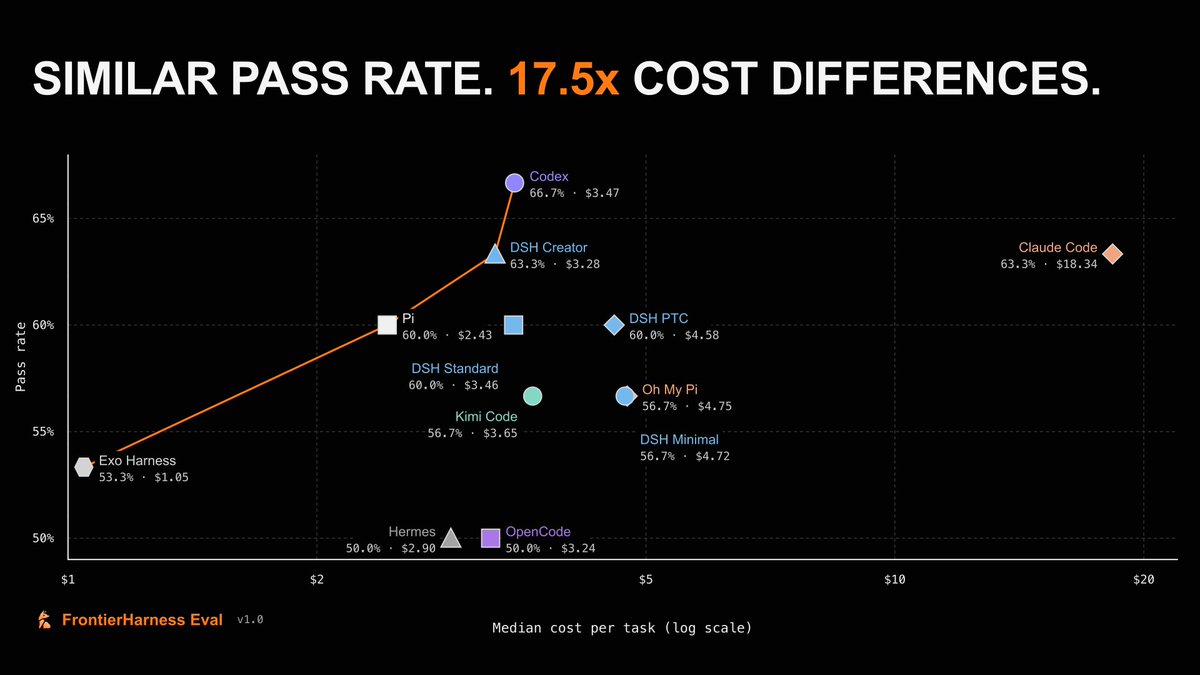
A year ago the question was which model. Now it's which harness.
Pi, Exo, Claude Code, Codex, DeepSeek Harness and 4 others. Same model, same tasks, same runtime. 360 runs, 2 billion tokens.
Pass rates: 50% to 67%.
Cost per pass: $1.05 to $18.34.
Introducing FrontierHarness Eval. 🧵
We just killed…everything.
Introducing Monid, the OpenRouter for agent tools.
Today we crossed 4M agent transactions. And raised a $2.1M pre-seed to kill every subscription in the world.
Your agents can now:
> discover, run, and pay for tools at runtime
> one connection to 1,800 APIs: SEO, leads, search, ecommerce, stocks, video/image/music/3D gen, private company data
> all pay per call, 0 subscriptions
I'm hiring a SWE intern for Pinetree Research, and the salary is $300K
Before you ask: 300K annualized. And no, we don't want your resume, coverletter, or grades
Here's how to apply:
1. Fork the Solari repo: https://t.co/TxbSy4v2XQ
2. Build a real use case with Solari (browsers, sandboxes, and/or desktops)
3. Publish it on a public Github account
4. Share it in a post on LinkedIn or X
Tag @harrychow_ and @getsolari
Use AI to build it. Seriously, we insist. We don’t care how you ship, we care that you can ship something great, and if you can ship if faster with AI, even better. (@im_roy_lee)
What happens next:
- We review every build that tags us
- If we like what you made, we schedule an interview
- If you're the right fit, we'll hire you on the spot
Know someone who can take on the challenge? Tag them below
For questions about Solari or the role, comment below or DM 🚀
May the best dev win
@FahimFaisaal It's really, really, really good and cheaper, running 4h sessions spending $0.37 implementing a queue of issues using OMP loop, it was the first flash model that followed my agents.md completely, also changed my Hermes main model from dsv4f to glm 5.3 flash
@lincolixavier OMP com modelo local com /advisor ativo ou o contrário, um modelo chinês qualquer com um qwen local como task model e se preciso de um harness especifico pra algo, modifico o Pi e já eras
The VRAM barrier is officially dead.
I just ran Qwen 3.8 Flash Next (MoE) 125B A6B with a 250,000 context window on a single 24GB RTX 4090.
21 tokens/sec decode. 364 t/s prefill.
no mtp. no dflash. no kv cache quantization!
We are running datacenter models on consumer hardware.
Tested on Ubuntu 22 | CUDA 13.0 | PCIe 4.0 x16 | 110 GB DDR4 System RAM with a continuous 28k prompt across all runs.
### The Benchmarks & Scaling
# 1. Hybrid Offload (-ncmoe 40 @ 80k Context)
Offloaded 40 expert layers to the GPU, pushing VRAM to the ceiling.
./build/bin/llama-server -m Qwen3.8-Flash-Next-UD-Q4_K_XL-00001-of-00004.gguf -c 80000 --port 8080 -v --fit off -b 4096 -ub 4096 -ncmoe 40
Prefill: 383.85 t/s | Decode: 22.52 t/s
Footprint: 23.85 GB VRAM | 97 GB RAM
# 2. Full CPU MoE Offload (-cmoe @ 80k Context)
Pinned all 512 expert layers to DDR4 RAM (-cmoe), keeping attention on the 4090.
llama.cpp flags: (Same as above, replace -ncmoe 40 with -cmoe)
Prefill: 355.72 t/s | Decode: 20.84 t/s
Footprint: 11.66 GB VRAM (12GB+ VRAM freed up!) | 110 GB RAM
# 3. The 180,000 Context Run
Prefill: 357.75 t/s | Decode: 20.98 t/s | VRAM: 15.6 GB | RAM: 110 GB
# 4. The 250,000 Context Absolute Ceiling
./build/bin/llama-server -m Qwen3.8-Flash-Next-UD-Q4_K_XL-00001-of-00004.gguf -c 250000 --port 8080 -v --fit off -b 4096 -ub 4096 -cmoe
Prefill: 364.29 t/s | Decode: 20.97 t/s
Footprint: 18.3 GB VRAM (Still ~5.7 GB of VRAM headroom!) | 110 GB RAM
### Key Insights:
-b 4096 -ub 4096: doubles the prompt ingestion from ~150 to 364+ t/s.
-cmoe Free Lunch: Shifting expert layers to DDR4 RAM slashes VRAM from 24GB to 11.6GB with virtually zero decode penalty (22.5 -> 20.9 t/s), enabling the 250k context ceiling.
Qwen 3.8 Flash-Next (UD-Q4_K_XL) is a massive 111.4 GB model split across 4 shards. To run this architecture, you must build from the experimental PR branch (#27742) by @danielhanchen:
git clone && cd llama.cpp
git fetch origin pull/27742/head:qwen-next && git checkout qwen-next
cmake -B build -DGGML_CUDA=ON -DCMAKE_CUDA_ARCHITECTURES=native -DBUILD_SHARED_LIBS=OFF
cmake --build build --config Release -j $(nproc) --target llama-server
A single 4090 paired with 100 GB of cheap DDR4 RAM will comfortably serve production grade 125B inference.
While Qwen 3.8 27B (dense) still holds the crown for single 3090/4090 rigs, Flash Next proves 125B hybrid models are officially viable on consumer hardware.
Hugging Face GGUF link and complete performance telemetry graphs are dropped in the replies below.
GLM 5.3 Flash VS Qwen 3.8 Flash Next, which one takes the open weights crown this week?
@elshayib_ I saw 2 research paper saying exactly the same and one said that the only thing that works is "explain me like I'm X", personas usually decrease assertiveness or hit the same result as none