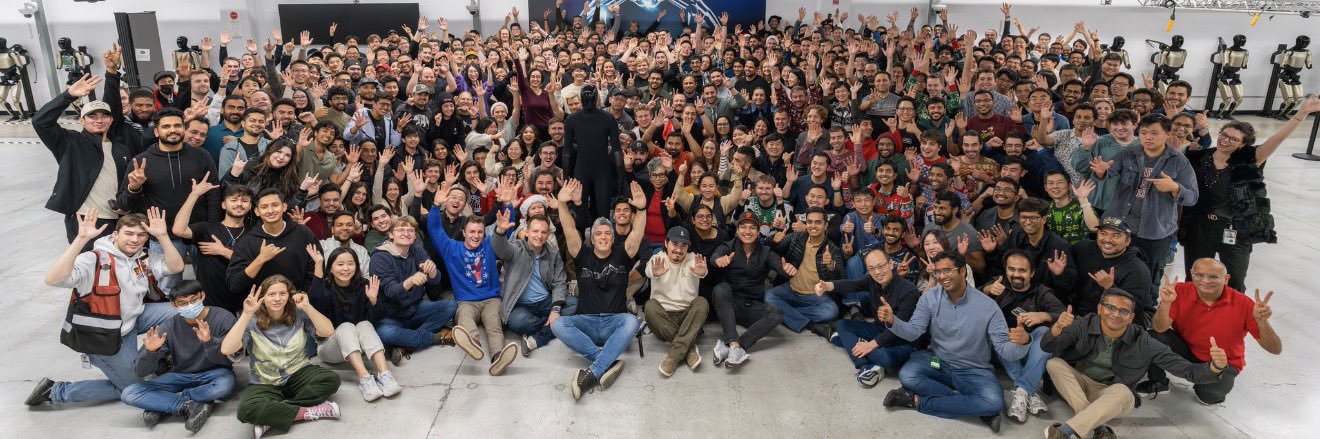
Huge congratulations to @anandnk24@Rebecca and the entire @PatronusAI team on an incredible milestone! 🎉
I’ve had the chance to work closely with the team, and it’s been an amazing experience. They’re some of the most passionate, driven, and thoughtful people I’ve met, with a relentless focus on building the infrastructure that will power the next generation of AI. Betting on them to bring this vision of Digital World Models and simulation driven agent training to life!
Excited to see what’s next. Onwards and upwards 🚀🚀
@getdarshan Varun Varun Madelyn Mariya Shivani Chinmayee Nicholas 🔥🔥🔥
Today, we’re excited to announce our $50M Series B, led by @GreenfieldVC, with participation from @lightspeedvp and @notablecap. 🚀
At Patronus AI, we develop simulations and evals to train and improve AI. The first phase of AI was built on static benchmarks, but that era is over. As agents are used to solve longer and longer tasks, they need to practice in dynamic, living worlds to get better. Simulations are the critical infrastructure powering this next phase.
As a company, we’re behind the most influential research and products in AI evaluation, like FinanceBench, Lynx, and Percival. And things have moved at the speed of light since.⚡ We partner with the world's leading frontier AI labs and enterprises, and our revenue has grown more than 15x over the past year.
Additionally, today, we’re introducing a preview of the first Digital World Model for AI agent training and simulation: Patronus-DWM.
Digital World Models are language diffusion world models that predict realistic environment behaviors and steer agent actions across digital workflows. Just as physical world models predict how objects move through space, we’re developing the equivalent for the digital world: predicting how agents act in digital workflows, then using that to scale the creation of high-quality training data for LLMs.
Digital World Models help us push the frontier of ultra long horizon workflows, and unlock a new class of self-improving RL environments. This is our scalable approach to simulating all of the world’s intelligence.
The round was also joined by @datadoghq, @SamsungVentures, @gokulr, @factorialcap, and a large cohort of amazing AI leaders across @AnthropicAI, @OpenAI, @GoogleDeepMind, @nvidia, @Recursive_SI, and more.✨
It has been the ride of a lifetime. But we’re just getting started. The best is yet to come.
"Do not go gentle into that good night,
Rage, rage against the dying of the light"
- Dylan Thomas (1954)
We’ve designed and built our first AI chip: Jalapeño.
Designed from the ground up by OpenAI and brought to production with @Broadcom, Jalapeño is purpose-built for the LLM workloads powering ChatGPT, Codex, the API, and future agentic products.
Chips are foundational to the AI economy. Building our own expands our full-stack platform from products to models to infrastructure, and will help us scale intelligence, serve more people, and expand access to AI.
We are presenting at #CVPR over the weekend our research on “Watermarking AI Generated Content”
I would not be attending this year, but some of my talented co-authors will be presenting. Would love to hear your thoughts and suggestions on the paper or just stop by for saying hi or DM !
@i_amanchadha@sharmavasu55@amitava_santu@VinijaJain@shashwatb1729
https://t.co/kFdL0LIy6i
#CVPR26 #PECCAVI
ICML just gave me a Gold Reviewer award and free registration.
Nice to know that writing:
"the claims are not fully supported by the experiments"
47 times in one month finally unlocked an achievement badge.
Reviewing ML papers is basically:
- destroy your sleep schedule
- read PDFs until your vision blurs
- argue with Figure 3 at 2am
get rewarded with... more papers
Jokes apart, still genuinely honored. Behind the chaos, reviewing is probably the fastest way to see where the field is actually going before the Twitter hype cycle starts.
I talked to 10+ robotics operators, customers, and investors in the last week.
Here's what I learned:
1/ Roboticists are building robots for themselves, not for the customers.
2/ Physical AI is harder than LLMs. We need way more data, and how we collect data is more important ever.
3/ Humanoids are over-valued. We don't need general robots & human-looking legs for many tasks. People are underestimating the power of building robotics vertically for certain tasks.
4/ People are paying big bucks for ego-centric data. Foundational labs are cutting exclusive deals with data brokers.
5/ There is disagreement as to whether "robotics is a bubble." Some people believe that we overfunded robotics companies. Other people believe that we have not even scratched the surface.
6/ A lot of founders play the VC game (e.g. nice humanoid robot videos to get more funding), rather than understanding the needs of a customer.
7/ Teleop is undervalued and is doing way more work than people admit.
8/ China is eating the component & humanoid stack.
9/ Customers don't care about your robots. They want outcomes cheaper and efficient.
10/ The best robotics teams aren't just pure ML & AI PhDs. They have a weird mix of hybrid backgrouds.
I'm curious what others are seeing on the ground. What am I missing?
I'm excited to finally release the fruit of the research we've been doing at Perceptron for the last 16 months: Perceptron Mk1. We've been developing multi-modal recipes from the ground up to build models that perform best in the physical world, from video understanding to embodied reasoning to robotics. Mk1 is our scaled up recipe.
I gave a talk at ICLR 2026 about how we are scaling RL on frontier LLMs with 1T+ parameters, on experimental data from our physical lab at Periodic!
Here's a rough recording of the talk:
"General robots" have been a story for a decade.
Still slow, brittle, and data starved.
Eka’s take is different: model the world in forces, not just pixels.
Vision → Force → Action as one system.
If that holds, you don’t trade speed for generality anymore.
You get both.
Then the real question isn’t capability.
It’s how fast this leaves the lab.
Many many congratulations to @pulkitology and team for Eka's launch! Cant wait to see where it goes 🚀🚀🚀
Eka means unity -- “one,” in Sanskrit and “first” in Finnish.
We’re building intelligence for the physical world in its native language: forces.
Until now, robotics faced a tradeoff — generality or speed. The real world requires both. Robotics also faced a data problem.
Our Vision–Force–Action (VFA) model — the first of its kind — breaks the generality-speed tradeoff and the data barrier.
It's a new foundation uniting performance, generality, and safety for putting capable robots in everyone's hands.
Today, I am excited to share our journey of pushing robots beyond human limits.
Today, dexterity becomes scalable.
Today, I welcome you to the Era of Eka.
Co-founded with @haarnoja, and so thrilled and grateful to be working with a dream team at @EkaRobotics.
Learn more: https://t.co/QYQ6x2Etyi
6 months ago, I moved to San Francisco.
It’s the best place in the world to build, and one of the worst places to stay human. My unfiltered take:
1. SF is both overhyped and underrated
The overhyped part: there are a lot of people with incredible resumes who are deeply unimpressive in real life. They were at the right company, at the right time, in the right market, and got carried by the wave. They made money, got comfortable, and now spend their time “exploring opportunities” over coffee, wasting your time.
The underrated part: the top 1% here is insane. But almost impossible to get. Hiring in SF feels like being a guy on a dating app: everyone you want is out of your league, and everyone in your league wants someone out of theirs. The best people have unmatchable packages, endless options, and are optimizing for maximum impact: labs, frontier companies, or startups raising $100M pre-seed rounds.
If you raised $10M from Tier 1 investors, you’re not hot shit here. You’re a B-player. It’s humbling.
2. There are fewer mission-driven people than I expected
Especially on the application layer. A lot of people are in “secure the bag before it’s too late” mode. And honestly, it gives me the ick.
The real religious builders I’ve met are often in labs, hardware, biotech, deeptech, defense — places where the work is hard enough that you can’t fake obsession.
3. The status game favors builders
This is what SF does better than anywhere else. It rewards obsession. It rewards weirdness. It rewards people who make building their entire personality. Europe punishes that. SF gives it status. If you’ve felt like an outsider your whole life because you care too much, work too much, think too radically, or refuse to be chill about things that matter, this city will make you feel less insane.
4. The market liquidity is absurd
Even if you don’t build a billion-dollar company, if you manage to build a strong product with a great team, someone smart might still acquire you for $ 100M. Yeah I know, it’s not your dream outcome as a founder, but on the days you feel desperate, it helps to keep going.
5. SF does not care about the meaning crisis that’s coming
Anyone paying attention here can feel that something massive is happening with AI. But I’m shocked by how little people talk about the meaning crisis coming next. Everyone wants to talk about AI liberating humanity. Almost no one wants to talk about what happens when work — the thing that gives most people identity, structure, dignity, status, and purpose — starts disappearing. The vacuum will not be peaceful. People are underestimating the chaos that comes from humans suddenly having no idea why they matter. And I really feel like no one cares.
6. Personally, I’ve never been more unhappy
I moved to SF and entered the matrix. I’ve always been intense. I’ve always worked crazy hours. But here, I lost the last parts of myself that were not about building.
I don’t go to events. Most networking events feel like theater for people pretending to be important. The only events worth going to are small, curated dinners with people who are actually alive. I’ve made 0 real friends. I don’t do well with transactionality. I don’t do well with people constantly performing greatness. I don’t do well with rooms where everyone is optimizing and no one is being honest.
So yes, SF is lonely, transactional, delusional, addictive, inspiring, boring, extraordinary, and completely insane.
But it is still the only place to be right now if you’re a founder trying to build the next wave of humanity.
And for now, that’s enough.
Everyone’s trying to sell AI tools.
@apoorva_mehta raised $100M to not sell his.
He’s building investor agents and using them only on his own capital.
If they’re even a bit better, the edge compounds fast.
Most people think better models mean better products.
This is betting they decide which products get built.
If that’s right, who’s actually allocating capital in 5 years?
@radbackwards@radbackwards Optimus does have it's own actuator design and production too. So American companies definitely are capable of producing them... We just quite haven't scaled the production yet