Chinese researchers killed fine-tuning and reinforcement learning in one shot 😳
They built a framework called Skill-Pro.
It allows AI agents to autonomously learn, refine, and reuse procedural skills from their own experiences, with zero parameter updates.
Not a single weight in the model is touched.
Here is how it works:
Instead of dumping messy, passive chat logs into a memory bank, Skill-Pro converts past experiences into clean, executable "Skills." Each skill has strict rules: when to activate, how to execute, and when to stop.
Then comes the real breakthrough: Non-Parametric PPO.
Instead of using math gradients to retrain a neural network, it uses semantic gradients to generate better skills, and a "PPO Gate" to ruthlessly verify them before saving them to memory.
Bad habits get deleted. High-performing skills get compressed and locked in.
The results across in-domain, cross-task, and even cross-agent tests are staggering:
- Massive performance gains without retraining the base model.
- Extreme memory compression, no bloated context windows.
- Skills learned by one agent can be transferred and reused by another.
And the model doesn't just remember what happened.
It builds muscle memory.
We spent years thinking that to make AI agents truly autonomous, we had to keep retraining bigger and more expensive models.
We created the world’s first open source benchmark for end-to-end autoresearch. Today, its results are live.
Which models are best for RSI? Can they understand the literature? Can they conduct complex scientific experiments, while maintaining good taste?
We spent about $7.4k in tokens across 8 models, 6 providers, and 3 evaluation tracks to find out.
The OpenResearch Intelligence Index evaluates models on scientific knowledge (20 hand-picked Terminal-Bench-Science tasks), post-training ability (6 novel post-training tasks), and literature relevancy/taste (a subset of PaperFindingBench), with each model running in its native harness inside OpenResearch.
So far, the index includes Opus 5.5, GPT-6 Astra, GPT-6.1 Sol, Gemini 4 Argon, Fable 5.1, DeepSeek V4.1 Flash, Kimi K3, and Qwen3.8-Flash.
Opus 5.5 scores the highest at 61.8%, costing $16.46 per task. GPT-6.1 Sol scores slightly lower (54.9%) at a fraction of the cost (only $3.83 per task). When paired with OpenResearch’s literature search tools, DeepSeek V4.1 Flash performs nearly as well as GPT-6 Astra on the literature relevancy track (47.7% vs 48.7%, respectively).
Check out the blog post to learn more: https://t.co/xSsRzXyNme. More models and source code coming soon.
Must-read papers of the week
▪️ World In-Context Learning for Agentic Robot Manipulation
▪️ Don’t Just Trust Your Memory
▪️ Is Your Robot’s Memory Just a Clock? Temporal Shortcuts in Memory-Augmented VLA Policies
▪️ Unbundling Multimodal Vision Encoding
▪️ V-JEPA-LM
▪️ Learning Heterogeneous Tactile Representation for General Dexterous Manipulation
▪️ Training Reasoning Models in Simulation to Natively Use Real Robots
▪️ Embodied First Exam
▪️ Continual-ARC: Measuring Skill Acquisition over a Working Lifetime
▪️ Reframe: Observation-Aligned Multi-Teacher On-Policy Distillation for Agentic Visual Reasoning
▪️ MemInStream: Memorizing or Merely Recognizing? Rethinking Streaming Video Memory Evaluation
▪️ Infrathon: Benchmarking Language Agents for Real-World, Long-Horizon AI Infra Optimization
▪️ Actor, Judge, or Teacher? Understanding Decision Models in Long-Horizon Agents
▪️ GTAGym: AAA Game Tasks Environment for Evaluation and Reinforcement Learning
Explore these to keep up with main AI trends. Here’s also the full list of outstanding papers + links, and our weekly AI news digest: https://t.co/XJLza8hzI8
"La-JEPA: Compact Robot Policies with Latent World Modeling"
What if robots could outperform massive video-generation models with a fraction of the parameters, simply by learning to predict the future without actually generating it?
This paper La-JEPA trains a compact robot policy using pretrained V-JEPA visual representations. During training, it learns to predict both future scene representations and robot actions, but at inference, it only generates actions.
On RoboTwin 2.0, its 1B model achieves 60.8%, compared to 39.9% on 12.4B Fast-WAM. It also runs 5x faster and achieves comparable real-robot performance to π0.5 across four tasks.
https://t.co/w1KhQgiVhS
ICLR 2027 reviews are out. I pulled every ICLR review since 2025, about 250k of them, and it's not looking great.
AI written reviews are now the majority (* based on a sample):
2025: 18%
2026: 41%
2027: 65%
Scores are collapsing into the middle, and as others have pointed out - most consolidate around "Weak reject" (score 2). Weak rejects went from 36% of all scores to 57%. Clear accepts and rejects fell from 41% to 21%.
An indication that this is an AI phenomena - AI-flagged reviews picked a clear side less than half as often as humans.
Then you have the really awkward slip-ups.
94 reviews this year call the paper "the provided manuscript." That's chatbot for "the PDF you uploaded." In 2025 there were zero.
28 complain the paper is full of garbled numbers. Those are probably the line numbers embedded in the submission's margins, which is what they look like after a chatbot turns the PDF into text.
23 reviews have a Weaknesses section written for a different paper, word for word. For example, one paper on RL training got criticized for its chemistry. It has no chemistry. In half of these cases, the two reviews were posted less than 9 minutes apart.
I'll leave everyone to draw their own conclusions, but clearly we're not adapting quickly enough.
RoboKit by OpenRoboKit is an interesting project that brings together AI agents, Real2Sim, motion generation, and robot simulation.
I find it interesting how these tools could help connect AI agents with real robotics applications.
1/5 FlexiTac has been accepted to the CoRL 2026 Demo Track, and today we’re releasing FlexiTac-Gen! 🧵
Try it: https://t.co/A1HNclEi4U
Over the past two years, we’ve received many requests to customize FlexiTac for different robots. With help from AI agents, we built a tool that makes it easy to design your own sensor and export the files for fabrication.
A simple piece of tactile hardware to help move your research forward. See you at CoRL!
In 2022, our first cuRobo prototype took 100 ms and consumed the whole GPU.
Today, we’re open-sourcing cuRoboV2-Fast under Apache 2.0: collision-free, torque-limited motion planning in 4.4 ms.
Collaborating with researchers across robotics and GPU architecture brought us to 50 ms, then 30 ms. B-splines, GPU time optimization, and faster kernels brought us to 4.4 ms while producing motions that execute faster.
As planning got faster, perception, grasping, and control became the bottlenecks. We built a 7 ms perception pipeline (SceneFields): from stereo RGB to depth, voxels, and robot and object segmentation, and accelerated GraspGenX to 1.6 ms. We also integrated wrote a cpp controller for YAM and built a low-latency CUDA-GL visualizer for an interactive live view of the task.
We deploy the stack as a two-process application: one dedicated to real-time control, the other handling perception, grasping, planning, and visualization.
On a real YAM arm, pick-and-place cycles averaged 6 seconds, 34.6% shorter than cuRoboV2.
A long journey, made possible by amazing collaborators. The rest of the stack is coming soon.
https://t.co/IDCfrxtN0l
Joint work with @Adithya_Murali_ , @BirchfieldStan
Prompt your agent with :
Use cuRobo cpp_runtime for collision-free motion planning: https://t.co/angQPvGLMp
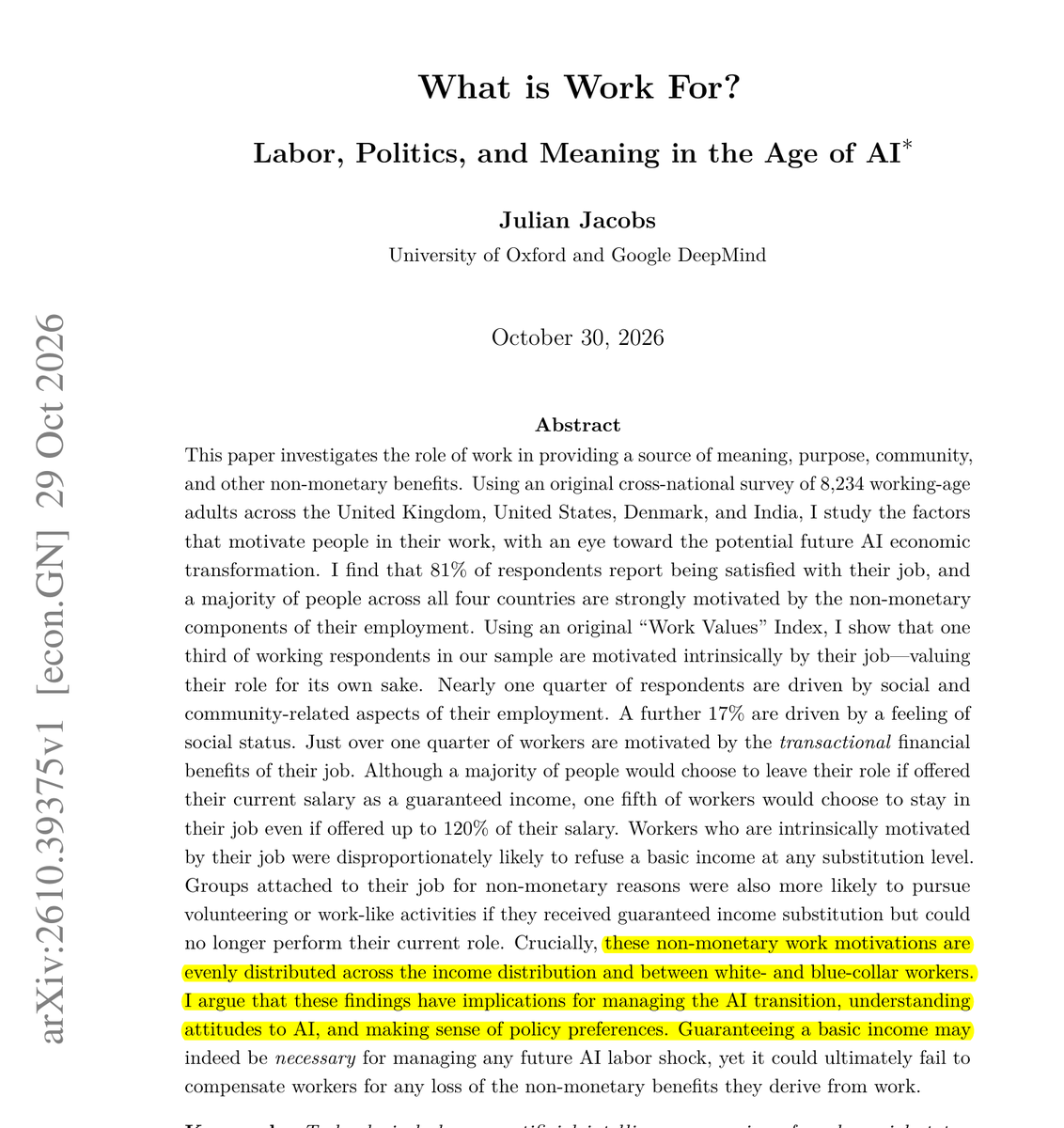
New Oxford and Google DeepMind paper finds most workers value jobs beyond pay, so basic income alone may not offset AI job losses.
So plans for the AI transition should protect purpose, community, and dignity at work as well as income.
finds that about 75% of workers would quit if guaranteed 100% of their wage, yet 1 in 5 would refuse even 120%.
If AI automates many jobs, a common plan is a basic income that replaces lost wages. That plan works only if people work mainly for the money.
The author surveyed 8,234 working-age adults in the UK, US, Denmark, and India. Workers were sorted by what they value most in their job and asked what guaranteed income would make them quit.
Only 26% of classified workers valued their job mainly for pay, while one third valued the work itself. 20% would keep working even if offered 120% of their salary as guaranteed income, a share similar across income levels.
You can now book our humanoid cleaners on a recurring subscription, for up to 3 hours per cleaning at https://t.co/Brl42KyISx.
Video is first take, uncut, shown at 4× speed. See the reply for detailed footage at 1× speed.
OpenAI CEO Sam Altman says it’s “quite terrible” that people have so much DRAM sitting in their own PCs instead of being used in data centers.
“Everyone have a bunch of the world’s limited supply of DRAM sitting in their own computer. And be used 5% of the time,”
He argues that cloud data centers should make better use of limited memory supplies instead of people running AI models locally.