"The architect alone is responsible for what leaves his drawing board and carries his signature. No politician or developer will bear the architect's guilt for a botched environment." Rob Krier
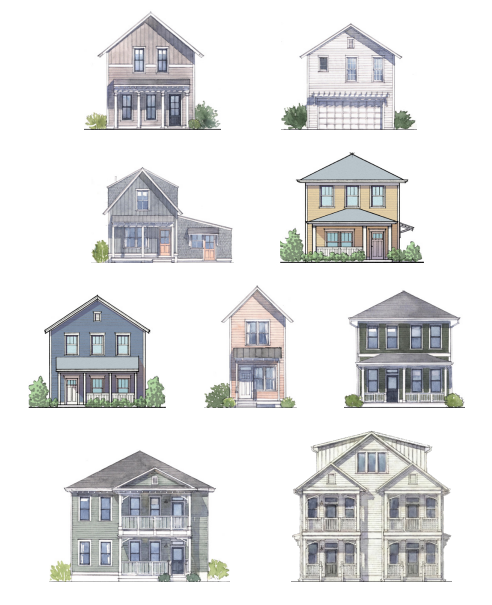
Tulsa has a pre-approved stock house program.
You do not have to pay a license fee.
You do not have to pay a review fee.
You only have to pay a permit fee.
https://t.co/DMFQgtJkWw
@trevoracorn An 8 unit, two story apartment building would be quite safe with no fire sprinkler system. Build one hour rated walls between the dwelling units and gave good smoke detectors.
A 1904 design for a pair of houses at Mozartstrasse 11 and 13 in Barmen, Germany, by Albert Schutte and Volmer. See how little it takes to give a wall some life: a bay here, a gable there, one roof higher than the other.
every neighborhood that blocks apartments eventually develops three exciting new amenities: $2,700 rent, a restaurant with a HELP WANTED sign permanently taped to the door, and someone at the neighborhood meeting asking where all the young families went. this is a mystery only to you.
While the growth or replication of NU projects didn't proceed as many hoped (2008 had a lot to do with that), bear in mind that it was the NU movement that gave us:
ADUs
Missing Middle Housing
Street Design Reform
Parking Standards Reform
Major zoning reform (form-based codes)
Code-free zone theory (Lean Urbanism)
Building Code reform
Reform of the design professions, especially architecture
and much more...
All of that came from the work of the developers, designers and advocates of NU. It's just that it often takes 20-30 years for good ideas to marinate before they become "common sense."
Another mansion block scheme by @OS_Architects (right is the site currently). We are continually told that beautiful buildings are unviably expensive, and yet this little Stockport practice produces a stream of handsome buildings on tricky infill sites in extremely weak Northern housing markets.
People often mistake our new builds for historic renovations. Townsend is no exception. We’re not trying to make anything look old — we’re simply using the methods and materials that were standard a hundred years ago, and for most people the only reference point for that craft is the historic buildings still standing.
When you respect masonry as a material, and how it works in compression rather than tension, you are limited. Arches need certain dimensionality to support the weight above them; natural stones need thickness to span a window; large openings need “buttressing” at the ends to carry the load to the ground.
Historic buildings were guided by these limitations; there was no way around them for thousands of years (until the advent of mass-produced steel).
Our eyes have grown accustomed to the proportions of real masonry buildings, and it’s why modern brick buildings don’t fit into that intuitive understanding. Something looks off. People may not be able to point out why it looks off, or exactly what is different about our buildings, but they sense it. They know it.
@matt_hayes4 and I are good designers (we designed Townsend together), but I believe it’s our respect and understanding of the material itself that makes Building Culture’s work stand out. Rather than trying to overcome the limitations of masonry, making it do something it wasn’t intended to do with steel, we celebrate those limitations.
There is a whole world of exploration within the material. As any artist will tell you: limitations are the key to creativity. The geometries inherent in compression-only buildings reflect the laws of nature, and are harmonious – just like all the great buildings throughout history.
We’re not copying historic buildings; we’re trying to build the future’s historic buildings.
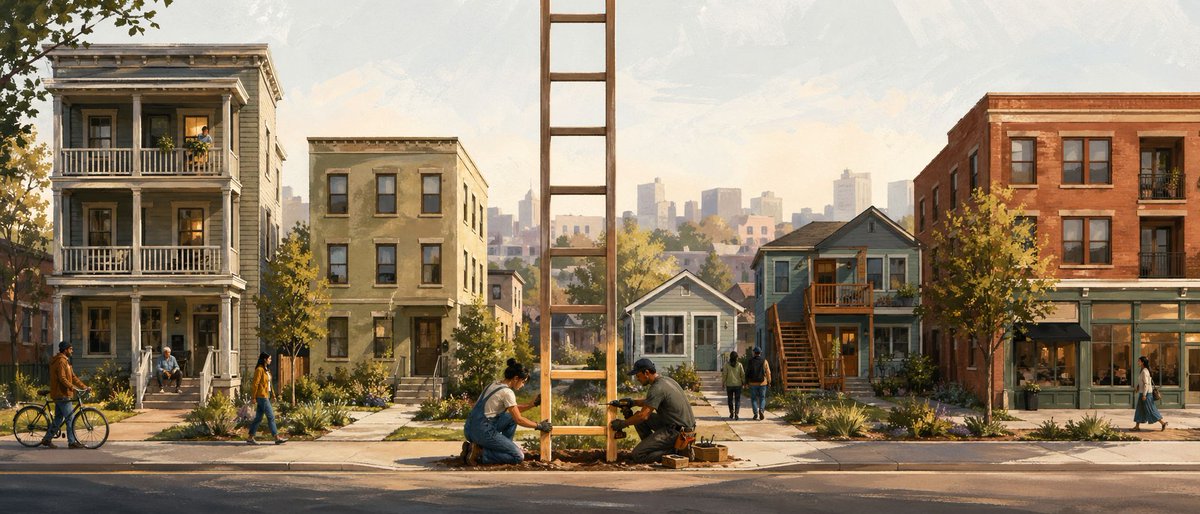
We've made the cheapest forms of housing illegal, difficult, or financially impossible to produce, then we are shocked when the poorest folks can't find housing.
If we want fewer people living outside, we need to rebuild the housing ladder from the bottom up.
That’s interesting about the difference in rent control affecting flat development.
Another way the post-war Spanish development differs from pre-war is that the roads and buildings are much larger. The pre-war developments are finer-grained, have smaller lots, smaller buildings.