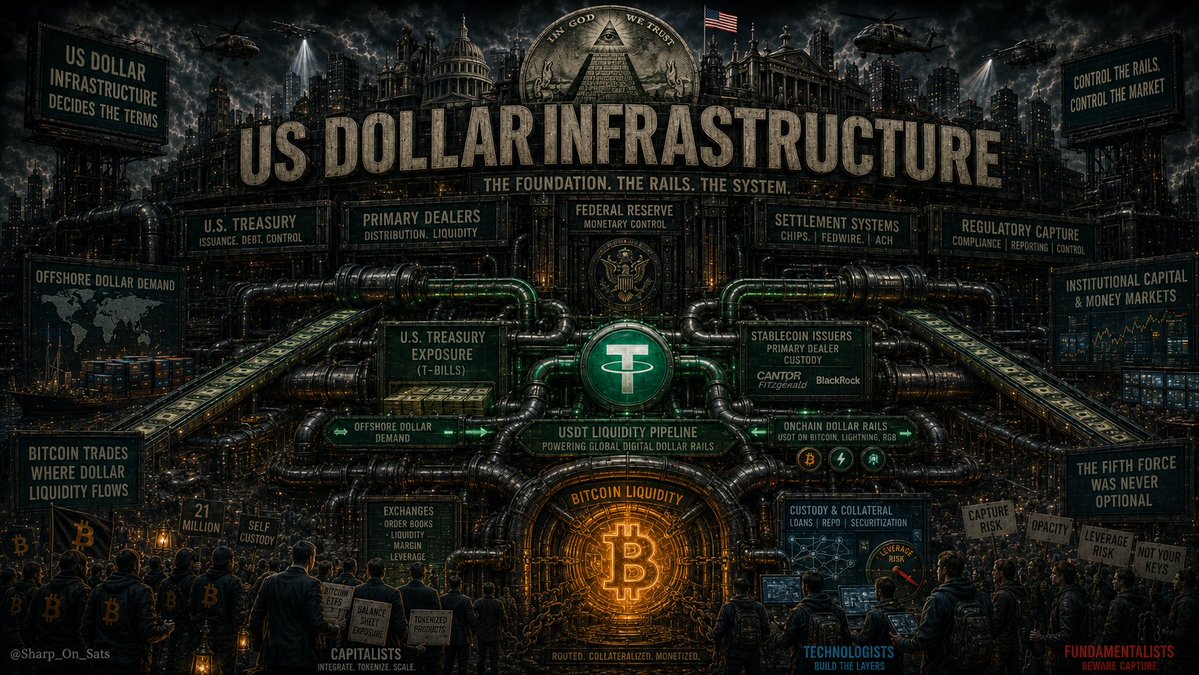
1/3
Bitcoin doesn’t eliminate credit. It gives us a better form of capital from which to issue it.
Harder money doesn’t remove the reason to borrow. It removes the assumption that the monetary base will expand to protect failed liabilities
"Michael Saylor knew his voice carries weight, and he threw it in the direction that made sense for him and his interest. I don't fault him for it. I think he did the right thing."
- @Sharp_On_Sats
This is one of those questions I wish I had given a more concise answer to...
My pratteling on boils down to this:
When you lack the technical expertise to evaluate every downstream consequence yourself, the responsible thing to do isn't to manufacture certainty.
It is to:
1) recognize the asymmetry of the risk;
2) place a higher burden on those proposing change;
3) identify the people whose technical judgment and first principles you trust;
4) and then decide where your own influence should be placed.
China does not need a healthy consumer to keep expanding industrial capacity.
AI demand, exports and state-directed capital can keep the strongest factories profitable while households, property and private investment remain weak.
The imbalance doesn't disappear. Instead it gets exported as lower prices, lost market share and trade retaliation.
China can sustain this longer than the domestic data suggest because exports and AI infrastructure demand are doing the work.
But capacity that cannot be absorbed at home has to be sold abroad, which could turn a narrow industrial recovery into a trade problem for everyone else.
https://t.co/r0WZDesfPL
To reject Bitcoin’s integration with banks and corporations, custodians and exchanges, equity and credit markets, governments and currencies is to deny its benefits to 99% of the world and doom it to 1% of its potential.
It’s Sunday.
Come sit in the pew. Bring the week you’ve had, the worries you’re carrying and the prayers you haven’t quite found the words for.
There’s a place for you at Mass this morning. Come home for an hour.
Now that the backup route has become part of the risk, the question is no longer whether oil gets through. It is whether the added cost persists long enough to force the Fed and ECB to respond.
The barrels are still reaching buyers, but longer voyages, higher insurance costs and tighter tanker availability allow the shock to spread into freight, margins and consumer prices.
That's where an oil problem could become a central-bank problem.
https://t.co/G6kNC1kHMw
@ZynxBTC The sooner you accept reality the sooner you can begin building a life that accounts for it.
Applies to many areas in life.
https://t.co/KoOjYc8OW1
5/6
The bright orange future was always too clean... Too Libertarian... Too idealistic.
Bitcoin was never going to win by somehow floating above fiat in ideological purity.
It was always going to win by being dragged through it and then deeply embedded in the very infrastructure some Bitcoiners hoped to see going away.
So many great points here...
One of the hardest parts of being early is accepting that mass adoption will not flatter the people who were right first.
Institutions will custody Bitcoin, lend against it, package it into products and use it in ways many early Bitcoiners would never choose for themselves. That is not Bitcoin being captured. It is Bitcoin escaping the subculture that discovered it.
Yes to keeping your standards, holding your own keys, and running a node.
But understand clearly that cultural ownership is not protocol ownership. Bitcoin can outgrow the people who understood it first without ceasing to be Bitcoin.
Bitcoiners can be incredibly immature at times.
There comes a point in life where you have to accept the world for what it is, not for what you want it to be.
The cold hard truth is that the percentage of Bitcoin held by institutions and public companies is only going up from here. It will not reverse. The rubicon has been crossed.
Just today Saylor helped launch the Bitcoin Security Consortium alongside BlackRock, Fidelity, Coinbase and others. $15 million pledged to protect the network from future threats. Of course the institutions with the most to lose are the ones now funding Bitcoin's defence. That vested interest was always coming, and we could have done far worse than Saylor to lead the cause.
You can spend your energy raging against custodians, ETFs and corporate treasuries. Or you can accept that this is how a global monetary asset gets adopted and position yourself accordingly.
Bitcoin was always going to grow beyond the cypherpunks and Sovereign Individuals.
It is what it is.
Self custody your own stack, run your node, keep your keys. Nobody is stopping you and I will always advocate for this.
However, do not confuse your personal principles with how the rest of the eight billion people on earth will actually use Bitcoin.
Accept reality or struggle against it.
One of those paths sets you free. The other will just make you bitter.
This is exactly right.
Bitcoin’s education problem isn’t that people are unwilling to learn. It’s that we often explain it in the language of people who already understand it.
To me, it's an example of why @Swan's work has been so valuable. Nobody has done a better job of making Bitcoin understandable without making it simplistic.
The people who need Bitcoin most shouldn’t need a finance degree to understand why.
This is a beautifully honest way of putting it.
A moral code isn’t proven by how certain you sound before life tests it. It’s proven by whether experience can deepen your judgment without turning your values into a weapon against others, or your past mistakes into a life sentence against yourself.
I have built and revised my own personal moral code throughout my entire life.
By trial and error I tested what I consider acceptable personal behavior and what I do not.
My moral code is how I move through life, not how I expect others to move through life.
This is a really useful piece from @bitcoinerliz and @BitcoinerTalent
A lot of folks trying to get hired by a Bitcoin company seem to believe that conviction can carry the interview. It can’t. You still have to show that you know how to do something valuable, that you’ve done it before and that you understand how it applies to the company sitting across from you.
I can attest to this from my own career.
Most of my career has been spent outside the Bitcoin industry. I’ve sold complex technology, built partner motions, worked across vendors and customers, and been responsible for producing revenue. I wouldn’t leave any of that behind if I went to work for a Bitcoin company. In fact, that would be the reason to hire me.
You don’t need to manufacture a Bitcoin résumé from scratch.
Find your edge. Get paid for that edge. Build a record of results. Store the value you create in Bitcoin.
And then this: Learn how to explain why that experience makes you useful to a Bitcoin company in a precise manner.
I think Elizabeth’s framework is a very good place to start.
https://t.co/ldYNxl06qj
Japan’s problem isn’t that the export engine is weak. It’s that the same currency supporting that engine is raising the cost of running the rest of the country.
AI demand can keep the factories busy, but it can’t solve the policy bind created by a weak yen and expensive imported energy.
This has placed the Bank of Japan in a policy bind.
A weak yen supports the manufacturers benefiting from the AI cycle, while households and domestic businesses absorb higher energy and import costs.
Unless oil falls or the yen strengthens, Japan is choosing between more imported inflation and tighter policy that weakens growth.
https://t.co/3rZTm0XMWk
@BudJohnson photographs Bitcoin from inside the culture. He’s been part of it for years and it shows in the moments he catches.
He took this photo of me at @TimKotzman conference in NYC last year and it’s still one of my favs. His pinned thread is worth your time.
A few things I noticed as the photographer at the @btcdigitalconf BTC Treasuries UnConference 🧵
(And as a retail investor and a Ron Paul era bitcoiner)
*Thanks @ejuline and @TimKotzman for having me!*
“Set reminder” is nice but some of us are serving time inside Microsoft Outlook.
Where’s the .ics download @elonmusk?
I’m trying to add Café Bitcoin to a calendar already containing pipeline reviews, compliance training, and six meetings that should’ve been emails.
😎
Rod’s frustration is understandable. Too many Bitcoin Spaces have become noise, performance, and too much inside-baseball nonsense.
That’s why it’s so good to have Café Bitcoin back: newcomers can ask honest questions, experienced people can disagree, and education still comes before ego.
unironically this couldn’t come at a better time.
cafe bitcoin sounds like a dream compared to the chaos and pleb slop nonsense on all the other bitcoin spaces.
This is exactly right.
Bitcoin’s education problem isn’t that people are unwilling to learn. It’s that we often explain it in the language of people who already understand it.
To me, it's an example of why @Swan's work has been so valuable. Nobody has done a better job of making Bitcoin understandable without making it simplistic.
The people who need Bitcoin most shouldn’t need a finance degree to understand why.
Wall Street will understand Bitcoin before the people who need it most.
Here's why.
Wall Street understands volatility natively.
They literally have an index for it!
A guy selling juice on a street corner in Buenos Aires sees a Bitcoin chart after it crashed 40% and thinks this is a worse store of value than the Argentine Peso.
His financial literacy is not his fault but this is the way the actual nocoiner audience thinks.
So you got to break it down like they're five years old.
But instead we say: read the white paper, bro.
"You don’t need a job in Bitcoin. Find your edge, get paid for it, and store the value you create in Bitcoin. That’s how you work in Bitcoin."
On @DailyStackHQ with @halstonvalencia & @JodyFlournoy
https://t.co/Tk99gSgPfV
The full conversation between @TimKotzman and Michael Mescher is worth the time, especially the sections on collateral haircuts, balance-sheet defense and how treasury companies can remain opportunistic through a drawdown.
Listen here:
The Bitcoin Treasuries Podcast with Tim Kotzman | The $10 Billion Bitcoin "Put Wall" Nobody Is Ready For | Michael Mescher
https://t.co/KthQRVx0f6
Mescher makes a great point about how a Bitcoin treasury should be built for more than accumulation. It needs enough liquidity, control and capital-market flexibility to remain aggressive when the market turns against it.
What I would refer to as a fortress balance sheet isn’t necessarily proven when the company survives the drawdown. It's when the drawdown expands the company’s opportunities.
Among other things this could mean buying more Bitcoin, retiring liabilities, repurchasing discounted shares or acquiring weaker competitors while others are forced to sell.
I invested in Swan early because @CorySwan and the co-founders understood that price alone would never make Bitcoin politically irreversible.
That requires enough people to own it, understand it and refuse to surrender it.
Bull markets create attention. Bear markets build the intransigent minority.