A super long overdue (3+ years?) post on scaling laws.
Compute is expensive. Scaling laws are a way to help us reason about the optimal compute allocation between data and model size before committing to a large run.
The post covers what scaling laws predict, how compute-optimal allocation works, why Kaplan et al. and Chinchilla disagree, and how data limits + fitting details make extrapolation tricky.
https://t.co/HP26eJvjHB
Trained some terminal agents with friends!
Introducing Tmax, open RL terminal agent models. Under default settings and shorter length (65k) token budgets, tmax outperforms prior open work on terminal use. We are releasing all data+weights+rollouts publically!
🚀 DeepSeek-V4 Preview is officially live & open-sourced! Welcome to the era of cost-effective 1M context length.
🔹 DeepSeek-V4-Pro: 1.6T total / 49B active params. Performance rivaling the world's top closed-source models.
🔹 DeepSeek-V4-Flash: 284B total / 13B active params. Your fast, efficient, and economical choice.
Try it now at https://t.co/GCdiMzk1Dl via Expert Mode / Instant Mode. API is updated & available today!
📄 Tech Report: https://t.co/drlDrxkYtp
🤗 Open Weights: https://t.co/T13Y8i7SDM
1/n
Train LLMs to manage their own cache directly with rl!! No summarization in tokens, direct evictions of blocks trained end to end with RL.
Very cool work from @michaelyli__
1/ It’s been so fun working with @shengjia_zhao, @alexandr_wang and the team to build muse spark from scratch. It is early and has rough edges, but excited to continue our research velocity. I especially love that we’re doubling down on the fundamental science. We’re focused on building methods that scale well along all axes: pretraining, RL, and test-time compute. https://t.co/tTQmEjUlTJ
If you want to understand the latest landscape of RL training and frameworks
this blog by @DirhousssiAmine and the @huggingface team compares 16 different RL frameworks from VeRL, SLIME , TRL to many more across the following aspects.
> Orchestration & Concurrency Primitive:
+ how distributed components are coordinated (Ray actors, asyncio, pub/sub, HTTP).
> Rollout Buffer Design:
+ how rollouts flow from inference to training.
> Weight Synchronisation Protocol:
+ how updated weights reach inference servers, and whether the system must pause to accept them or continue generating.
> Staleness Management:
+ how off-policy rollouts are handled: version rejection, depth bounding, or importance-sampling correction.
> Partial Rollout Handling:
+ what happens to in-flight generations when a weight update arrives mid-sequence.
> LoRA Training Support:
+ General LoRA support and whether adapter-only parameters can be trained and synced, enabling sub-millisecond weight transfers.
> Distributed Training Backend & Parallelism:
+ what parallelism strategy is used for training, constraining max model size.
Its very well written and i was able to learn a lot from it!
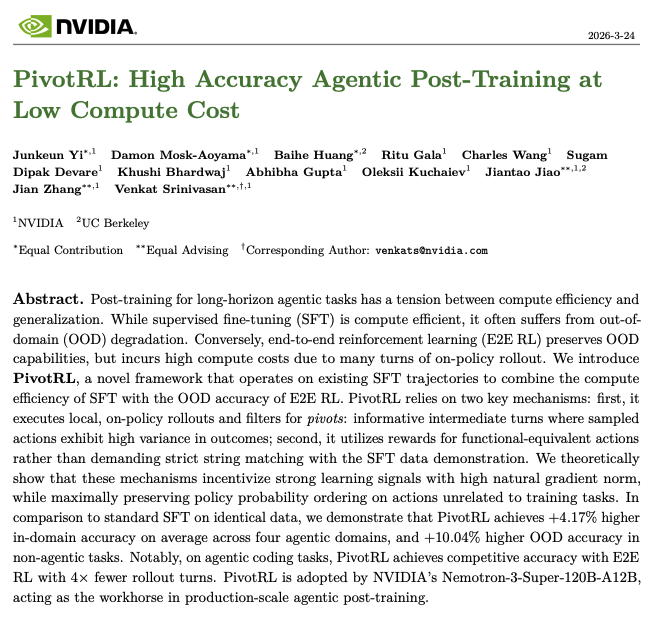
New paper from our team is now on arxiv. One of the techniques we use for Nemotron-3 post-training.
"PivotRL: High Accuracy Agentic Post-Training at Low Compute Cost"
Today we're releasing MolmoWeb, an open source agent that can navigate + complete tasks in a browser on your behalf.
Built on Molmo 2 in 4B & 8B sizes, it sets a new open-weight SOTA across four major web-agent benchmarks & even surpasses agents built on proprietary models. 🧵
🚨 I’m on the 2026 Research Scientist Job Market!
I am a PhD student at UNC Chapel Hill (advised by @mohitban47) and recipient of the Apple Scholars in AI/ML PhD Fellowship. My research centers around:
🔸Reasoning & RL/Post-Training: Evaluating and interpreting the reasoning process, and improving post-training and alignment through self-generated and reward-based signals (Intrinsic Dim., ReCEVAL, ScPO, LASeR).
🔸Agents & Planning: Designing adaptive agent frameworks to that use extra test-time compute & reasoning upon failure (ADaPT, System-1.x, PRInTS).
🔸Reward & Skill Discovery in Code: Leveraging execution signals to build reliable rewards, automate debugging, and discover abstractions in code (UTGen, ReGAL).
Prev (Research Intern): Google DeepMind, Meta FAIR, Allen Institute for AI (AI2), and Adobe Research.
Feel free to reach out via DM or email if you’re interested, have leads, or would like to connect!
🌐 https://t.co/17h5KwDZHA
📧 [email protected]
#NLP #AI #JobSearch
Introducing Theorizer: Turning thousands of papers into scientific laws 📚➡️📜
Most automated discovery systems focus on experimentation. Theorizer tackles the other half of science: theory building—compressing scattered findings into structured, testable claims. 🧵
🚀 New paper alert — Nemotron-Cascade
We introduce Cascaded Domain-Wise RL (Cascade RL), a sequential RL pipeline that trains the model across domains one stage at a time, simplifying training while optimizing performance in each domain.
🔥 Key wins:
- Cascade RL yields state-of-the-art accuracy, with the 14B Nemotron-Cascade model outperforming its SFT teacher (DeepSeek-R1-0528) on LiveCodeBench v5/v6/Pro.
- Interestingly, RLHF as a pre-step greatly boosts reasoning capabilities in math, code, science, and SWE.
- Later RL stages for math, code, and SWE preserve earlier domain performance and often improve it, highlighting the stability of cascaded training.
🌟Take Away
Cascade RL is a powerful method for building highly accurate, general-purpose reasoning LLMs, with scalable, domain-wise training that preserves and improves performance across tasks.
📄 Paper: https://t.co/eSEq7RHLT2
🤗 Models & Data: https://t.co/xe2hGXXXA8
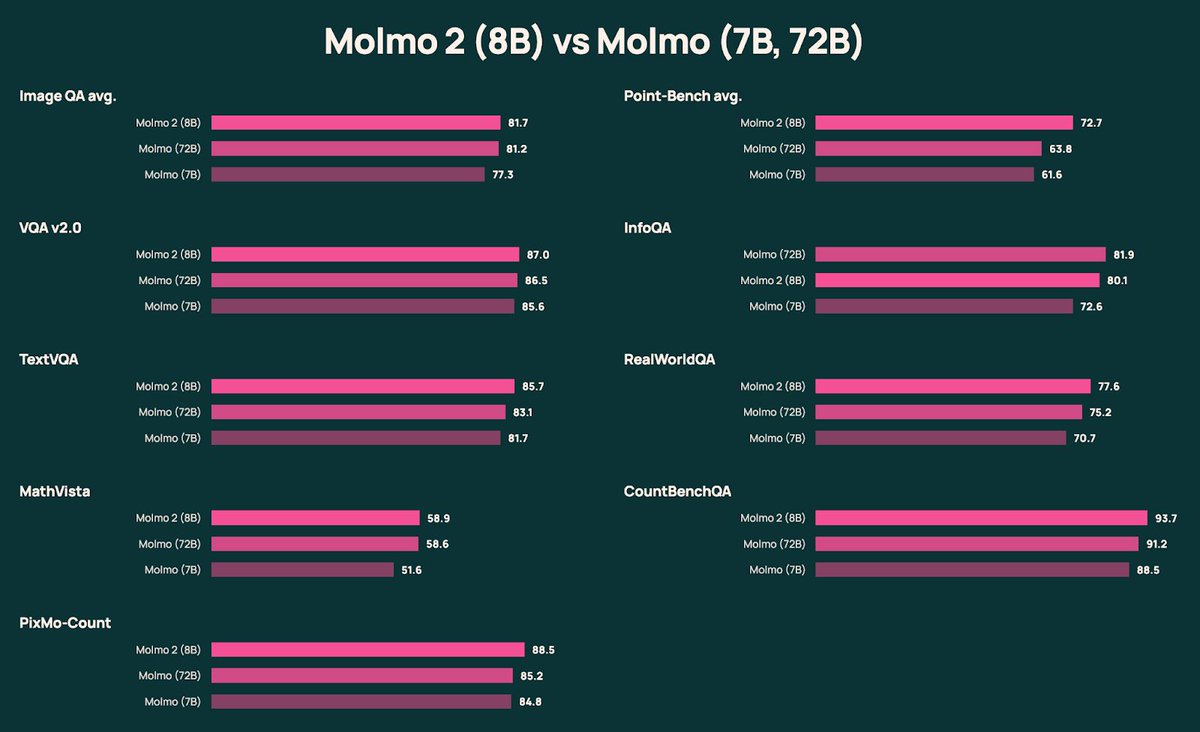
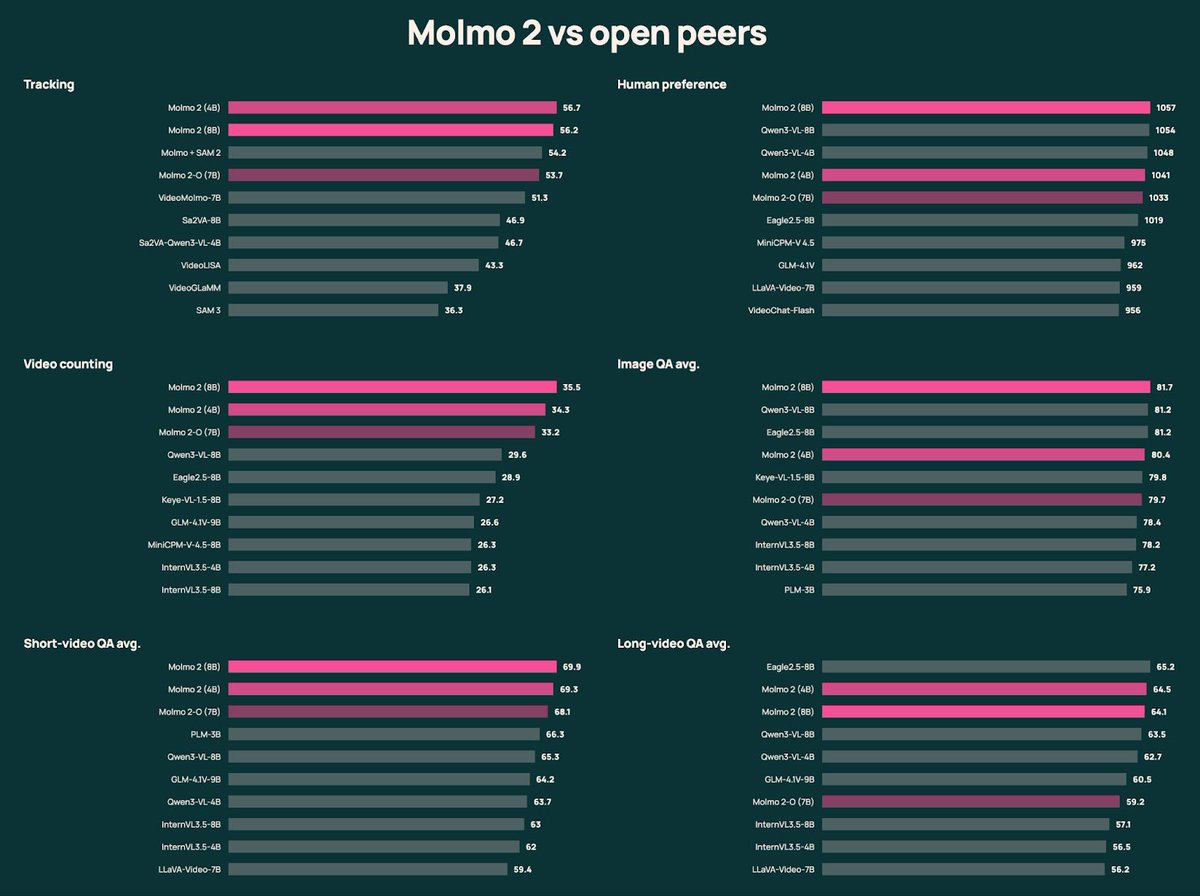
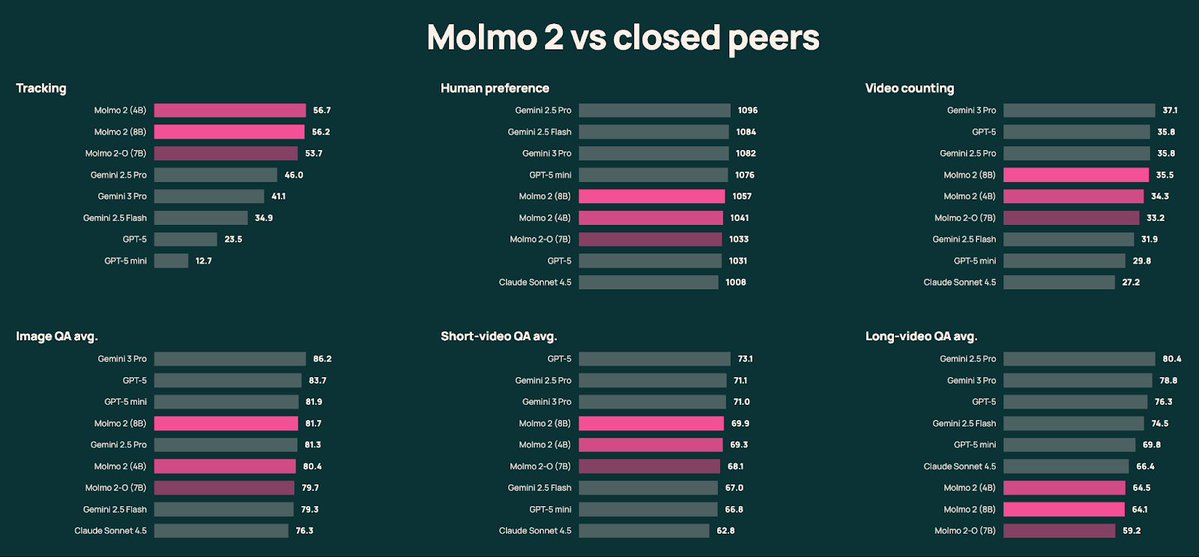
Last year Molmo set SOTA on image benchmarks + pioneered image pointing. Millions of downloads later, Molmo 2 brings Molmo’s grounded multimodal capabilities to video 🎥—and leads many open models on challenging industry video benchmarks. 🧵