Another Golden Sweep by India as our Chemistry team bags 4 Gold medals securing Rank #1 (jointly with China, Vietnam, and Individual Participant (Russia)) at the 58th International Chemistry Olympiad, Uzbekistan (https://t.co/ZCxapjbtvG).
1/5
Your AI bill tells you almost nothing.
It shows the total. It cannot tell you which team spent it, what they bought, whether a cheaper model could do the same work, or where the cost belongs in the books.
One customer found $10K a month lost to prompt caching and fixed it the same day. Another turned off Fast Mode after Ramp showed it was creating 6x the token spend.
We built Ramp Token Spend Management to connect every token to an owner, use case, and decision. Across 1,300+ businesses, on average, Ramp identifies potential savings equal to 12% of monthly AI spend. One in three businesses has received a recommendation to evaluate a lower-cost model.
Agentic AI will make the meter run faster. The companies that can explain every token will be the ones confident enough to use more of them.
Ramp’s solution is live now: https://t.co/T4WoKw9KkU
AI is extremely good at spending your money very quietly.
our own token spend went from a rounding error to more than 10% of payroll in a year. one week in May we burned through $1.5 m. our CFO didn't love telling me that number, and he really didn't love telling the internet.
but every finance leader we talk to is living the same story. the bill keeps going up and teams can't answer basic questions about it. which team is driving it? which models they're using? what changed this month? whether a cheaper model would do the same job?
so finance gets two bad options: keep paying and hope, or cut broadly and slow down the work that's actually compounding.
we built a third one. Ramp now connects to OpenAI, Anthropic, Gemini, Cursor and pulls it all into one place. see it, understand it, control it - down to a single API key. built with 1,000+ companies managing 100T+ tokens a month, and now spending less than they expected too! try it today at https://t.co/dbQK7feZaA
Cool news for construction crews: you can now bring job cost coding, project budgets, and compliance checks into the same system as cards, expenses, and accounts payable.
Ramp for Construction is here.
Video animated by the good humans at Study Hall
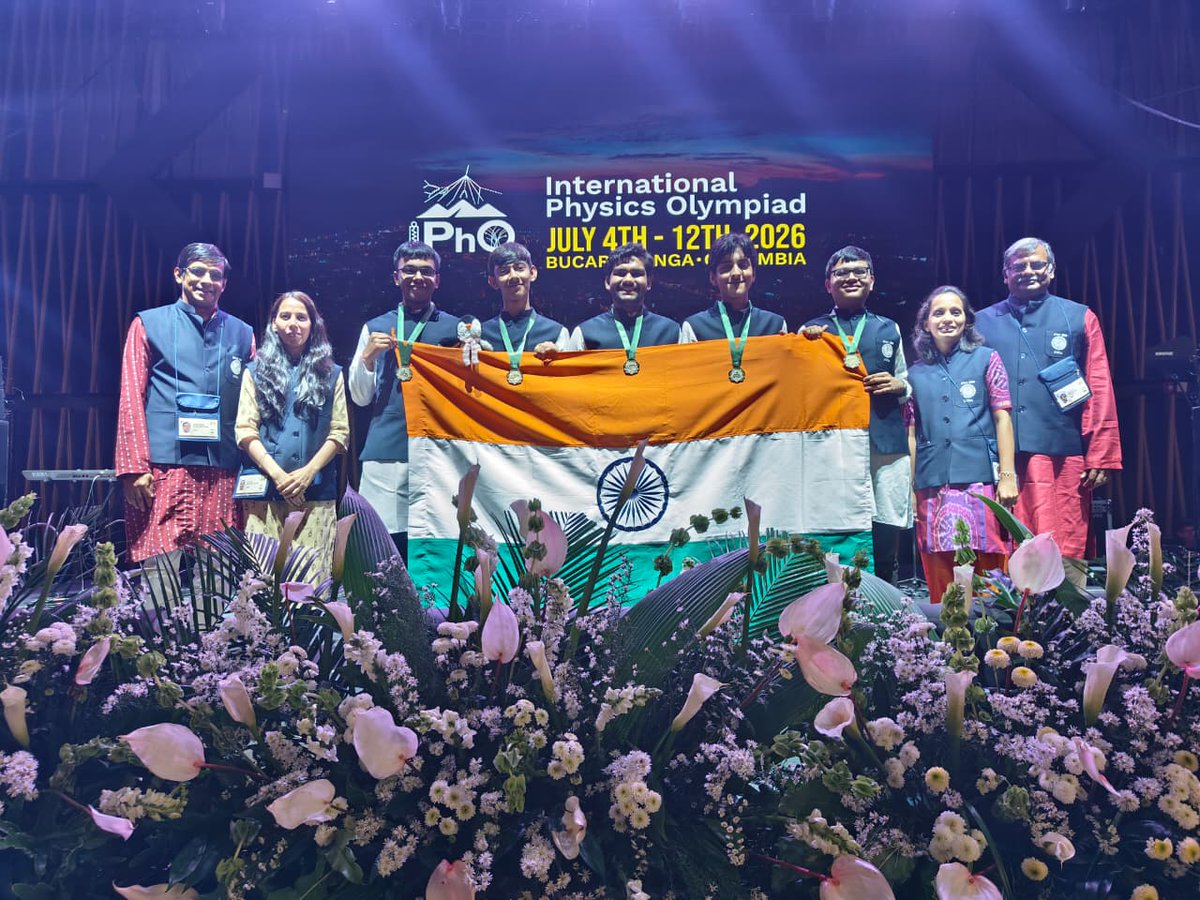
🇮🇳GOLDEN SWEEP FOR INDIA 🏆
All 5 Indian students win GOLD at the 56 International Physics Olympiad (IPhO) 2026 in Bucaramanga, Colombia -placing India at Rank #1 in the world (jointly with China, Kazakhstan, Russia, South Korea & Taiwan) among 381 students from 87 countries 1/5
Services are the future. Today we launched Ramp’s AI services motion.
It's easy to buy an AI subscription. It's hard to transform your company to actually run on agents.
Here’s our entire strategy.
1) Why now
Services are the new software (Sequoia)
Human labor TAM >> software license TAM. The market is bearish on seats and subscriptions.
Every enterprise AI company is doing this -- the labs have poured billions into services partnerships and their own deployment functions. Superintelligent models alone are not enough.
Palantir proved this is a strong business model: deeply embed engineers, build on top of a powerful platform, and customize extensively.
2) The real problem
Companies want AI. But the gap between "we have AI tools" and "agents run our workflows and we spend way less time" is enormous.
What we've found across over 50 companies we engaged with: agents start replacing real work when there is: complete data, read/write access across systems, agent-friendly policies. Most big companies struggle because:
- processes live in operators' heads
- dozens of disconnected systems (legacy ERPs, endless one-off excel sheets, etc.)
- archaic software with poor or no API access
Good data in the right place is a hard prereq to working agents.
Also, vibing in localhost ≠ a production system your enterprise can rely on. You still need hosting, ci/cd, observability, feedback loops, good interfaces. And taste to know what's even worth automating.
Everyone has a bulldozer, but most jobs just need a shovel pointed at the right spot.
What companies usually need is to be made agent-friendly. That's exactly what we do.
3) What we do
We focus on what Ramp does best -- finance.
And we embed FDEs that:
-> understand your problems
-> identify high-leverage, high-impact workflows that fit agents
-> scope the solution
-> connect your data
-> capture your context
-> deploy agents and often bespoke software for humans to collaborate with them
-> drive the business metrics that matter
Discovery and scoping are crucial. Building is easier than ever and thus judgement about what to build is more important than ever.
We're not a generic AI services arm, we're finance domain experts. Across the spectrum of financial operations, we help companies find and frame the problems worth automating -- similar to the taste a founder has in choosing which problems are worth solving (ex-founders make great FDEs).
Here’s the stack we deliver:
- Production infrastructure. Shipping an index.html from Claude isn't the same as creating a repo, hosting in a cloud service, ci/cd, testing, setting up evals, managing memories and skills, adding feedback loops, ensuring uptime, incident management, etc. Agents don't one-shot production systems yet. Production software is hard -- we build, host, and run it for you in a single-tenant, dedicated cloud environment. Most operators don’t have the time, knowledge, or experience to do this e2e. We help abstract the low-leverage plumbing so they can focus on the essential parts of their jobs.
- Data connectivity. Most enterprises have data lakes, but data is often incorrect, stale, or entirely missing. And write interfaces vary dramatically. Ideally we can use MCPs or CLIs, but usually it’s poorly documented APIs, SFTP, manual uploads, and email.
- A context layer. Things people have done for years aren't written down, so an agent can't do them until we capture that context -- ranging from simple policies to complex decisions. This usually involves creating policy documents, shared agent memories, and skills.
- Evals and feedback loops. How you know an agent is doing a good job, and how it improves over time.
4) Why Ramp AI Solutions
We focus on finance because it’s the vertical we know deeply, have structural advantages, and are most differentiated:
- Data. 70k+ customers use our core product, over $200B in annual payments, years of vendor data, millions of transactions and bills monthly.
- Money-movement primitives and partnerships. Global money movement rails, partnerships with banks, Visa, Stripe, etc. You don’t want to vibecode international wires for bill payments.
- An intelligence layer on top: fraud detection from hundreds of millions of expenses, PO-to-invoice matching, state-of-the-art OCR, and fine-tuned models for accounting coding, spend routing, policy review, etc.
Unlike the labs, we’re not incentivized to sell tokens.
Ramp is an AI fiduciary and an impartial broker to deliver AI that is:
- model-agnostic -- we benchmark all the leading models (labs, open source) and fit the right one to each task
- and token-efficient by design
Our main incentive is business outcomes -- which is Ramp’s mission, to save our customers time and money.
I’m extremely bullish about our motion, and the broad industry growth of AI-native services.
If you're a finance leader trying to be more agent-native,
If you’re interested in joining our FDE team,
I’d love to talk 🙂
Today, Ramp raised $750M at a $44B valuation.
Last time we grew this fast, we were 1/20th the size.
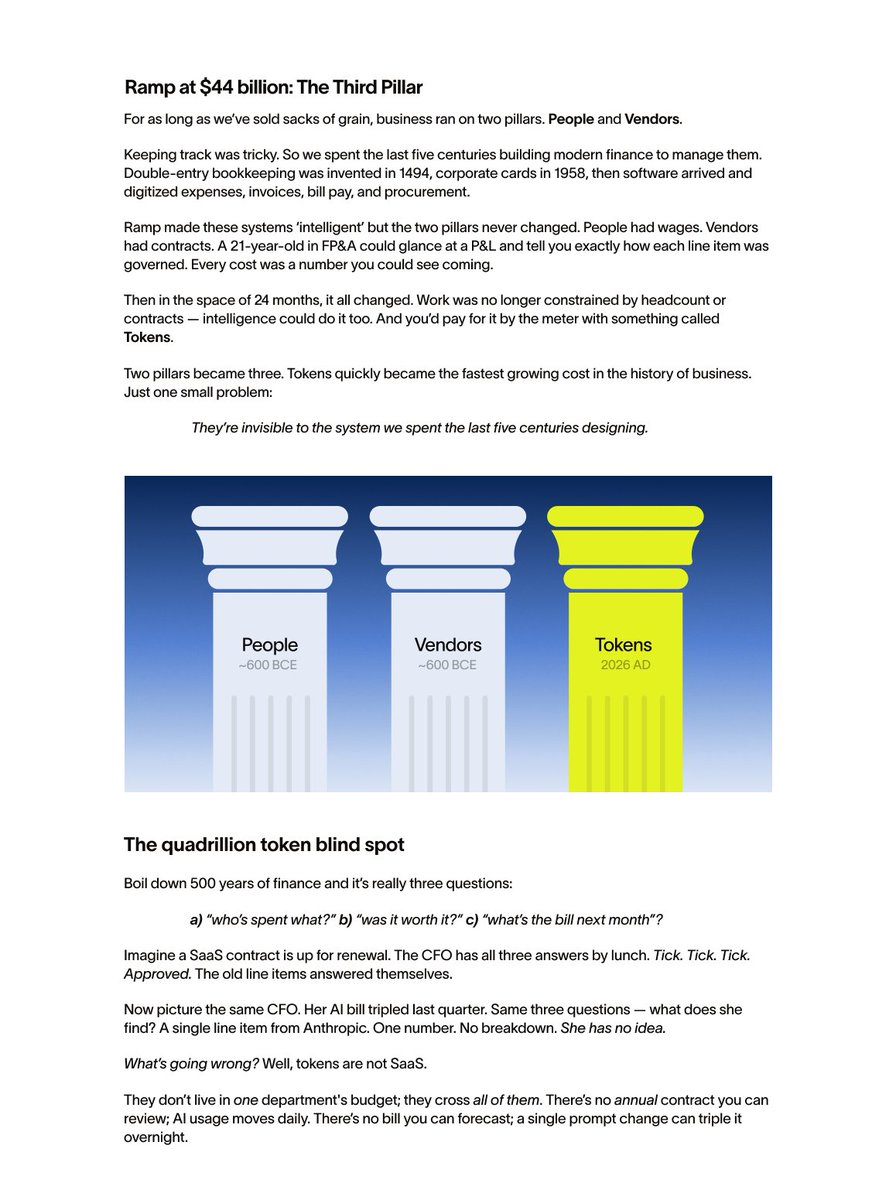
For 2000 years, business was built on two pillars. Today, a third: intelligence.
It’s your least governed cost. It’s also your single greatest opportunity.
Introducing Stack.
The AI operating system that lets accounting firms take on more clients without hiring. Learns your firm's process, runs the close, posts the journals. Fully auditable.
We’re living through the biggest shift in accounting since the spreadsheet.
N. Swaminathan, eminent artist and head of the Thevara Padasalai of Dharumapuram Aadheenam, will be honoured with the Padma Shri for his exceptional contribution to Tamil Pann Isai, traditional Thirumurai hymns, and the preservation of ancient musical discourses.
Celebrated as a supreme artist and 'A' grade All India Radio performer with an artistic journey spanning over 55 years, he has dedicated his life to carrying Tamil devotional music to global audiences across continents and releasing over 100 albums. He is deeply revered for his commitment to oral traditions, training generation after generation of students in the fine art of Thirumurai Isai at the grassroots level.
#PeoplesPadma #PadmaAwards2026
@HMOIndia@PadmaAwards@MinOfCultureGoI@pibchennai@airchennai
In this guest essay, Samridhi Seth and Nimai Verma examine how contemporary mythological fiction increasingly reinterprets the Hindu epics through modern ideological frameworks detached from their theological foundations.
Read: https://t.co/oh2R7aRHnA
Indian secularism is neither "indian" nor "secular." It is one of the biggest frauds committed on a giant population by its left wing elites who are conducting a weird sort of a live experiment on their human subjects.
In the 1985 Tamil classic 'Sindhu Bhairavi', the female lead challenges a Telugu kriti singer: "What's the point if the listener can't understand?"
That scene accidentally reinforced a myth — that Carnatic music must choose a language. 🧵
A recent article claims Swami Ayyappa was originally a 'local forest deity' later appropriated by Brahminical tradition.
The inscriptional record — from Pallavas, Cholas, Pandyas — says otherwise,
One key citation appears to have been invented. @tskrishnan
https://t.co/kFgMytIpQl
As usual, an article in The Print has appeared filled with factual errors, half-truths, and distortions about Ayyappa worship, with little evidence of any real understanding of its historical background.
Here is a detailed rebuttal intended to set out the factual position clearly and correct the record. Please read and share.
https://t.co/C8jte1ngSk
Part 1 of my 3-part series on how the Dravidian movement betrayed the Dalits of Tamil Nadu. I look forward to your feedback. Do read and share.
https://t.co/Vy62l2Wy29
This is a reimagination of the veena parts I played in "Phir Se", a song from the movie Dhurandhar - The Revenge.
Kindly use headphones 🎧
Original song composed by Shashwat Sachdev and sung by Arijit Singh.
The caps on my fingers are for a temporary injury.
Tempo as in the original ≈ 153 bpm
Audio recorded using the custom-made Buddha Systems pickup and ATM-450 microphone, in my home studio.
Video recorded with a Canon M50, edited in Davinci Resolve Studio.
@AdityaDharFilms@shashwatology@arijitsingh
#dhurandhar2 #ramanabalachandhran #phirse #veena #cover
By this logic, Top Gun: Maverick reflects a world Americans "browbeaten by years of Pentagon messaging" believe to be real. James Bond is 60 years of MI6 recruitment propaganda. Dunkirk is Churchill's ghost writing British exceptionalism into celluloid. Zero Dark Thirty literally had CIA officers on set.
But when those films release, The Economist writes about "the power of cinema to capture national memory." When India makes one, it's a symptom of mass delusion manufactured by a strongman.
Fifteen thousand Indian civilians killed in Pakistan-sponsored terrorism since 1970. A film dramatises it. The Economist's concern is not the terrorism. It's that Indians noticed.
Condescension this perfectly calibrated hasn't been seen since the last time someone in London explained to Indians what Indians actually think.