While waiting for DeepSeek V4 we got two very strong open-weight LLMs from India yesterday.
There are two size flavors, Sarvam 30B and Sarvam 105B model (both reasoning models).
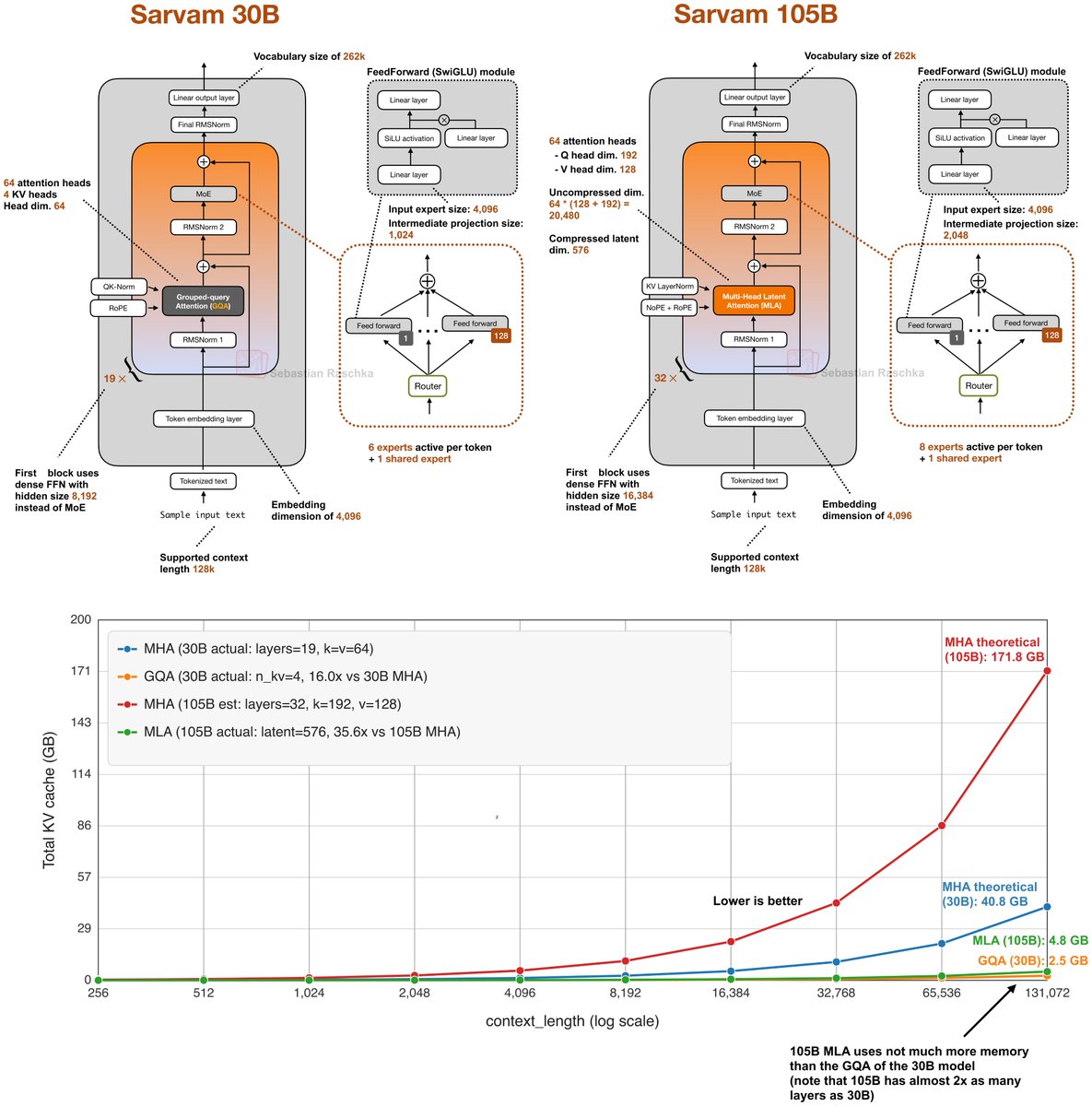
Interestingly, the smaller 30B model uses “classic” Grouped Query Attention (GQA), whereas the larger 105B variant switched to DeepSeek-style Multi-Head Latent Attention (MLA).
As I wrote about in my analyses before, both are popular attention variants to reduce KV cache size (the longer the context, the more you save compared to regular attention).
MLA is more complicated to implement, but it can give you better modeling performance if we go by the ablation studies in the 2024 DeepSeek V2 paper (as far as I know, this is still the most recent apples-to-apples comparison).
Speaking of modeling performance, the 105B model is on par with LLMs of similar size: gpt-oss 120B and Qwen3-Next (80B). Sarvam is better on some tasks and worse on others, but roughly the same on average.
It’s not the strongest coder in SWE-Bench Verified terms, but it is surprisingly good at agentic reasoning and task completion (Tau2). It’s even better than Deepseek R1 0528.
Considering the smaller Sarvam 30B, the perhaps most comparable model to the 30B model is Nemotron 3 Nano 30B, which is slightly ahead in coding per SWE-Bench Verified and agentic reasoning (Tau2) but slightly worse in some other aspects (Live Code Bench v6, BrowseComp).
Unfortunately, Qwen3-30B-A3B is missing in the benchmarks, which is, as far as I know, is the most popular model of that size class. Interestingly, though, the Sarvam team compared their 30B model to Qwen3-30B-A3B on a computational performance analysis, where they found that Sarvam gets 20-40% more tokens/sec throughput compared to Qwen3 due to code and kernel optimizations.
Anyways, one thing that is not captured by the benchmarks above is Sarvam’s good performance on Indian languages. According to a judge model, the Sarvam team found that their model is preferred 90% of the time compared to others when it comes to Indian texts. (Since they built and trained the tokenizer from scratch as well, Sarvam also comes with a 4 times higher token efficiency on Indian languages.
People with 90k following will post a lot of gyaan on twitter on a saturday morning
But won’t take out 10 minutes to try the model and share feedback
This is the reason why not enough people care, if you just use your following to criticize without even trying you are a part of problem
if you're still wondering how this model can make real-world impact - go build a bot for yourself using this model on @GooeyAI
Here's a nurse advisor i made in a few minutes https://t.co/OO8r139I3Y
@realpulkitgarg@theskindoctor13 One can say that even humans are unpredictable in nature. What if, after entering the lift the human assaults another person or does something nasty?
We don't create separate rules for humans right? More often than not, humans are worse than animals.
@realpulkitgarg@theskindoctor13 Very simply there is a talk of boycotting pet parents without actually providing proper solutions. How is boycotting helpful here? It would cause more anger than coming to an agreement. Have a separate lift or something else.
Messi is Barcelona. Barcelona is Messi.
You’re not celebrating any major club milestone without acknowledging the GOAT and everything he means to FC Barcelona.
He may have not been able to be there, but his presence is inescapable in the essence of the club.
Any “agentic” application is basically a computer program with LLM calls in the mix.
We think an agent orchestration framework should support any custom agentic use case, whether it’s some simple LLM routing calls or an entire ReAct agent.
@llama_index workflows have the following properties:
✅ Event-Driven: Reflects how each agent operates as a micro service
✅ Composable: Piece together granular workflows into higher-level workflows
✅ Flexible: Write logic through LLM calls or through plain Python
✅ Code-first: Express orchestration logic through code. Easy to read and easy to extend.
✅ Debuggable and Observable: Step through and observe states
✅ Easily Deployable to Production: Translate workflows into services through llama-deploy!
We have 10+ examples showing you how to build agents from scratch with workflows - you can also treat all of these as prebuilts and subclass as you wish. Check out the resources below!
Workflows intro guide: https://t.co/2QGP4ANhCL
Workflows reference guide: https://t.co/YnZYWKgdQj
A bunch of notebooks here: https://t.co/EBqoSRQl57
Both ColBERT and ColaPali(gemma) are model architectures and not a single model checkpoint.
It’s the approach and architecture that is interesting. We will see more checkpoints, trained smarter and with improved accuracy and efficiency. https://t.co/9FdTtgKJe3
What the fans did last night will be unforgettable. Not just the Argentines, even the Colombian fans. When they saw Leo Messi crying , they started chanting his name. This is something to be proud of. It is MESSI. He has won his love from all over the world.
HE IS THE GREATEST OF ALL TIME🐐❤️✅
I had a great time presenting the work we did at @Atlassian and how we used AI to make our search better.
It was great listening to other speakers and talking with the other attendees at @fifthel ! There's so much going on in the AI space and I'm glad that for this community!
Shashank presented an educational talk on Atlassian's Jira Service Management's latest advancements. Highlights include the transition from keyword-based search to AI-driven semantic search, achieving 94% accuracy in query understanding, and reducing latency from 23 to 9 seconds.