Introducing Dexto! Dexto is our coding agent built on the Dexto Agents SDK, our open agent harness designed for builders with a local-first, HIIL and extensible experience.
Choose from over 50+ LLMs (cloud & local support via Ollama or llama.cpp), connect to /mcp to expand capabilities and work with your local files. @dexto_ai
$ npm i -g dexto
Dusting off this tweet from April because this gap in shared understanding of LLM capability is *widening*. It's now less "two groups of people speaking past each other" and more a sharp funnel.
- Napkin math somewhere around 6B people (~75% of the population) have barely come in contact with LLMs at all.
- Around 1-2B (~20%) are casual and infrequent users of free-tier ChatGPT-like products. This group sees derpy chatbots and treats them a bit like a better Google search, a writing aid, or etc. Maybe an agent tries to book you a flight. I have non-tech friends who (reasonably, imo) say they have not much use for it at all. Even many professionals outside of math&code are in this tier. For example, execs and many other functions spend a lot of their time talking to other people, so while they understand what is happening intellectually, it is still second-hand and a bit abstract.
- Now we get to professional use of frontier-grade LLMs in math&code. Somewhere around 20M people (0.2%) see first-hand that large, complex projects that used to take them weeks/months can now be completed by agents with a prompt. Building apps, copying apps, translating apps, decompiling apps from binaries... This has all happened very quickly and recently - less than 1 year ago, I was writing code manually by hand, typing memorized computer code commands into a code editor character by character, occasionally pressing Tab to autocomplete a little chunk of code.
- And finally we get to the ~5,000 people (~0.00006%) with access to frontier-grade systems internally. The external world has seen the preview. It looks like swarms of thousands of agents collaborating over weeks on software mega projects: minting zero days, running cyber attacks and defenses at machine speeds, discovering new science, advancing the frontier of mathematics. Things that would have taken top professionals in the industry years of work. Meanwhile, human review and comprehension are starting to fall behind. For example, people are still involved in the "archeology" of the OpenAI-HF incident from many months ago. Mathematicians may be poring over the 722 manuscripts on frontier mathematics for a while.
The funnel is driven by a combination of factors:
1. The impact scales with ambition, problem size, and horizon. A question with a paragraph answer barely stresses the system. You need a reservoir of big, difficult problems that you really care about. This aspect drives the consumer / professional dimension of the funnel.
2. The jaggedness of the system (which I have written about a lot separately). Capability peaks in domains that are digital, verifiable and economically valuable. This is because LLM capability emerges from reinforcement learning on verifiable rewards on a curated environment mixture driven by revenue potential. This aspect primarily drives the area (e.g. math&code) dimension of the funnel.
3. Access. Free-tier, paid-tier, internal.
So this is the weirdness of the moment. The general public has mostly not interacted with these systems. When they have, it looks like a derpy chatbot. The majority of professionals still see only a modest uplift. And a small sliver of professionals are experiencing the vertigo of the curve going vertical. And it is all happening at the same time.
the next 6 months is going to have some really interesting, fresh products i think
models are now very capable but i don't think we are nearly extracting anywhere close to what it can really do
next breakout products will be those that come from people who have high taste, creativity and ability to push these models to give shape to their wildest ideas
the jump in model quality on long-horizon tasks over the last 2 weeks has been unreal
been using both gpt-6.1-sol and opus-5.5 and their ability to handle a task end-to-end is simply mind-blowing
one of the most understated opportunities of AI right now is helping people keep up with SOTA model capabilities
if you have find a set of people, who have a repeatable problem and can help them solve it, and continue to give them improvements in the form of making decisions around which model or skill or workflows to adopt based on new drops, there are whole new classes of underserved markets to be explored
OpenAI’s math release is, in the words of Opus, “the single most consequential mathematical release ever” *
LLMs have how made substantial progress on 4 of 7 Millenium Prize problems: Navier-Stokes (claimed), Riemann, Hodge and Birch-Swinnerton-Dyer. Poincaré was solved in 2003. The two left are P v NP and Yang Mills.
*conditional on verification
On average, each OpenAI result used only 3hrs of thinking compute on their new unreleased models.
Two years ago, models said 9.11 > 9.9. Today, we have results that the smartest human minds have not been able to achieve in their entire lives. It is clear that data, compute and algorithms scale. Every model generation (3mos) has made substantial intelligence progress.
It also becomes incredibly hard to not believe that all knowledge work will change monumentally over time. The things AI can not do in the foreseeable future are very likely context-bound (don’t have access to the right information) than intelligence bound. Some might argue they are also creativity-bound or judgement-bound (what should I work on), although it can be argued that future generations could solve for this (given, say, the advancement in research taste for models over time).
AGI is defined as surpassing human capabilities on virtually all cognitive tasks. By most interpretations of that definition, we are there. The domains humans are still better than AI, such as, robotics / physical world control (data-bound?), natural science research (data-bound), some creative domains like writing, movies, music (creativity-bound), super long tasks (context-bound), choosing problems to solve (creativity-bound) and maybe human relationships management (meat-proxy bound?).
In many ways, we have achieved AGI.
when we started building dexto, there were some very counter-intuitive assumptions that we made and was incredibly hard to justify at the time
but i'm glad to see that it's paid-off in incredibly compounding ways
i don't know if you guys are seeing this but the ai reverse engineering stuff that's going on in gaming is absolutely insane
apparently the ps5 is 96% ported to PC already
and tons of games across consoles - wolverine, bloodborne, mario have been ported to PC already. people are even making mashups of popular games
and all of this will be free
it's the wild west out here
engineering is NOT dead
engineering has always been the art of problem solving. it often combines first-principles thinking, literature, known methodologies and best practices from past experiences and other practitioners. this often involved years of studies, training and experience
in a world of ai, i don't think we have a shortage of problems. if anything, i only see there being a lot more
previously, cultivating an engineering mindset took years, maybe decades. this collapse in enablement is a GOOD thing since more people can now solve problems without having to wait years to learn or needing to find good engineers
in a world filled with problems waiting to be solved and with a magical-box called ai, i don't think it's been a better time to be a startup founder
up until even just 3 months ago, i feel like you had to do a lot of work in building your skills correctly
over the last month or so, i've realized good harness rails + what you want is sufficient for your agent to adapt, refine and create incredibly powerful skill trees
We’re releasing a broad range of new mathematical results produced by an internal frontier model.
We’ve been consulting with the independent Advisory Group on Mathematics and Artificial Intelligence at the Institute for Advanced Study, and we have drawn on their advice and public recommendations to inform how we release these results.
https://t.co/7N6TPlft1P
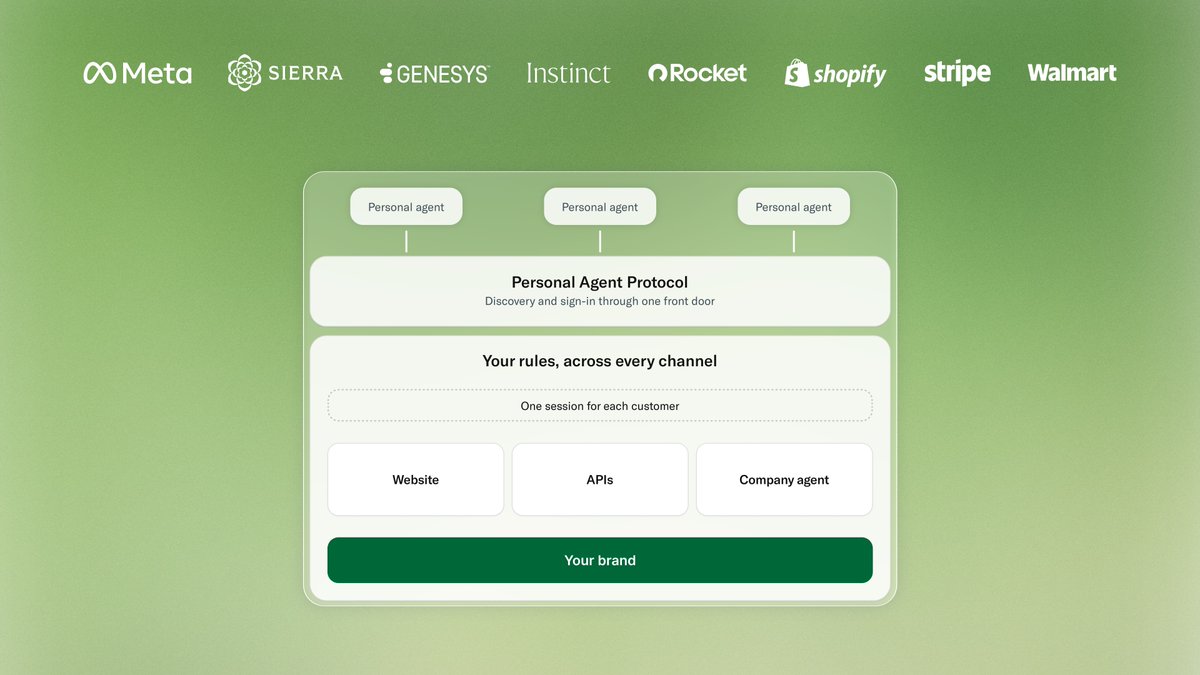
Today we’re announcing Personal Agent Protocol — an open standard @Meta and @SierraPlatform are developing along with industry partners at @Genesys, @instinct, @RocketOTD, @Shopify, @stripe, and @Walmart. It will help define how personal agents interact with businesses and is open for anyone to implement. You can read more here - and if anyone is interested in joining let me know! https://t.co/Yb90VEHMnn
everyday, i am so glad i spent time in college working on robotics and autonomous driving
designing agents, multi-agent swarms, etc. is almost all the same systems design principles adapted to the quirks of LLMs
You don't have to commit your entire life to optimism, just try it on for a week. Start thinking "what if it all worked out?" and "what a time to be alive!". Then compare your state of mind to the week before filled with pessimism and doomer nonsense.
inference is becoming a market-making business
upstream, GPU capacity is bought in chunks: financed, contracted, take-or-pay, multi-year
downstream, tokens are bought on demand
warehousing the mismatch between the two means forecasting demand, absorbing idle capacity, and repricing compute into tokens
neoclouds are moving down into inference and inference providers are moving up into GPUs whoever can make a market between fixed capacity and variable demand takes the spread