@bbcnickrobinson why ask about a report you haven’t even read?
You repeatedly get the definition used in that report wrong. Goodwin's report is based on the ONS ethnicity question which is self-identified. The King would likely identify as White British.
Shockingly poor "journalism", I've complained to the
@BBC. No wonder public trust in BBC News is so low.
Is King Charles “a white Briton” ? I ask the leader of @RestoreBritain to explain why his warning that Britain is becoming an Islamic country is based on a report which suggests he’s not.
The EUSS was a wildly expansive disaster. It gave EU nationals more rights to bring family to this country than British citizens -- adult parents, siblings, grandparents and even relatives (!) from non-EU countries could qualify as dependants! Just madness.
What supermarket companies like Tesco and Sainsbury’s have to realise is that ‘playing nice’ with the British government won’t get them anywhere. It’s time they fought back by publicly rebuking the liars and cheats in government and explaining, in clear terms, how the government drives up the cost of everything to the ordinary person’s detriment.
I’m reluctant to get into an argument with @profbriancox, who is a great advocate for science. But I would like to stand up for UKRI’s strategy here, which I think is trying to do something really important – both for curiosity-driven research and for the wider benefits that research and innovation can bring to everyone in the UK.
(Fair warning: if you’re expecting a snappy 280-character tweet, this is not one.)
Everyone knows that Britain has a proud track record of amazing basic research; we’re 0.8% the world’s population and 8.4% of the academic citations. If scientometric stats don’t do it for you, consider some of the greatest hits. The Human Genome Project, the RECOVERY trial, gravitational waves, AlphaFold, graphene – all significant breakthroughs of recent decades with a big UK contribution.
But the UK’s track record of successful innovation – of translating research into real-world impact, or of doing applied R&D for practical benefit – is more mixed. I’d like to see more R&D-intensive businesses in the UK creating good jobs, drawing on the UK’s scientific expertise. And a stronger connection between research and its application, to make the most of the potential of great research to improve people’s lives.
The point of UKRI’s strategy is to invest in curiosity-driven research, while also doing a better job of backing translational R&D to improve people’s lives and drive economic growth. Prof Cox argues this is ‘short sighted’ and ‘short term’. I strongly disagree. Take our investment in Quantum Research Hubs and the wider quantum research strategy. These build on 20+ years of research council investment in quantum research, and combine pure scientific research with application, and also links to quantum start-ups, established businesses, public procurement, investors, and the Government’s wider industrial strategy.
So I think UKRI’s strategy is the right thing to do in the national interest. I also think it’s the right thing to do pragmatically, even if all you care about is curiosity-driven research.
To explain why, we need to talk about the process how the government allocates investment, including for scientific research. I hope I’m not giving away anything I shouldn’t. At fiscal events like the 2025 Spending Review that determine UKRI’s current budget, organisations like UKRI aren’t given a pot of money and told to spend it how they like. The spending negotiation is about “how” as well as “how much”.
My reading of last summer’s negotiations is that the financial settlement for R&D – which as Prof Cox says was ‘quite generous’, especially at a time of straightened public finances – would have been significantly less generous if UKRI and DSIT had proposed to focus spending purely on curiosity-driven research, and that had we done that, curiosity-driven research would now be in a worse position, not a better one. I don’t say that because the last Government (or the previous Government for that matter) are against curiosity-driven research; on the contrary, they’ve been great advocates for it. But there are many other demands on the public finances, and all the research I’ve seen (and indeed, that I’ve done) on voters’ feelings about science is that application – and the practical benefits science brings – really matter to a lot of people. What happens in future fiscal events is obviously the new Government’s choice, but I’d personally be surprised if they see this issue radically differently, and as Prof Richard Jones has observed, no-one should take generous research budgets for granted.
So my case is that the UKRI strategy, and its focus on advancing knowledge, improving lives and driving growth, is the right thing to do from a national perspective, *and* would also be the right thing to do even if all you are interested in is curiosity-driven research. If you’ve made it this far, thanks for reading.
I've written about the small number of French nuclear plant shutdowns in the recent heatwaves on Substack...and why its not really to do with nuclear. Link in reply.
I have alot of sympathy for UKRI who have to make hard funding decisions - but whether it's from them, local funds, or philanthropic and commercial efforts Jodrell Bank and The Lovell Telescope simply must be kept both operational and supported as a home for science.
The strategic case is overwhelming: The Lovell Telescope is the third-largest steerable radio dish on Earth, it does space debris & satellite tracking, satellite capability inference and provides defence from GPS-spoofing all of which are now critical defence capabilities as well as significant commercial opportunities for the UK.
And beyond the immediate importance of that work, e-MERLIN gives us reciprocated access to a global research base, astronomy data to power further research and perhaps most importantly continues to inspire over 130,000 visitors & 20,000 schoolchildren a year.
This can't be turned off and back on in a few years if we change our minds on scientific priorities - it's a one way ticket and I am sure there's a path to avoid what would be a huge loss on many fronts.
@Alph4betSoup Keep going! You are doing good work. UKAS date setup is ridiculous. Face recognition is too invasive to be handled by only the rules of private companies.
Pakistan has its own space programme, yet we send it £133 million a year in aid while shutting down Britain's largest space telescope because we “can't afford” a few million.
This telescope helped inspire generations of scientists.
If we keep cutting investment in our own scientific infrastructure while other nations push ahead, we'll only fall further behind.
I hope this decision is reversed. Britain should be investing in its future, not dismantling it.
@nida_banou@BrennpunktUA Ein Foto finden Sie unter folgendem Link: https://t.co/gzhjx9qVx6
Aus datenschutzrechtlichen Gründen können wir dies nicht direkt auf Social Media teilen.
At present, local councils keep 50% and get some of the other 50% back through revenue support grants. That's not enough fiscal autonomy.
At the same times, there needs to be a central approach to social care - it's too big and difficult for local councils to deal with (it's their biggest liability). We'll see what Andy Burnham comes up with.
There should be greater investment-backed insurance to cover more of social care (as well as pensions and health insurance), not enough of our liabilities are backed by investments.
It would be better to allow local authorities to retain 100% of business rates revenue. This would give local leaders more fiscal autonomy and an incentive to back development in their area.
This is the norm in the US and on the Continent - in France, local authorities wanted nuclear power plants in their backyard as they captured all the property tax.
"Just 5 per cent of tax revenue stays with mayors and local authorities, while 95 per cent goes directly to Whitehall.
Britain also has the lowest local government funding via taxes of any of the G7: just 19 per cent of revenue comes from levies."
UK Civil Service salaries never cease to confuse me, you can either help manage the UK’s nuclear defence for £47k or you can make TikToks for Andy Burnham for £57k
1. Transfer the tens of billions earmarked for net zero to defence and supply chain resilience, to create a major industrial/defence sector, thereby creating skilled jobs in UK, rather than China (as net zero does)
2. Radical tough love welfare reform to get 1m people of working age into work, thereby cutting the welfare bill and increasing the tax base. Coupled with massive expansion of German-class STEM skill apprenticeships.
3. Radical reform of planning laws to stop nimbys/greens from thwarting every major infrastructure development. Put judges/courts in their place when it comes to such matters.
4. Put rocket boosters under high-speed rail link between Leeds-Manchester-Liverpool. Brook no opposition/delay.
5. Unleash North Sea oil/gas + slash energy bills by removing all green levies. New breed of gas-fired and smaller nuke generating stations.
Much more to suggest. But this should be good for starters.
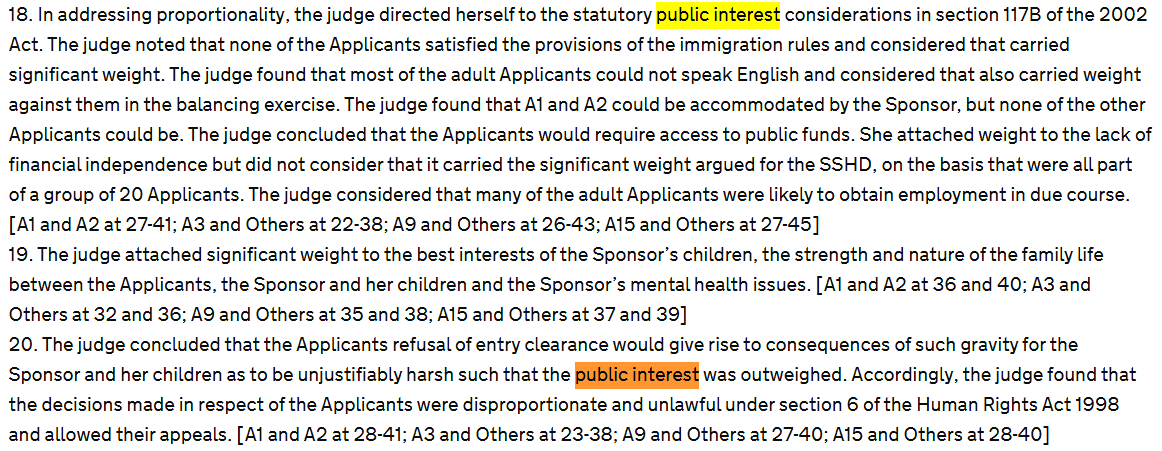
The judge accepts that it's not in the public interest because the family (a) does not meet the immigration rules, (b) cannot speak English, and (c) would require public funds, but decides that the mental health impact on the Gazan woman in the UK outweighs the public interest.
The reasons can be debated (eg incorrect sentencing guidelines for each offence, heavy-handed approach to speech that the state does not like) but the outcomes are wrong and feel like two-tier justice
Kiran Kaur will serve less jail time than Lucy Conolly due to a shocking two-tier loophole.
The mother of Henry Novak’s murderer got three years today for hiding the weapon her son used to repeatedly stab Henry Novak to death.
She would normally serve just 40% of that sentence due to early release rules. But it gets worse…
Buried in the judgment, the judge says Kaur may qualify for “Home Detention Curfew”. That means on top of her early release, she can be released on house arrest 180 days before the 40% point.
Put simply, Kiran Kaur will serve just 8 months for her role in Henry’s murder.
To put that into context, Lucy Conolly served over 10 months for one badly worded tweet. Unlike Kaur, she was told that her offence made her “presumed-unsuitable” for house arrest.
I’m sorry. But this looks like another case of two-tier justice to me.
Kaur conspired with her son as he sought to smear Henry as racist he lay dying on the street.
Frankly — as an Indian national — she should be deported to serve a very lengthy sentence in her country of origin.
But to let her off with house arrest, when it was denied to others, would be an outrage.
Keir Starmer — ever a man of his word til the end.
In June 2023 he explicitly ruled out ever indulging in a resignation honours list (BBC Radio 4 Today).
Today he’s marked his resignation with 21 peerages, overwhelmingly public-sector/legal jobsworths. Barely a single wealth creator among them.
Classic line up of the New Establishment which has run the country under Labour and Tory governments for the past three decades and is now firmly in control. Largely (if not entirely) with the following characteristics:
*Career almost entirely in public sector, often taking salaries from several sinecures at once as they work up the greasy taxpayer-funded pole.
*Associated with various ‘right-on’ causes.
*Largely middle class, London chattering class, Oxbridge well represented (of course).
*Fashionable left but not too left. Good mainstream Labour links.
Thus is the antediluvian House of Lords perpetuated by the Left as well as the Right as a comfortable state-funded retirement home for the well-connected ‘good and great’ past their sell-by date — when it should simply be abolished.