Day of Remembrance for Herman of the Cherusci
Today we take a moment to honour a man whose leadership allowed the Germanic tribes to defeat 3 Roman legions in the dark forests of Germany.
Herman, known at times as Arminius, was that man. The son of a German nobleman, Herman served in the Roman army and learned their tactics and capabilities firsthand.
In the fall of 9 AD Herman (only 25 years old) led a confederation of German tribes that defeated three Roman legions in a three day long battle that decisively stopped the Roman takeover of all of Germany. Over 20,000 Roman soldiers perished there in the Teutoburg Forest. Rome would from then onward stay out of Germany proper.
Herman's tale is one that should still inspire us today....... A hero's tale for the ages. A young lad responsible for keeping the Roman Empire out of Germany proper for another generation or two and letting the German folk, his folk, keep their freedom for just a little while longer.
Probably every age goes looking for a hero to rally around. A King Arthur, a Beowulf or Sigurd, a Widukind or a von Richthofen. Today we are a people again in need of a hero, a man among men who can rally our folk and unite us together as Herman once did against the onslaught of modernity. Let his example, and that of other heroes of our folk, inspire us to always strive to be more as individuals and to do more to aid our Gods and folk.
Raise a horn today in honor of Prince Herman of the Cherusci.
Hail Herman!
-Goði Blaine Qualls, RFU
The only true heritage Americans are people with deep ancestry from here. The rest of you are foreigners in our land.
Hispanics, Asains and Africans are not the core of America and we must be able to say that not matter who it offends.
25% of all Mexicans live in the US. 70% rely on welfare.
10% of Guatemalans live here. 77% are on welfare.
12% of Nicaraguans live here. 75% rely on welfare.
12% of Haitians live here. 53% rely on welfare.
When the United States was run by White guys without a Jewish federal reserve system- 1776-1913, the prices were roughly the same from the Start of the country till WW1.
Once the Jewish federal reserve system was set in place, coin clipping at government scale began.
Because this system is more complex and intentionally harder for the Goyim to understand, it makes it easier to transfer Wealth from the founding stock to the newly arrived Jews.
Most Jews arrived in this country from 1880-1920. If you were to map a chart of side by side wealth of Founding stock Americans vs the Jews post federal reserve, you would notice Jewish wealth slowly but surely parasitically outstripping the wealth for this countries citizens until we get where we are today… a Jewish run oligarchy.
The federal reserve is working exactly as intended.
Odin knows what is coming.
He understands fate. He knows that Ragnarok cannot simply be ignored, and he knows what waits for him at the end of that road.
Yet his response is not resignation.
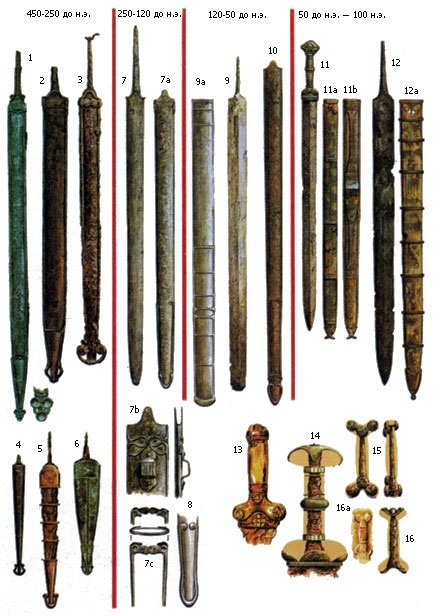
Rather than relying on a single Roman account, I researched the strength of Celtic swords a few years ago.
Firstly, most popular Roman style of sword was just imitations of Celtic swords. Gladius is the chief example. The name is from Celtic *kladiwos ("sword"). Why would they be copying inferred weapons?
Secondly, this was the Iron Age, and it is called that for a reason. It isn't the high carbon Steel Age. Iron can break. Making an iron sword that is designed to bend rather than break is an advantage. This concept survived into Irish folklore, where the legendary smith is able to forge a sword that can be bent in either direction rather than break.
The longer the sword, the more pressure is placed on it in combat. By the middle La Tène period, mainland Celts were making swords as long as medieval arming swords. By Late La Tène, the size was even longer. The size was partially influenced by cavalry combat. In order not to break, they had to be made with skill.
The swords showed a range of quality differentiation. In other words, there were cheeper swords that the less wealthy had, and very find swords possessed by elites.
Most of the swords were forge-welded and piled. This involved fusing different strips of iron together to make a stronger blade, folding them to hammer out and evenly distribute any impurities.
Not infrequently they would specifically fuse layers with different properties, creating the core out of a softer shock absorbing low carbon iron, while high carbon steel plates were fused into the cutting blade. The result was a blade that could withstand heavy shock (and thus bend) but hold a deadly sharp edge.
This is the exact same process used in the creation of Japanese katanas, which many people regard as excellent sword, but they were doing it more than a thousand years before the Japanese.
Eventually Romans were able to make stronger swords because they developed blast furnaces able to smelt iron and create pure steel. However, until that time the Celts could create the best swords anywhere in the world. That doesn't mean every single sword they made was great though.
In regard to the account of vending a sword on the battlefield, this probably did happen. I recently saw a video where a Japanese sword master did exactly the same thing when doing a cutting demonstration. Some novice was trying to make a cut and kept failing. He comes over, places his foot on the blade, straightens it, then makes repeated excellent cuts.
Germanic immigration law…
Under Clovis’s Salic Law, if one wanted to settle in a village, he required the approval of every resident, and only once he made it through a year with no objections did he become a resident. One objection, he’d have ten days to leave or face the Þing.
The U.S. House will be in session only 4 full days from July 24th to November 8th.
That’s 100 paid days off versus 4 full workings days plus 4 travel (half) days.
Meanwhile TRUMP says YOU have too many holidays.
One of our Founding Fathers looked at the finished Constitution and said he "would sooner chop off his right hand" than sign it.
His name was George Mason, and he was George Washington's neighbor, a few miles down the Potomac from Mount Vernon.
He was no bystander. Back in 1776 he'd written the Virginia Declaration of Rights, the document Jefferson drew from for the words "all men are created equal."
At the Constitutional Convention in 1787, Mason saw a problem. The new Constitution created a powerful federal government, but listed no protections for the individual. No guarantee of free speech. No free press. No freedom of religion. No trial by jury.
Days before the signing, he proposed adding a bill of rights but the convention voted him down. Unanimously.
In response, Mason refused to sign. He was one of only three delegates who wouldn't. Mason rode home to Virginia "in an exceedingly ill humor." His decades-long friendship with Washington never recovered.
But he his vision ended up winning. James Madison introduced ten amendments in the first Congress, drawn straight from Mason's Virginia Declaration of Rights. They were ratified them in 1791 and called the Bill of Rights.
The freedoms Americans cherish most came from the man who initially lost the vote, refused to sign the Constitution itself and went home angry.
@DanDavisWrites I stopped sending money to your Patreon and unfollowed you everywhere due to your promotion of this. Our men’s group has the same distain over your ineptitude.