Creator of Hackers Dreams and Kaizo Veteran.
Working on @InpulseGame, a musical rocketjumping platformer where the pitch of your notes determines your moveset
obscure music theory fact of the day:
Take any scale with 7 notes in it and reverse the interval sequence. The scale you get is a mode of the original if and only if one of the other modes is a palindrome.
This works in arbitrary equal-tempered tuning systems, but the number of notes in the scale must be odd (e.g. half-whole diminished is a counterexample but has 8 notes in it)
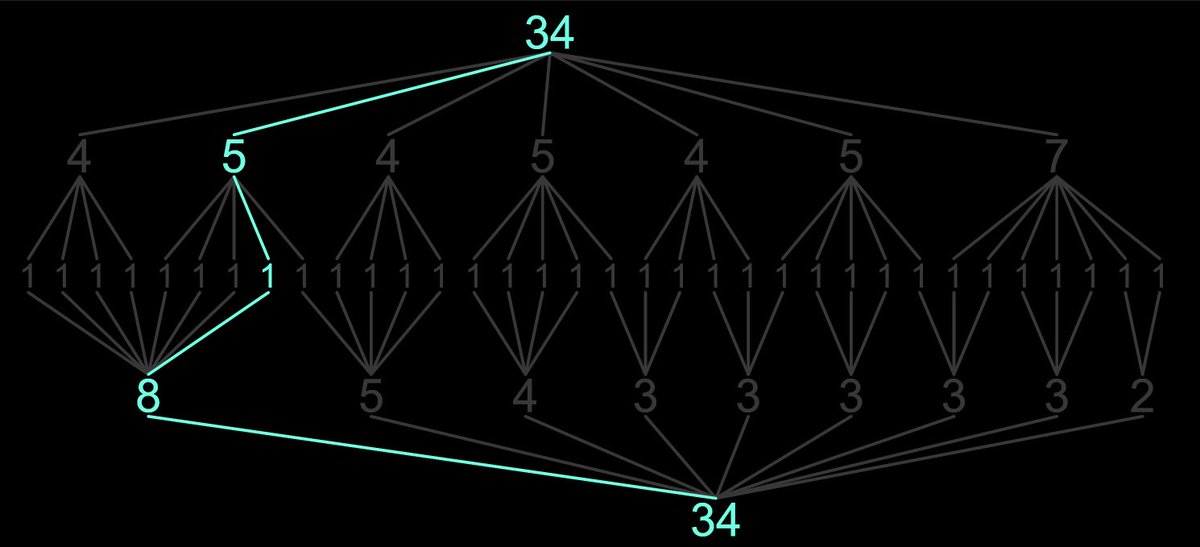
In music theory, the 5th scale degree is known as the dominant. It plays a crucial role in establishing tonality.
In Inpulse, the 5th scale degree is known as the laser and plays a crucial role in making you ZOOM REALLY REALLY FAST.
what do you mean by difficult?
that could mean its alien or unintuitive, which is just another way of saying its not closely related enough to things you have a familiar grasp on. you solve that by slowly pushing your frontier of experience outward incrementally. ("abstract" is a special case of this)
it could mean it contains too many components interacting at the same time. you solve that by treating subsystems as a single black box once you understand those parts separately. also a familiarity thing.
it could mean, as in a proof, a need to fill in and connect n missing dots from beginning to end, where n is large. again you gain enough familiarity that the dots don't seem as invisible and then suddenly the number of ones you gotta fill in shrinks.
all of those things have the same solution, namely sharpening your intuition through experience, and building good mental models. the application of that advice is separate in each case, but its still kind of the same thing each time. it doesn't seem like a talent or intelligence thing in my experience, its just familiarity with a given pattern type and the efficiency of your mental model for that pattern.
Once again, Bill Thurston is the guy to read up on regarding this.
@TonyTheLion2500 so the group of deck transformations of the universal cover of X is the same as pi1(X), and you get a galois-theory sorta thing where the subgroups of pi1(X) fit together in a way that matches the way the covering spaces of X fit together
@TonyTheLion2500 not really my subject but I think you can use the jet bundle to define PDEs on fiber bundles, no? you might be asking something deeper, idk.
in the rationals 3, 3.1, 3.14, 3.141, ... does not converge but gets arbitrarily close together (the condition OP posted). One way to define a real number (e.g. pi) is as an equivalence class of such sequences which "would converge to the same thing if there weren't a hole there".
https://t.co/EaG66X6bvM
off the top of my head:
all of master courses
springboards and shells
swiss hotel
swissotel
missingno
worldpeace tubular
most of ferpy's levels (everywhere else specifically)
most of sweetdudes levels
most of tithered with some major exceptions
"my qldc level"
bramble levels from vip 3
@TheSph3ricalCow@martinmbauer can you provide a code snippet integrating f(x) = 1 on irrationals 0 on rationals from 0 to 1? should be interesting since every float evaluates to 0 and it integrates to 1...