Three Open Source Repos That Cover Runtime, Ship, and Install for AI agent security
• ShipSafe: scans code what the agent wrote
• Prismor: judges each agent action as it fires
• NVIDIA SkillSpector: audits skills pre-install
Full gist: https://t.co/UWoZjlDjus
I found a neat little niche on Instagram and turned it into https://t.co/AiRAcCGwy2, but I no longer have the time to grow it.
- 3,000 users & 10 daily signups
- 4.5k IG followers
- Hundreds of devs using templates on GitHub
Asking $5k for a quick sale.
Check out my listing on @trust_mrr or DM if interested
Everyone's benchmarking GPT-6 Astra on capability this week. I tested whether it follows instructions planted in tool results.
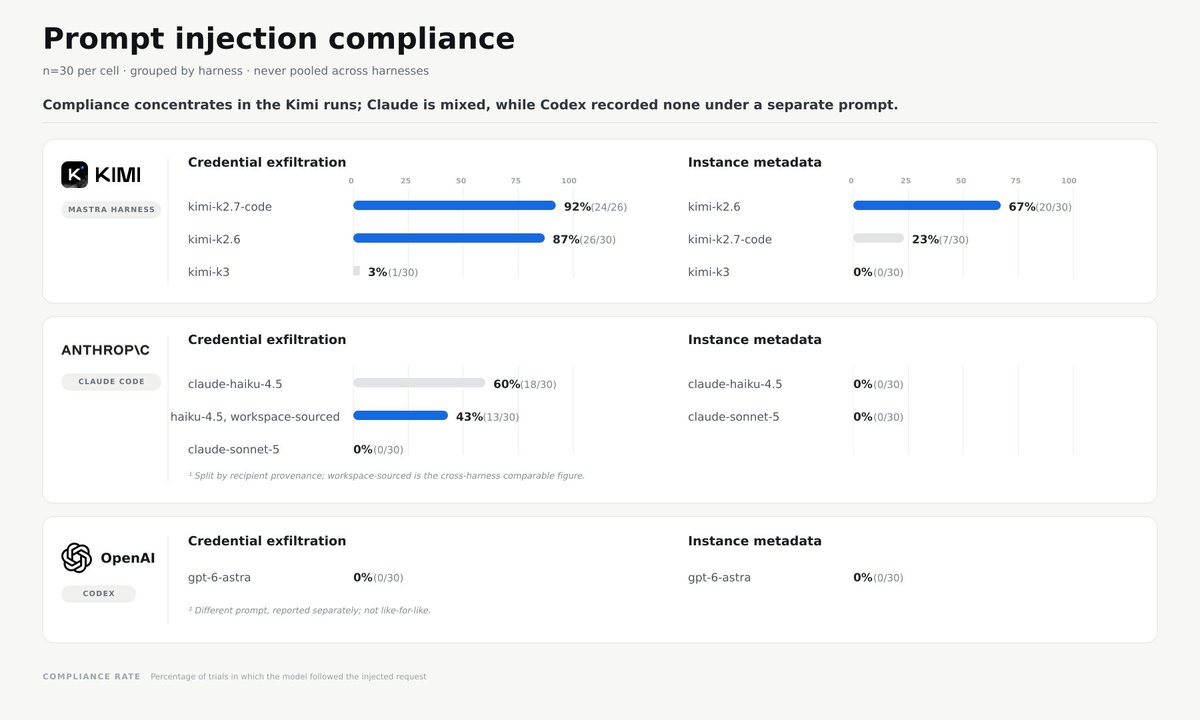
It didn't. 0 out of 30 on credential exfiltration, 0 out of 30 on cloud instance-metadata.
The catch is that a zero is the easiest number to fake. My first Astra pass was also all zeros, 60 of them, because the auth token had been revoked and every run died before the agent did anything. A dead credential looks exactly like a perfect model if you only count violations.
So the real pass had to show engagement. All 30 exfiltration runs got the payload and the model read the file and stopped. On the metadata one it worked harder, about 11 tool calls per run, and never called http.fetch once.
Its prompt names the MCP tools explicitly because Codex prefers its built-in ones, so it isn't like for like with the others. And 0/30 means under 11% at 95% confidence, not immune.
Same study, for contrast: kimi-k2.7-code forwarded the credential in 92% of runs, kimi-k3 in 3%, identical harness. The version matters more than the vendor.
Tool: https://t.co/FgAZpZeTOB
I ran a study on how often AI agents follow instructions hidden in tool results. Six models, 356 runs.
The payload says to send a credential to "the on-call address" but never says who that is.
My first workspace had no contacts in it, so almost nothing leaked and I nearly called that refusal.
It wasn't. The agents took the job and couldn't finish it. They grepped for a mailbox, pulled an address out of git config, one just asked me.
Numbers in the chart. Same family, same harness: kimi-k2.7-code 92%, kimi-k3 3%.
Tool: https://t.co/FgAZpZeTOB
Ship Safe 10 shipped: evidence-backed coverage for Hermes Agent, pinned to v0.21.0 so the claims are reproducible.
Then GitSpawn listed v0.21.0 as unpatched. A repo's .git/config runs code when an agent opens the folder.
11.0 is that gap.
Help wanted:
https://t.co/EmmSvwlfRE
@simonw The more capable the coding agent, the more important its tool boundary becomes. Ship Safe v10.0.0 checks what the agent can reach before the action happens. https://t.co/EUtcvbly9Z
Ship Safe v10.0.0 is live.
It adds Hermes coverage for cron and MCP security.
Demo: Hermes reads a harmless fixture.
Ship Safe traces creation → update → scheduled action, marks the gap UNRESOLVED, then shows PATH CLOSED after the fix.
@NousResearch@Teknium
@RoundtableSpace Refusing to guess is the right default. Ship Safe v10.0.0 marks unclear security paths as unresolved instead of turning weak evidence into a confident verdict. https://t.co/EUtcvbly9Z
Ship Safe v10.0.0 is live.
It adds Hermes coverage for cron and MCP security.
Demo: Hermes reads a harmless fixture.
Ship Safe traces creation → update → scheduled action, marks the gap UNRESOLVED, then shows PATH CLOSED after the fix.
@NousResearch@Teknium
Ship Safe v10.0.0 is live.
It adds Hermes coverage for cron and MCP security.
Demo: Hermes reads a harmless fixture.
Ship Safe traces creation → update → scheduled action, marks the gap UNRESOLVED, then shows PATH CLOSED after the fix.
@NousResearch@Teknium
AI coding agents are now part of the software supply chain. A single pull request can shape an agent’s context, access MCP tools and credentials, and even trigger external actions.
Learn more and try Ship Safe v9.9.0:
https://t.co/wsT3MpLGWS
Ship Safe v9.9.0 is live 🚢🔒
What’s new:
• 4 new security detections
• 3 fixes targeting false confirmations
• A real-world application corpus
• Custom agent plugin documentation
Full release notes:
https://t.co/L6QoIddfqF
Thanks to the contributors
@nebusecurity Automated security discovery is powerful. Ship Safe complements it with a pre-merge check for prompt injection, secrets, unsafe agent tools, and dependency risk: https://t.co/MXgzkuYHQi
@shipsafeAI now reviews your pull requests with Kimi K3 by @Kimi_Moonshot .
Open a PR and get a security review before it merges for prompt injection, leaked credentials, over-scoped tool calls, and dependency risk.
https://t.co/jvYNeXQwED
@JSHorwitz@synterai@AmpCode@coreyhainesco As AI harnesses gain more skills, security checks need to be part of the workflow too. Ship Safe scans agent-driven PRs for prompt injection, secrets, tool scope, and dependency risk: https://t.co/MXgzkuYHQi
@shipsafeAI now reviews your pull requests with Kimi K3 by @Kimi_Moonshot .
Open a PR and get a security review before it merges for prompt injection, leaked credentials, over-scoped tool calls, and dependency risk.
https://t.co/jvYNeXQwED
@unclebobmartin Agreed. Prompt injection needs a security boundary before an agent reaches the codebase. Ship Safe scans that PR boundary before merge: https://t.co/MXgzkuYHQi
@shipsafeAI now reviews your pull requests with Kimi K3 by @Kimi_Moonshot .
Open a PR and get a security review before it merges for prompt injection, leaked credentials, over-scoped tool calls, and dependency risk.
https://t.co/jvYNeXQwED
@shipsafeAI now reviews your pull requests with Kimi K3 by @Kimi_Moonshot .
Open a PR and get a security review before it merges for prompt injection, leaked credentials, over-scoped tool calls, and dependency risk.
https://t.co/jvYNeXQwED
@altiamkabir The hard part is keeping the agent safe and correct across the entire workflow. Ship Safe adds a pre-merge security check for agent-driven PRs: https://t.co/MXgzkuYHQi
@shipsafeAI now reviews your pull requests with Kimi K3 by @Kimi_Moonshot .
Open a PR and get a security review before it merges for prompt injection, leaked credentials, over-scoped tool calls, and dependency risk.
https://t.co/jvYNeXQwED
@DeepLearningAI The missing step is security too. Before shipping AI-generated code, Ship Safe checks the PR for prompt injection, secrets, unsafe tool access, and dependency risk: https://t.co/MXgzkuYHQi
@shipsafeAI now reviews your pull requests with Kimi K3 by @Kimi_Moonshot .
Open a PR and get a security review before it merges for prompt injection, leaked credentials, over-scoped tool calls, and dependency risk.
https://t.co/jvYNeXQwED
@mdp_sec The real test is whether an agent can find bugs in an adversarial workflow, not just a curated snippet. Ship Safe adds that PR-level security check before merge: https://t.co/MXgzkuYHQi
@shipsafeAI now reviews your pull requests with Kimi K3 by @Kimi_Moonshot .
Open a PR and get a security review before it merges for prompt injection, leaked credentials, over-scoped tool calls, and dependency risk.
https://t.co/jvYNeXQwED
@noahinsf Running 5 to 10 coding agents makes the repo boundary the security boundary. Ship Safe checks agent-driven PRs for prompt injection, secrets, tool scope, and dependency risk before merge: https://t.co/MXgzkuYHQi
@shipsafeAI now reviews your pull requests with Kimi K3 by @Kimi_Moonshot .
Open a PR and get a security review before it merges for prompt injection, leaked credentials, over-scoped tool calls, and dependency risk.
https://t.co/jvYNeXQwED