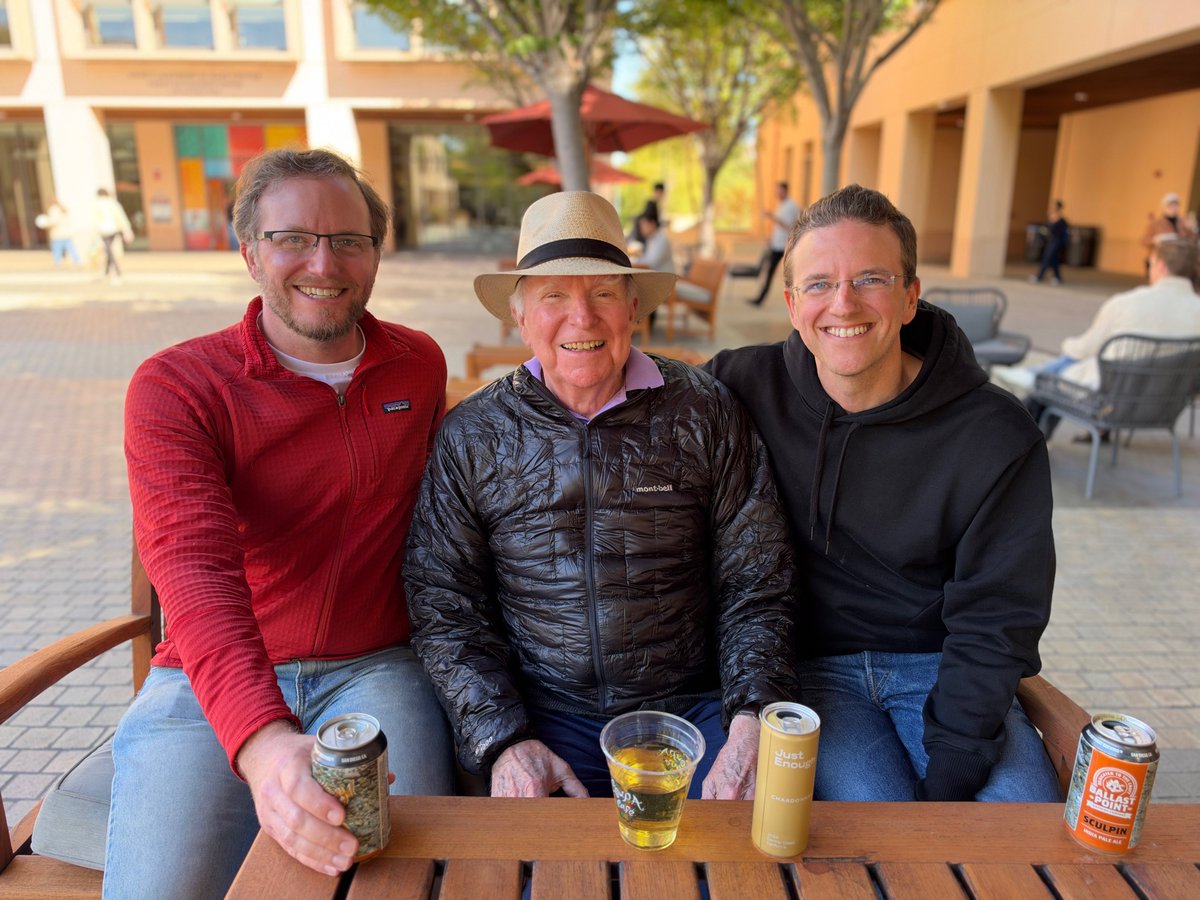
Robert E. Hall, Hoover senior fellow and @Stanford economist, celebrates his Nobel win on campus with his sons Jonathan Hall (red sweater) and @AHall_Research (black sweater).
Read the announcement: https://t.co/uVuglqTJT7
@alz_zyd_ Don't you think your hypothetical would incentivize students to just appease professors, focus on being known rather than developing the relevant skills? Imo it's not a loss of trust, just a response to competition and homogeneity among students from top unis
I formally modeled and worked out what conditions you need for what the essay describes to actually happen. You need fairly implausible conditions on both what happens to investment and preferences. Plus no fiscal policy at all. Here is the essay write up, with all the math in a linked technical note. https://t.co/FmxT2OgqMr
I really want people to see the story above the story here, which is that whether you're reading Citrini, or listening to Jamie Dimon at a cocktial party, the conversation about AI is a marketplace of competing science fiction narratives.
That's not to say I think the technology is a parlor trick. But rather that the level of uncertainty is so high, and the quality and supply of real-world, real-time information about AI's macroeconomic effects so paltry, that very serious conversations about AI are often more literary than genuinely analytical.
And I think that observation sets up another important point: I feel lucky to be able to have conversations about the frontier of AI with executives and builders at frontier labs; economists at AI conferences; investors in AI; and other AI folks at off-the-record dinners where important truths can theoretically be shared without risk. I can't emphasize enough that "nobody knows anything" is about as close to the reality here as three words are going to get you.
Nobody what's going to happen this year, or next year, or the year after that. There is no secret cigar-filled room of people who have unique access to some authentic postcard from the future. When you drill down underneath the bluster, the boosterism, the fear, the anxiety, what's there at the bottom is genuine uncertainty, a vacuum into which storytelling is flooding. The frontier labs don't really know what they're building exactly, and economists don't really know how to model the thing they claim they're building (genuine recursively self-improving AI agency isn't really analogous to something we know about).
I wish more people talked about and thought about this subject thru that sort of lens: We're trying to model the economy-wide effects of a technology whose properties the frontier labs can't even really describe yet. Whatever you think about AI today, be prepared to change your mind soon.
🚨1/N Really excited to announce a new working paper, “Interviews” 🚨
We demonstrate that interviews allow workers to screen firms and preview whether the job is a good match for them—using ~500k Glassdoor reports + a randomized field experiment. 🧵
New Stanford + SambaNova + UC Berkeley paper proposes quite a revolutionary idea. 🤯
Proves LLMs can be improved by purely changing the input context, instead of changing weights.
Introduces a new method called Agentic Context Engineering (ACE).
It helps language models improve by updating what they read and remember, instead of changing their core weights.
It has three parts: a Generator that works on tasks, a Reflector that learns from mistakes, and a Curator that updates the notebook with helpful lessons.
So ACE works like this. The model first tries to solve a task. While doing that, it writes down its reasoning steps, which show what helped and what caused mistakes.
That record is passed to another model, called the Reflector. The Reflector reads it and writes short lessons based on it, such as useful tricks, common errors, or patterns that worked better.
Then another component, the Curator, takes these lessons and turns them into small, clearly written notes called delta items. These are merged into the existing playbook using simple rules. The system does not rewrite the whole context, it only adds or edits these tiny pieces.
Because of this, it keeps all the useful older notes while gradually improving the context with every new task. Over time, the playbook becomes a stronger, richer guide that helps the model perform better on future tasks without retraining or changing weights.
This design avoids full rewrites that can trigger “context collapse”, where a long, useful context shrinks and accuracy drops. Instead, the context grows steadily and stays specific to the domain.
🧵 Read on 👇
An important lesson in academic writing is if you add enough hedging language ("essentially", "in some sense", "under some conditions", "it is conceivable that") you can make arbitrarily ridiculous statements
The issue with inflation is that it refers to two-ish things
1. Money becomes worth less
2. The cost of goods in terms of labor hours becomes higher
1. and 2. are awkwardly mixed in the CPI. Presumably the consumer cares mostly about 2., but the central bank controls(-ish) 1.
There's a good reason the Frisch-Waugh-Lovell Theorem is taught in intro econometrics, at least at the graduate level. It's used to characterize omitted variable bias as well as the plim of OLS estimators under treatment heterogeneity and also diff-in-diffs. And more.
Greater enforceability of non-compete agreements significantly reduces innovation and inventor mobility.
An average-sized increase in enforceability leads to a 13% decrease in patenting accompanied by a 22% decrease in inventor mobility.
https://t.co/BTsB5HTpnO
@justalexoki Also, Asian languages name numbers more logically than English. E.g. there is no "eleven" or "twelve" in Chinese, rather eleven is "Ten-One," twelve is "Ten-Two," etc. This makes addition (a fundamental skill) easier in those languages and provides an advantage over Americans
One of the interesting things that, for some reason, only recently occurred to me about the nonlinear DiD models (logit, exponential, etc) I've written about is that the ATEs (making the stronger parallel trends assump) generally differ from the ATTs even without controls.
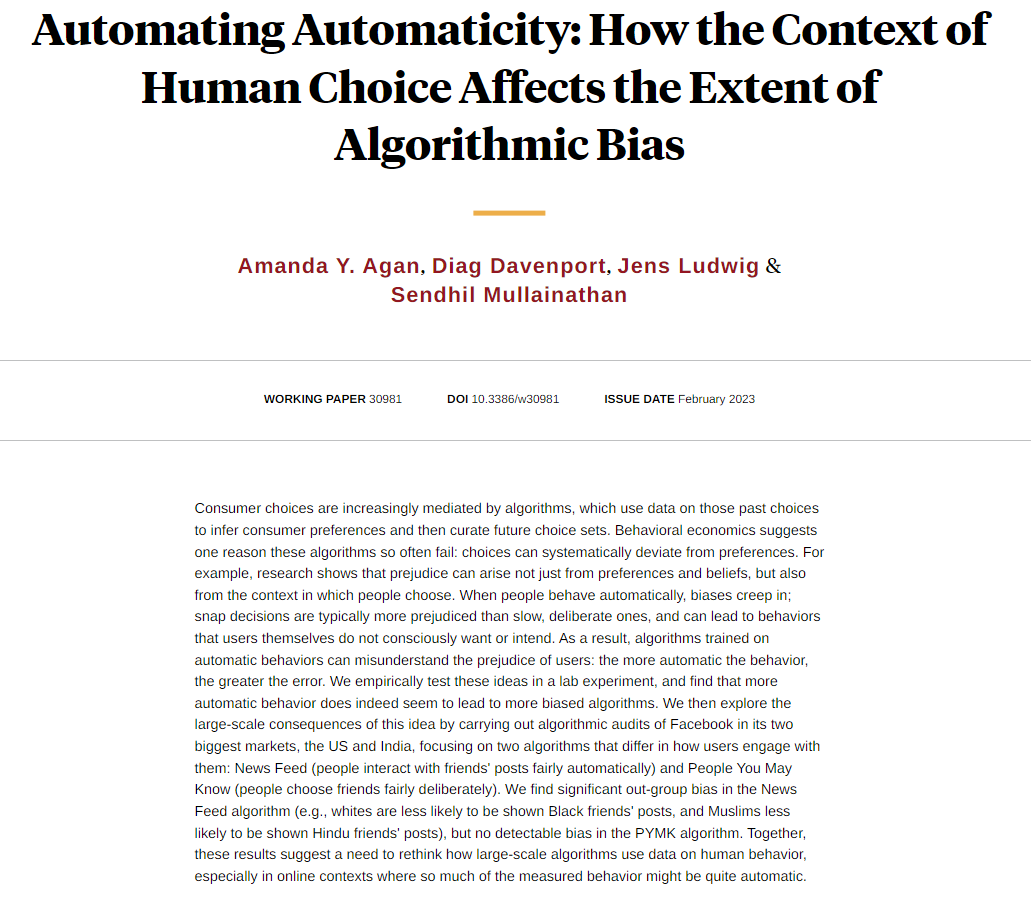
Evidence that curation algorithms (recommender systems) can learn and propagate biases that users themselves do not want, from @AmandaYAgan, Diag Davenport, Jens Ludwig, and @m_sendhil https://t.co/WRCN1tmTIf