This is my problem with almost every chart that goes viral on this app. Someone plots a number over sixteen years, circles the last dot, writes "all time high", and lets everyone fill in the meaning themselves.
Half the replies will say inflation is out of control. The other half will say hoarders are looting the country.
Both are guessing, because the chart deliberately gave them nothing to work with.
So let me add the missing lines.
First, inflation.
The 2010 peak on that chart is around ₹4,400 a quintal. Consumer prices in India have gone up roughly two and a half times since then. So ₹4,400 in 2010 was worth something north of ₹10,000 in today's money.
Sugar today is at ₹5,340. In real terms, sugar is far cheaper now than it was sixteen years ago. Calling this an all time high is only true if you pretend the rupee has not changed since 2010, which is a strange thing to pretend on a chart about prices.
Second, cost.
Nobody ever plots what it costs to make the thing. According to the sugar industry's own numbers, the all India average cost of producing one kilo of sugar is about ₹41.72.
Ex mill prices this week are around ₹54 to ₹55 a kilo. So this "record high" is roughly the first time in years that mills are comfortably selling above what it costs them to produce.
Third, and this is the one nobody knows about.
The government sets a minimum selling price for sugar. It is ₹31 a kilo. It has not been changed since February 2019. Seven years.
Meanwhile the price mills must pay farmers for cane, called the FRP, has gone up every single year. It was ₹275 a quintal in 2018-19.
It is ₹355 for the 2025-26 season, a 29 percent increase, and it has just been raised to ₹365 for 2026-27.
So, the input price up by nearly a third. Output floor frozen. Mills were being told to buy dearer and sell at a price fixed when Avengers Endgame was in theatres.
That is a slow squeeze, and the people at the bottom of that squeeze are cane farmers waiting for payment.
Now, why is the price actually rising right now.
Supply is genuinely short.
Closing stock on 30 September is estimated at around 3 to 3.3 million tonnes. India consumes roughly 2.5 million tonnes a month. So the country is walking into the new season with barely a month of buffer, which is among the lowest carryover in decades.
Cane went to fuel instead of sugar.
From 1 November 2025 the government allowed cane juice, syrup and both types of molasses to be used for ethanol. About 28 lakh tonnes of sugar equivalent has been diverted this ethanol year up to end June. India hit its 20 percent petrol blending target. That fuel had to come from somewhere, and it came out of the sugar bowl.
Weather.
Heavy rain across Maharashtra and Karnataka in late 2025 waterlogged fields and pulled the cane estimate down from 465 million tonnes to 455.
And the world is short too.
Drought cut European beet output to an eleven year low. Brazil is sending its cane to ethanol because crude is up. Forecasters who were predicting a global surplus for 2026-27 have flipped to predicting a deficit.
On top of all that, festival season runs from Ganesh Chaturthi to Diwali, which is when this country eats the most sugar it will eat all year.
The government has already moved on both sides of this. Exports are banned. Dealer stock limits came in from 1 August. Bulk buyers like soft drink and confectionery firms get cut to fifteen days of stock from 1 September.
Mill stocks were physically verified in late July. And one million tonnes of raw sugar imports have been allowed till 31 October, which matters because the normal import duty on raw sugar is 100 percent.
And finally, here is why I think this price rise, managed properly, is good news.
At ₹365 FRP, mills will owe cane farmers roughly ₹1.3 lakh crore in the coming season. Around 5 crore families depend on that money.
As of April this year, mills had paid about ₹99,961 crore of the season's dues, roughly 88.6 percent, with the rest still outstanding. Cane arrears will help farmers in Uttar Pradesh waiting eight months for money he earned.
A mill selling at ₹31 cannot pay that bill. Bajaj Hindusthan reported a consolidated loss of ₹184.7 crore in the June quarter even in a firming market.
A loss making mill does not pay farmers on time. It just does not. Higher sugar prices are the only place that ₹1.3 lakh crore can come from.
The same money also makes the ethanol programme work. Mills have put over ₹40,000 crore into distillery capacity.
That capacity is how India cuts crude imports. It only stays viable if sugar economics are viable.
The honest cost sits with consumers. Retail sugar is ₹52.30 a kilo, up from ₹46.34 a year ago. That is about ₹6 more per kilo.
For a household using three kilos a month it is under ₹20. Real, and worth watching, especially with retail inflation crossing the RBI's target in June for the first time in seventeen months.
For a small sweet shop buying by the quintal, it hurts a lot more.
But a farmer getting paid on time and a mill that is not bleeding are the point of this.
Next time you see a chart like this, ask what got left off the axis. Usually it is the part that explains everything.
The understanding of "Banking" as a business and sector is pathetic. The total advances of BoB is almost Rs 15 lakh crores! Rs 35,715 crores is the write off over 6 years (it is inside the article not the headline) and the Bank has recovered Rs 9,946 crores out of it (again inside the article not in the headline).
This is how Banking is supposed to work. Across the globe. And shouting scam at every Bank and every write off is foolish.
Also there is a fundamental difference between an NPA and a Wilful defaulter. Not all NPAs are willful defaulters. The list of suit filed Wilful Defaulters is available!
The garbage tender is the most important thing happening in Bengaluru right now.
I have lived in this city long enough to watch the same cycle four or five times. Garbage piles up. Everyone gets angry. Somebody promises a fix. A few weeks later the garbage comes back.
So I went and read the history of why.
It is worse than most people think, and it explains why this has stayed broken for so long.
Bengaluru's waste system was never really a system. It was a set of arrangements. Contractors who came in years ago got their work renewed again and again without any fresh competitive process.
The civic body was spending somewhere around ₹50 crore a month on collection and transport, and the people doing the work were mostly the same people who had been doing it for a decade.
When you never re-tender, you never get to change who does the job, and you never get to change what you demand from them.
Performance stops mattering because nothing depends on it.
That is not a party point. When the state created Bengaluru Solid Waste Management Ltd in 2022, the official reasoning was that the sector was being run by what they themselves called a garbage mafia.
Yes, that word came from inside government.
Then there is the darker half of the story, about disposal.
From 2003, a big chunk of the city's waste went to Mavallipura, a village near the Jarakabande Kaval forest, about 700 tonnes a day of it.
The pollution board found it was contaminating land and water and shut the site in July 2012. Everything then shifted to Mandur, which was already taking around 2,800 tonnes a day.
Soon, Mandur collapsed too.
In June 2014, more than 700 policemen escorted garbage trucks into Mandur village to dump waste against the residents' wishes.
Section 144 was imposed. Over 100 people were arrested. That is what Bengaluru's waste policy actually looked like.
The Karnataka High Court had already ordered, back in 2012, that wet and dry waste must be separated at the source. Fourteen years later that still does not happen properly across most of the city.
See, if mixed waste leaves your gate, no processing plant downstream can do much with it. Wet food waste soaks the paper and plastic and turns the whole load into landfill material.
Every crore spent on processing capacity gets wasted if the garbage isn't segregated at source.
Now, after Mandur, the tendering attempts kept dying too. In January 2023, BSWML floated tenders splitting the city into 89 packages, about ₹590 crore a year, covering 42 lakh homes and shops.
Most bidders failed to meet the qualification conditions. It was floated a second time. Then it was cancelled entirely later that year.
The High Court eventually scrapped the 89-package structure and allowed a fresh tender.
Meanwhile the institutions too were a mess and kept getting reshuffled. BBMP handled it, then BSWML was created, then in 2025 collection was pulled back out of BSWML after a poor Swachh Survekshan ranking, and now it sits with five new corporations under the Greater Bengaluru Authority.
Every reshuffle reset the clock on accountability.
So no competition, no consequences, no segregation, no landfill plan, and a new organisation chart every couple of years.
The garbage situation was bound to be a mess.
Now has something changed now? Yes!
This is what has actually changed, and this is what I am genuinely hopeful about.
The cabinet approved a fresh structure in May 2025. Seven-year contracts, roughly ₹4,000 crore, split into 33 packages with one package per assembly constituency.
One package per constituency means there is a named contractor and a named MLA attached to every patch of the city.
When your street is filthy, there is now a specific person whose contract is on the line. Seven years is also long enough that a serious operator can justify buying new auto tippers and running them properly instead of squeezing an old fleet.
As of June this year, 27 of those 33 packages were in their final stages. Six are stuck in court, which is frustrating but is also what happens when you actually run a competitive process instead of just extending old contracts.
Alongside it, tenders went out for integrated solid waste management parks to process 5,500 tonnes a day, split into a north package and a south package.
That is the first credible attempt to fix disposal since Mandur, and it is what stops the next village from being turned into a dump.
And the visible stuff has started. The Freedom from Waste drive in August mapped 1,616 specific locations holding around 22,730 tonnes of debris and started clearing them.
Vacant plot owners were told to clear their sites by 15 August, with the cleanup cost added to their property tax if they do not.
That fixes a huge share of blackspots, because most blackspots are just somebody's empty plot.
Now, I am not going to pretend this is done. Six packages in litigation is a big risk, and segregation is still the weak link nobody has cracked.
But this is the first time in twenty years that someone is fixing the contract instead of just sending more trucks. :)
Zerodha to offer mutual funds on Kite amid popular demand for all equity investments in a single app
"It will be a user-friendly experience because we do see investors who want everything on one app. We are also bringing a feature where customers can import all their mutual fund investments elsewhere to Zerodha on Kite."
Most fintech and trading apps offer all stock-market or investment-related products in one app and find Zerodha's dual-app strategy confusing.
This is also a significant strategy shift for Zerodha, which often pitched Kite as a platform for active equity investments and Coin as an app for passive long-term investments like mutual funds or systematic investment plans (SIPs), NPS (National Pension Scheme) and fixed deposits
By @AnandJRAnand
https://t.co/nlARWlt4g2
Arun Shourie was critical of Modi. The “right wing” started abusing his child who had challenges.
When justice DY Chandrachud assumed office, he was assumed to be a “liberal” and hence his children who had difficulties were considered fair game by the “right wing”.
In both cases, did it have sanction of the PM? Quite obviously no. But people did what they did.
The same applies for abuse in the name of any leader on any side. Literally impossible for any leader to control a whole bunch of anons on the internet who will do anything to mask their own impotency. Expecting Annamalai to condemn every abuse or expecting modi/shah to condemn everything that is said by some loser who is not even part of the party is ridiculous. People should get on with their lives instead of looking at each other like a jealous ex (this applies to me too as I can be quite trigger happy at times).
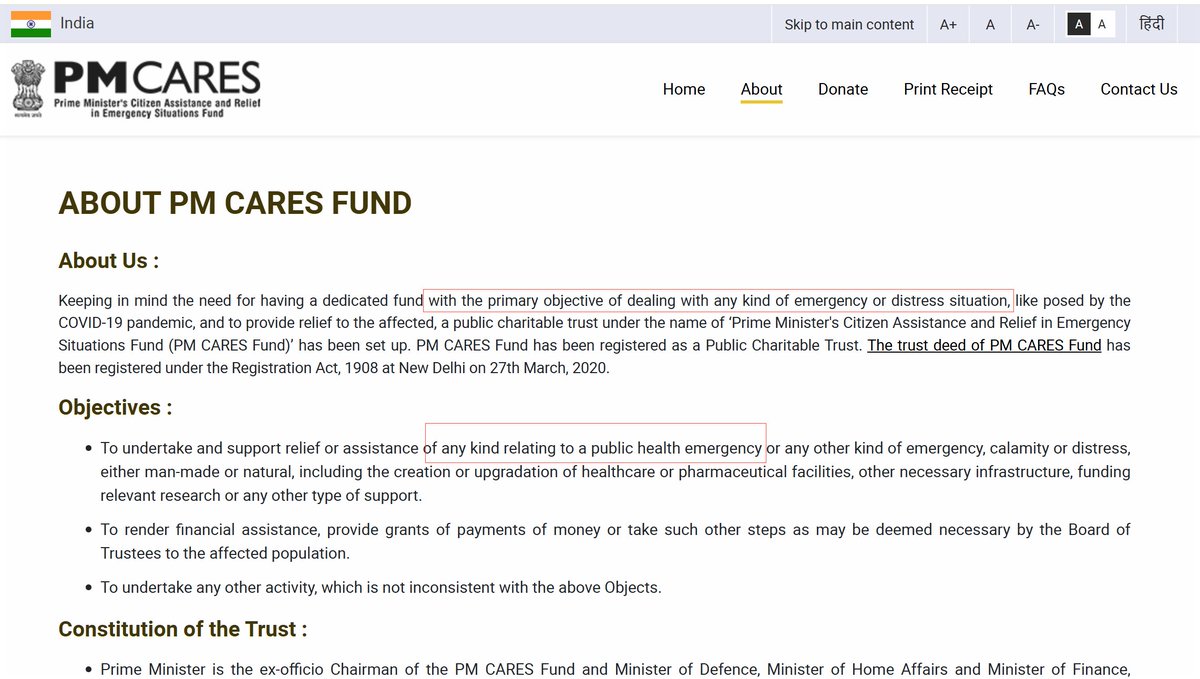
PM CARES has not spent the money. That is a scam? Think. How is not spending money and keeping it in an FD a scam? Should it instead have been spent on inflated toilet paper? #IYKYK.
Leave the rhetoric. Some facts:
1. PM CARES was created for a specific purpose : to have funds available to deal with a public health emergency when one occurs, rather than scrambling to raise money after the emergency begins. What exactly is wrong with saving for a rainy day?
2. Money collected for a specific purpose cannot simply be diverted to another purpose. Basic governance. If someone donates for healthcare, can you use that money to build toilets without the donor’s consent? That would be the real governance problem.
3. As an accountant, I can tell you: creating a fund for a specific purpose and accumulating money in anticipation of future expenditure is called prudence, not a scam.
4. If ₹8,500 crore or whatever that sum had been spent and there were questions about where it went, I would understand the criticism. But the money is sitting in a fixed deposit. It hasn't disappeared.
5. And finally, do we seriously think ₹8,500 crore is an extraordinary amount for the Government of India? Look at the Union Budget. Look at what governments even State Govt (both Congress and BJP) spend on various schemes. Yet some people seem far more outraged about money being accumulated for a purpose than about money being spent including state governments spending several times this amount on “khatakhat” schemes, with far less scrutiny over whether the intended beneficiaries actually received it.
To all the CJP leaders @SauravDassss@whattalawyer who have been relentlessly saying this money should have been used for schools: if you can factually challenge each of these five points, I am genuinely open to a debate. IF you can ask the PM for a debate. I can ask you for one. :-)
PS: And to those preparing to call me a “defender of the Government” or say I am helping “my master” — please spare yourself the effort. I know the script.
Interesting fact:
Since 2007, 11 railway ministers have used chartered flights 33 times for crisis,inauguration or official duties.
Ashwini became rail minister in 2021 & he has used it only once.
And that was 2 June, 2023 for Balasore accident, this is the pic of that night.
RBI has Rs 74.6 lakh crores in its reserve lying idle. They have not even put it into FD in SBI. Why can't the government use it to build schools? It takes just ₹8 crores to build a school. We can build 9 lakh schools and still have money left to throw a party for the pupils.
Purpose! When you start a college fund for kids and start keeping aside... you dont go and spend it to buy clothes suddenly because someone says you havent spent any this year!!!
Funds are collected with a purpose. The same guys would have filed a PIL and called SC Judges names if PM CARES was used for schools!!! See the purpose @abhijeet_dipke - I could understand it without going to Boston University.
This also is coming to Bharat.....🙏🙏
But I know a predictable group of critics will jump in to dismiss it with one word: "Screwdrivergiri."
They will claim assembling smartphones / laptops / defense equipment is just tightening screws on imported parts :))
What they completely miss is a fundamental law of global supply chains: Before a global giant hands you a screwdriver, they must first trust you with their crown jewels.
You do not just "assemble" an iPhone 15 Pro / an Advanced Light Helicopter / a high-end semiconductor module with a basic workshop tool.
Modern electronics and aerospace assembly demand micrometer-level tolerances, zero dust rooms....A single static discharge / a fraction of a millimeter misalignment destroys millions of dollars in silicon.
Passing those QA checks require an extraordinarily skilled, disciplined engineering workforce.
Global tech and defense supply chains are notoriously risk-averse. Companies like Apple / Google / defense OEMs do not move billions in production to a country just because labor is cheap.
China did not start by building indigenous silicon foundries / proprietary smartphone ecosystems. They started by assembling toys, radios, and basic circuit boards. Screwdrivergiri created the industrial ecosystem, trained millions of technicians, and attracted component suppliers locally.
Calling high tech assembly "screwdrivergiri" is industrial illiteracy. 🙏🙏
Voltas and Atomberg announced a joint venture to build AC compressors in India with a 2.8 million units/year capacity to cut import dependency. But does it address the tech dependency, as India relies on licensed tech for domestic production?
@indiaBUILDwiki
🧵
India consumes about a billion camera related chipsets a year, ~50M cameras worth close to $4-5B annually...mostly sourced from Chinese silicon.
That is a national security problem: cameras deployed in offices, streets, and sensitive infrastructure running on foreign chips with foreign middleware....
A not so known Startup called "BigEndian" designs fabless system on chips for surveillance, telecom, IoT, and enterprise systems, and is building a platform as a service layer specifically to help customers avoid Chinese middleware access in surveillance hardware.
Founded in 2024 by people with real industry scars: Sunil Kumar, Renuka Prasad, Dinesh Annayya, Kanagaraju Ponnusamy, and Jansen Cheng (Harpreet Wadhawan also co-founded as CFO). Between them, decades of experience at ARM, Intel, Broadcom, Cypress, plus earlier chip startups like Beceem and Arcus.
The founding team members had known each other for 25 years before starting this.
Kumar on why now, why them: "If we do not do it, this generation will die, and it will go. There is nobody else who has that experience to do the entire cycle." 🙏🙏
Now, Why it matters for Bharat....
- Beyond import substitution, Indian chip startups have historically struggled to even reach tape out (the point where a design gets committed to a foundry); most stay stuck at the concept / licensing stage.
- BigEndian getting to tape out is proof that the "architecture to silicon" capability can actually exist domestically, not just assembly.
- It also lines up directly with govt policy, new directives are restricting certain imported surveillance equipment in sensitive deployments, which creates real domestic demand pull, not just subsidy driven supply.
Raised $3M seed led by Vertex Ventures SEA, followed by $6M pre-Series A led by IAN Alpha Fund in May 2026).
Already Completed tape out of their 1st commercial chip: the hardest, most capital intensive milestone in fabless semis, which most Indian chip startups never reach.
Headquartered in BLR with strategic partnerships in Taiwan, they are now moving from test silicon to production ready SoCs for surveillance, telecom, and IoT customers.
Still early stag, pre-Series A, but de-risked in a way few Indian fabless startups have managed.
In 1985, global software exports from India were an exercise in absurdity. If an engineer in Bangalore wrote code for an American client, they could not just hit Deploy.
They printed code onto magnetic computer tapes, boxed them up, drove to the airport, flew them 9,000 miles across the Atlantic, and waited weeks to find out if the build compiled.
Texas Instruments (TI) wanted to change everything. They wanted to build a direct pipeline between a newly rented facility at Sona Towers on Bangalore’s Miller's Road and their global headquarters in Dallas, Texas.
To do it, they needed a dedicated 64 kbps (YES, 64 kbps) satellite link.....
In 1985, 64 kbps was space-age. But the Indian govt did not even have a mechanism to allow a private, foreign company to own and operate international telecommunications equipment. International comms were strictly state-controlled.
Bureaucrats panicked. Ministries demanded security clearances, suspecting a massive dish pointing into the sky could be an espionage tool......
For months, Texas Instruments fought a war of attrition through Indian customs. When the giant dish finally cleared the port of Madras and reached Bangalore, the team faced another absurd reality: 1980s Bangalore’s road infrastructure could not handle the heavy, delicate components.
The dish that would spark India's digital leap did not arrive in a high-tech transport convoy. It was strapped onto a wooden bullock cart, pulled slowly through the streets by a pair of white oxen.
Once the dish was mounted on the roof at Miller's Road, engineers flipped the switch.....
An engineer in Bangalore typed a line of code into a terminal, hit enter, and watched as data beamed directly from the rooftop dish, bounced off a satellite in geostationary orbit, and landed in Dallas.
The code was compiled and executed on a mainframe in Texas, and the terminal output flashed back onto the screen in Bangalore in realtime.
It was the first time in Indian history that physical distance was obliterated by tech. The myth that critical engineering had to be performed locally in the West collapsed overnight.
The TI experiment proved the impossible was possible. But it exposed a brutal economic wall.....
Operating a private 64 kbps satellite link was mind numbingly expensive. In the late 1980s, a single half circuit cost ₹45 lakh per year in licensing and bandwidth fees alone, not including the millions needed for the physical earth station.
Only multi billion dollar Western giants could afford to build private pipes. Early Indian startups, the precursors to Infosys, TCS, and Wipro were completely locked out.
The dream of Indian IT was about to become an exclusive playground for foreign conglomerates.....
And then enters N. Vittal into the scene, the legendary Secretary of the Department of Electronics....
Vittal looked at the absurd cost of TI’s dish and realized something fundamental: Why force every small software shop to buy its own dish when the govt can build shared digital highways?
In 1991, amidst a crippling balance of payments crisis where India had to airlift its gold reserves to avoid default, Vittal walked into a high stakes meeting with Finance Secretary Bimal Jalan.
India’s total software exports that year were a modest $100M.
Jalan asked Vittal: "If I approve your wild demands: zero import duties on hardware, single-window clearances, and shared satellite gateways...what export numbers will you guarantee for next year?"
Vittal bluffed: "$400M".......
When Vittal announced the $400M target at a NASSCOM event later that week, the room filled with Indian IT founders dropped into a dead, terrified silence. Narayana Murthy and other industry leaders thought Vittal had signed their death warrants.
Vittal simply smiled and launched Software Technology Parks of India (STPI)......
STPI shattered every operational bottleneck holding back Indian talent:
- Instead of forcing companies to spend ₹45 lakh on private links, STPI built massive shared satellite antennas. Small startups could plug straight into the high-speed data pipe for a fraction of the cost.
- Vittal designated STPI zones as dutyfree import areas, shielding young coders from dozens of harassing tax inspectors and customs agents.
- Companies did not need to build in remote govt zones; they could set up anywhere talent existed.
Within years, the horse flew. The $400M target was crushed.....
What started on the back of a wooden bullock cart carrying a single satellite dish down Miller's Road became a multi billion dollar juggernaut that rewrote global tech history. 🙏🙏
We have moved into our new office in Indiranagar, Bangalore.
Someone asked me last night, "If you had complete control over where you were born, which country would you choose?"
I was born in Munger, Bihar. One of the poorest districts of one of India's poorest states. India itself was one of the poorest countries in 1997. If that was not enough, I was born in an extremely poor family.
But I studied hard. Went to super 30. Cracked IIT Kanpur. Worked with Amex and Goldman. Started my own company. Raised institutional money. Went to Shark Tank and presented my vision on national television.
Built a cracked team. Built a solid product. Got love from thousands of customers. And now we have our own office in the heart of Bangalore, the silicon valley of India.
None of this was guaranteed when I was born. But I got a chance despite the odds. Because the country I was born in gave me a chance to achieve all of this. A chance to study. A chance to work hard. A chance to work for great companies of the world. A chance to build something of my own.
If I had to choose, I will choose India. I will choose Bihar. I will choose Munger. Every single time.
Happy 80th Independence Day! 🇮🇳
The controversy surrounding the attempt to halt the singing of Vande Mataram highlights a powerful moment of conviction.
While leaders may demand silence, true devotion to the nation cannot be paused on command.
The most defining moment was the courage of the singer. Despite being explicitly instructed to stop, they chose not to yield.
Standing firm, they let every verse of our national song echo with pride, uninterrupted and unwavering.
Vande Mataram is not merely a tune; it is the enduring heartbeat of our freedom struggle and a symbol of collective reverence for the motherland.
Respect for national symbols should always rise above political convenience or stage protocol.
Hats off to the artist whose spine and dignity proved that devotion to the country will always outshine political commands.
#VandeMataram #NationFirst #ProudIndian
Department of Expenditure had issued a clear and unequivocal advisory on how consultancies are to be awarded government contracts. In particular, it states that qualification criteria for government contracts should be commensurate to the project. Till now it was common for eligibility to be restricted through unnecessarily high turnover and payroll requirements that could only be met by a tiny club. This levels the playing field for Indian consultancies and new entrants.
India just made its first export-grade shipping container for Maersk at Dadri, Maersk ordered 1000 more.
China makes 96% of all containers globally, so any Indian production counts But container is not just steel shaped into box. It lives 10-15 years. During that time it gets leased, tracked, repaired, repositioned, insured, and resold.
Over half of all containers belong to leasing companies, not shipping lines. Factory profit on building box is thin. Real money sits in managing that box across its full life, not in welding it together.
Container spends 56% of its life sitting idle or moving empty to where cargo is. 20% of containers on ships at any time carry nothing.
Companies like Textainer and Triton manage fleets of 7-8M TEU and earn returns from leasing cycles, insurance, digital tracking, and resale at end of life. Over $5B in securities fund their fleet growth.
Leasing contracts run 5-8 years with 87-91% renewal rates. India making containers is good. Building leasing and fleet management alongside is what turns boxes into competitive positioning.
Government backed container manufacturing with Rs 10000 crore in Budget 2026 to bridge cost gap with China and fund new factories.
India needs 350000 containers per year, makes only 10000-30000. US DOJ indicted 4 Chinese container makers in May 2026 for price-fixing cartel that doubled prices during pandemic. That creates rare opening for non-Chinese suppliers.
But building boxes is starting point, not destination. Leasing companies, tracking platforms, repair yards near ports, and container-backed finance through GIFT City would capture far more value than factory output alone.
just think about How everything is Inter-connected
https://t.co/FqqCrrfkcF
Do these people understand how fast the service sector has grown in India? Services account for 55% of India's GDP and it far outpaces manufacturing. Manufacturing suffers because services simply has a higher payout and lower skill floor. People will simply choose BPOs than upskill and work in a factory. China spent 4 decades perfecting it's manufacturing core and then focused on services. It's the other way around for India. Try passing land acquisition laws, you'll think gen z protest is cakewalk.