Ran Opus 5.5 through Time Portal on November 2026 questions (midterms, jensen, anthropic) against Polymarket at the same cutoffs:
1. Polymarket: Brier 0.640
2. Opus + Time Portal: 0.670
3. Opus, no tools: 0.953
On the midterms its race-by-race odds correlated 0.98 with Polymarket, largely from news articles quoting the odds. Without filtering sources opus does no better than the peoples wisdom
I feel like 1 of 2 things may happen:
1. Outcomes like this are too chaotic, or hidden in private info, for anything on the public web to beat the crowd.
2. Some slice of the archive moves before the market does (like plot "early-ness" of sources against "accuracy" of sources).
@epochal can you give me more credits so I can find this out please 🙏🙏🙏
Announcing Epochal! ✨
We believe the best measure of intelligence is the ability to predict the future. Doing so requires learning about the past and constantly working to be less wrong.
Today's AI has read almost everything and lived through almost nothing. It learns from the internet all at once, already knowing how each story ends.
We want it to live through thousands of yesterdays instead, one day at a time, the way people do.
So, we built Epochal Time Portal, the first true point-in-time environment with trillions of pages spanning 30 years of history, where agents can browse the Internet as it existed on a past date.
@KaiwenZhou9 #2 and #3 would probably vary by markets. I feel like what you probably want to do is use epochal to study what sources (per market) are fastest to react and actually decisive (instead of reading all noisy internet data). I dont think this study would possible before?
Careful with agent-vs-Polymarket comparisons. In my Time Portal runs, Opus's midterm odds correlated 0.98 with Polymarket, mostly because it read news articles quoting Polymarket.
12 of my 15 comparison questions turned out to be circular. Blocking market sites isn't enough when the coverage quotes the odds.
RLM x Jev
Been super interested Repl style harnesses like RLMs by @a1zhang
But parsing outputs of LLMs within code feels clunky (regex, try-catch, etc)
I let RLMs write 'jev_query' calls instead. Jev sits nicely in code like this @typesafeai@CompleteSkeptic.
@kushbhuwalka@typesafeai This is a cool idea but only really economically better than rerank if your chunk sizes are pretty small no?
Re-rankers are already like ~$2 for 1k search units, chunks > 500 tokens and I think you are at the same cost.
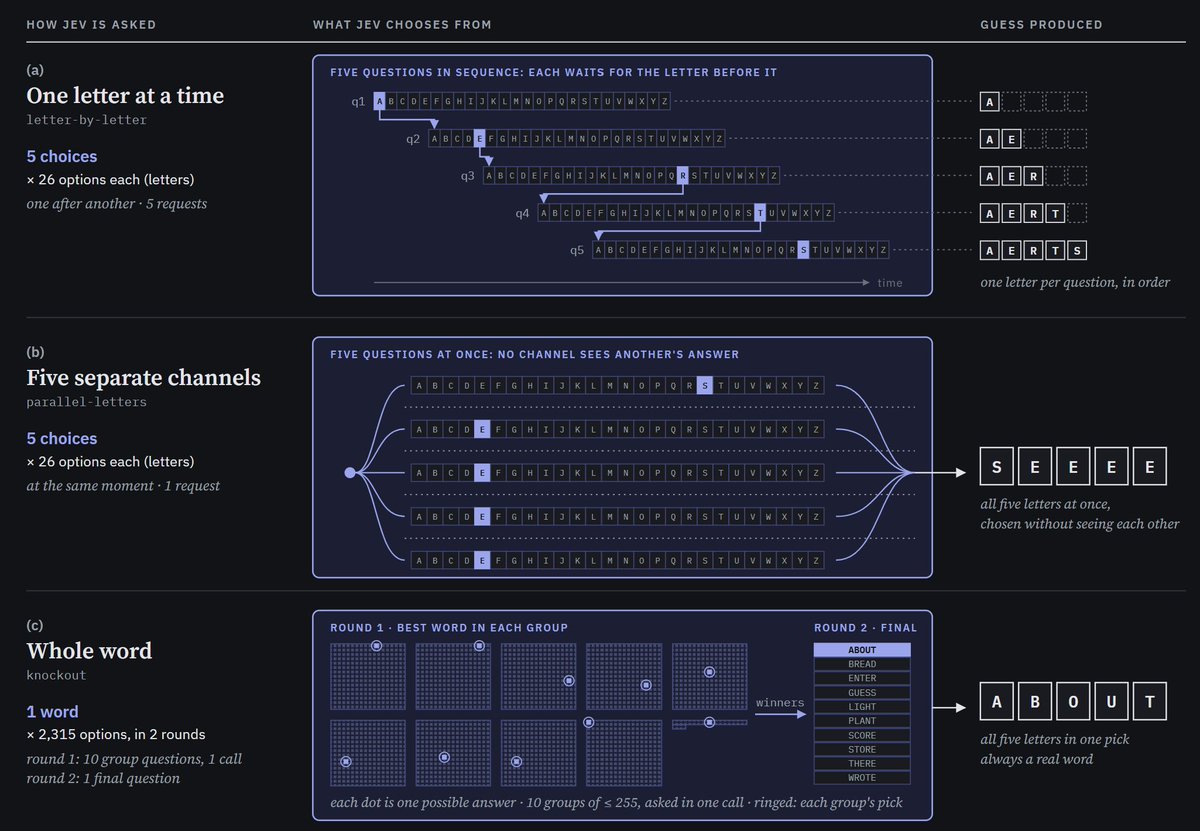
Jev @typesafeai playing wordle - with different stratergies is a pretty good case study in what Jev can and cannot do.
Guess letter-by-letter -> very greedy
All 5 letters at once -> spams SEEEE (repeatedly)
Guess the whole word -> solved in 3
https://t.co/7L6t4B6K7X
I got Jev @typesafeai and Opus 5 to play vs each other in competitive Pokémon
Jev won 🕺
Jev: $0.0029, 37s thinking
Opus 5: $2.35, 6m 29s thinking
~ 820x cheaper, 10x faster
Seem like high potential in finite action spaces
Shoutout @vercel for making the model available.
After co-inventing ChatGPT, I kept asking myself: why have superhuman chat models not led to AGI?
I’ve spent the last 2 years in stealth building a new way to train models (RLCD), and a new type of frontier AI model that we are releasing today: Jev
• 20-200x faster
• 40-400x cheaper (w/ output tokens free)
• Frontier composable intelligence optimized for decisions
AFAICT the shortest path to AI-based economic revolution
This is SUPER cool work. I'm really hoping to see a similar comparison between: default harness vs code mode style harness vs rlm ( or any repl style harness).
Probably have to go beyond coding workflows and towards more general agent work. Any plans in that direction?
I wrote a blog about this whole experiment, check it out: https://t.co/tGaZgccHKA
If you're building one of these: where is your tool boundary, and have you considered many of these options - super curious to hear, hit me up!
Agentic search is not one thing. You can put a search tool in a loop and let an LLM drive it. But what kind of tools can a language model use most effectively?
I tested 6 different tool configs for multi-hop Q&A (12 turns cap, GPT-5.6 luna backbone): 🧵
Should vector db providers be making search tools of different shapes like this? @turbopuffer, @weaviate_io, @pinecone or just make sure users have the flexibility to create their own composite tools?
@softwaredoug if you tell your model what kind of search mechanisms sit behind search tools, they can adapt their queries to each pretty well
we saw some of this, and some other interesting behaviour experimenting with handing different search tools to a search agent: https://t.co/tGaZgccHKA