The winning robotics data business has a much higher terminal value than investors are underwriting today.
Robotics will be a long race with many twists and turns, but when the ChatGPT moment hits, the winning data player will be in a very strong strategic position to capture token value. They will have large revenue, a strong balance sheet, talent density, deployments experience, and hardware supply chain knowledge. When it comes time to blitzscale they will be amongst the players that can capture the most value.
The reason this is misunderstood today is because most people are using traditional LLM data businesses as a prior for robotics data businesses and what their terminal value could be. I posit this is incorrect framing. Because the model and harness are integrated in LLMs, there is very little room for data players to play meaningfully in the token value flow in the long term.
In robotics this is exactly the opposite, the model and harness (hardware) are separate, the pretraining era is just beginning, there are many more dependencies on distributors/deployers, and there is a large surface area for other players than just models to capture value. Open source will also play a larger role earlier in the robotics race, as all prior LLM learnings will be incorporated as the race is run. This also creates opportunities for long term infrastructure players.
There is a massive amount of terminal value in winning robotics data and participating in the path of the industry from a position of strength.
From first principles:
The endgame of robotics will take place over the next decade. Empirically, today, no player has enough data, enough model intelligence, or sufficient hardware to facilitate a fast revenue takeoff in the field. No player has reasoned through the right sales motion either, which can take years to develop pilots and move to production. Serious players are correctly focused on scaling up pretraining/deep learning vs. who has the best model, deployment, or hardware today.
The robotics data business takes participants on a global hunt to build data, supply chains, and hardware. Along the way it also teaches deployment and deep knowledge of SOTA model development. Winning data participants also get the first crack at the still nascent robotics RL market, which will likely be the next large revenue stream after pretraining. As they compete to win data, data players must develop incredible talent density across both Asia and the US. The winning data business will have both Asian and North American DNA. Canada 🇨🇦 encompasses an interesting cultural mixture of both of these parts of the world. Bullish Canadian Robotics Mafias, more specifically Waterloo/Toronto.
So:
What would constitute a strong strategic position to capture value once the ChatGPT moment of robotics hits? You need a large revenue base, a strong balance sheet, and talent density + experience across data, deployments, hardware, supply chain, and RL. The hyperscalers, the frontier labs, and the winning data player all qualify.
Anyone under time pressure in what will be a long race is in a weaker strategic position in my view. Given the costs of integrated hardware+software+deployment, this would actually be most robotics-native players. They will depend on VC interest, which can be fickle.
Starlink is licensed in over 165 countries and has spent five years complying with every single law and requirement of the government of India, so why still no license?
Is Ambani the real boss of India?
Introducing ThyVoice: our state-of-the-art approach to solve "who said what" across conversations at 10x lower cost.
We benchmarked 8 speech systems, built on OpenAI, ElevenLabs, Deepgram, AssemblyAI, pyannoteAI and the academic baselines. ThyVoice made the fewest errors.
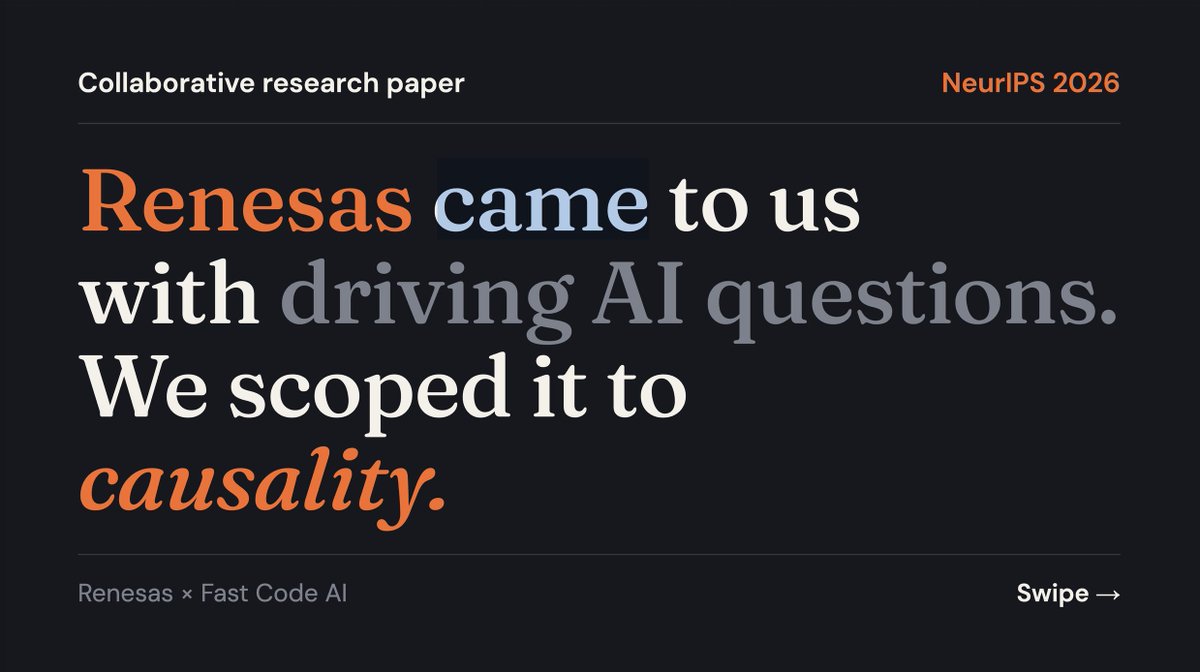
@RenesasGlobal is one of the world's top 3 makers of the small chips that run modern cars. It's a $9B revenue listed company on Tokyo Stock Exchange.
They came to us with a broad question about trust in driving VLAs.
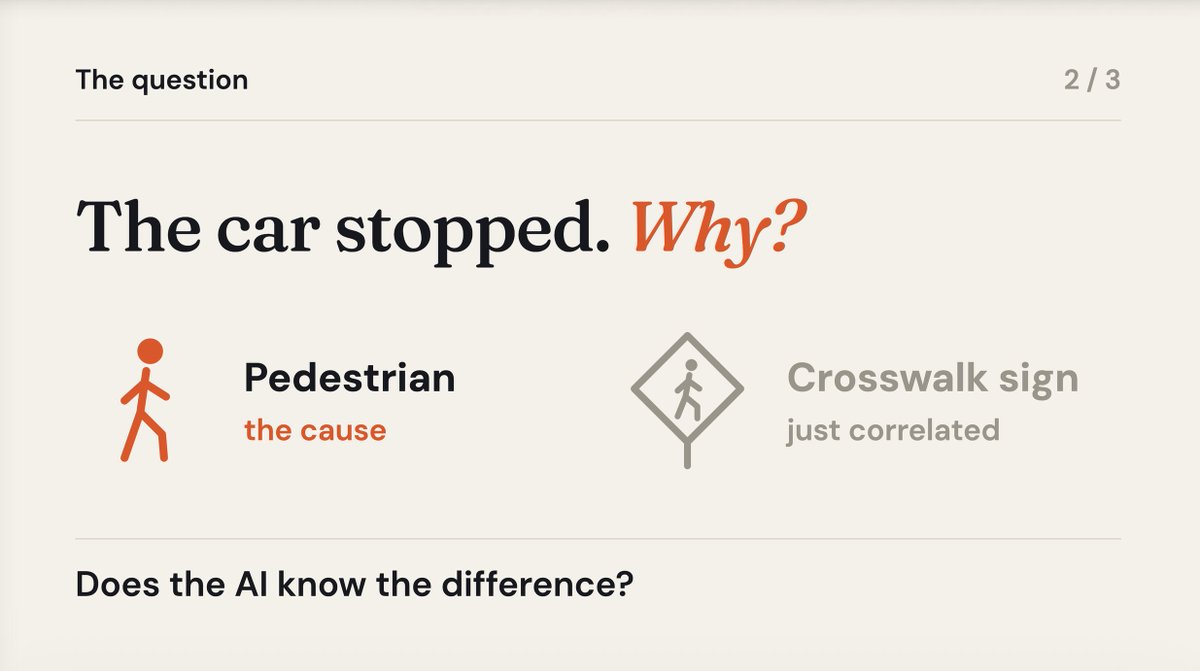
We scoped it into one research question: does the AI understand cause and effect in a driving scene?
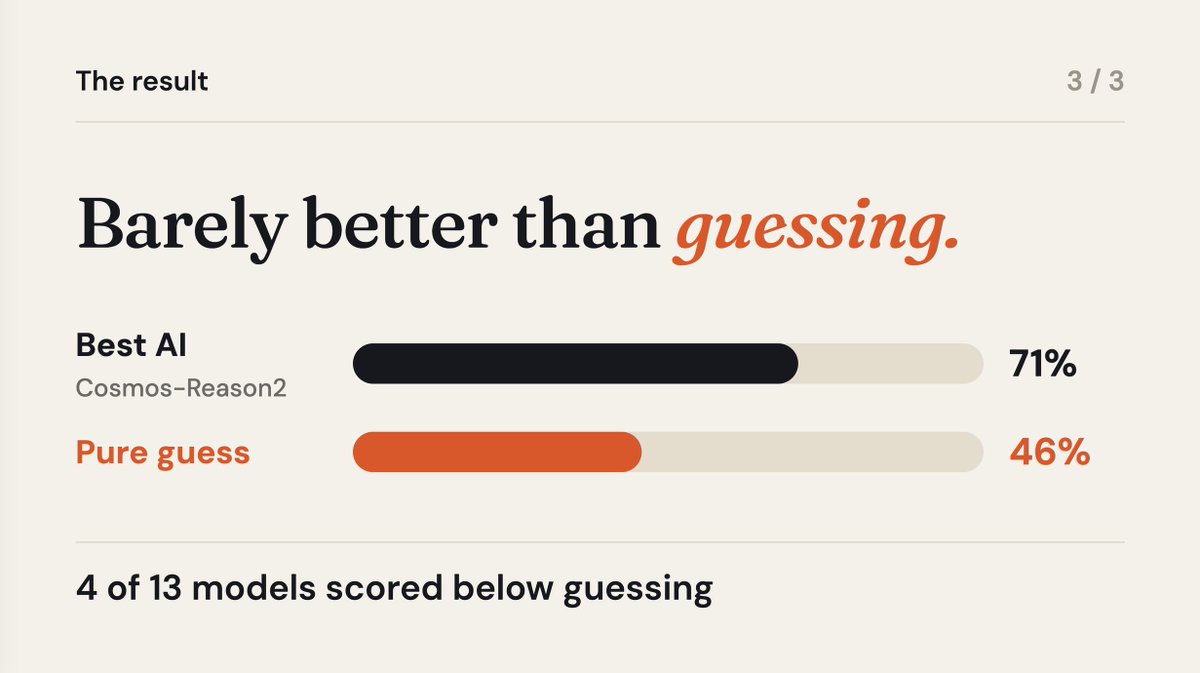
Then we tested 13 models.
Best score (Cosmos-Reason2): 70.6%. Four did worse than random guessing.
The paper, CausalDriveBench, is now accepted at NeurIPS 2026, co-authored by @FastCodeAI team with Renesas engineers.
Paper: https://t.co/ykjJvo7ltU