Are you using the right performance tests?
① Load: Normal traffic
② Peak: Expected maximum
③ Stress: Find limits
④ Spike: Sudden surges
⑤ Soak: Long-term stability
⑥ Failure: Test failover
More Details👇
https://t.co/WnnLXHElek
#PerformanceTesting#WebPerformance
How do you find high-load SQL in PostgreSQL? 🔍
pg_stat_statements lets you compare:
• calls : execution count
• total_exec_time : cumulative execution time
• mean_exec_time : average time per execution
Details👇
https://t.co/0Hg86ZzFy4
#PostgreSQL#SQL#Database
Why can retries make an overloaded system even worse?
Fixed-interval retries can cause many clients to retry at the same time.
Exponential backoff increases the delay, while jitter adds randomness to reduce synchronized retries.
More👇
https://t.co/yrZiqwvwFt
#Performance#SRE
What makes G1 GC different from other Java garbage collectors?
① Regions: Divides the heap into regions
② Concurrent Marking: Identifies live objects while the app runs
③ Mixed GC: Collects young and selected old regions
Details👇
https://t.co/vynliUGomZ
#Java#JVM#G1GC
How does Tomcat handle incoming HTTP requests?
Here's the NIO Connector flow:
① SYN Queue
② Accept Queue
③ Acceptor Thread
④ Connection Management
⑤ Poller Thread
⑥ Worker Thread Pool
Each stage has a different role.
More👇
https://t.co/7Y6hgx3PcU
#Tomcat#Java#Linux
How does Tomcat handle incoming HTTP requests?
Here's the NIO Connector flow:
① SYN Queue
② Accept Queue
③ Acceptor Thread
④ Connection Management
⑤ Poller Thread
⑥ Worker Thread Pool
Each stage has a different role.
More👇
https://t.co/7Y6hgx3PcU
#Tomcat#Java#Linux
Oracle DatabaseでUPDATEを実行すると、内部では何が起きる?
① UNDOで更新前の情報を保持
② Data Blockを変更(Dirty Buffer)
③ REDOで変更履歴を記録
④ COMMIT時にLGWRがREDOを書き込む
⑤ DBWnは独立してDatafileへ書き込む
詳細は以下👇
https://t.co/WROpdbnuyk
#Oracle#Database
ApacheのMPM、Prefork・Worker・Eventの違いを説明できますか?
① Prefork:Process単位で接続を処理
② Worker:複数Threadで並列処理
③ Event:Keep-Alive待機中のThread占有を削減
特に重要なのは、待機接続の扱い方です。
詳細は以下👇
https://t.co/hJ1lt1Tkbx
#Apache#Linux#インフラ
Why does response time increase so sharply as CPU utilization approaches 100%?
The M/M/1 queueing model explains why.
With a 10 ms average service time:
• 50% utilization → 20 ms
• 80% → 50 ms
• 90% → 100 ms
• 95% → 200 ms
More👇
https://t.co/VZOoBrgJVD
What's the difference between fork() and exec() in Linux?
① fork(): Creates a child process with a new PID.
② exec(): Replaces the current program without changing its PID.
Key point: fork() uses Copy-on-Write (CoW) to share memory efficiently.
#Linux#LinuxKernel
What actually happens when Linux executes read() and write()?
The key is the Page Cache.
For read():
Application → Page Cache
Cache Hit → data can be returned from memory
Cache Miss → read from storage → load into Page Cache → return data
For write():
Application → Page Cache → Dirty Page → Writeback → Storage
A normal buffered write can complete after updating the Page Cache, while the actual storage writeback happens later.
I explain Linux I/O internals with diagrams on my kindle book.
https://t.co/yUbHfdV3Qb
#Linux #LinuxKernel #PageCache #IO #Storage #PerformanceEngineering #OperatingSystems
Linuxの「Anonymous Page(匿名ページ)」って何か説明できますか?
ファイルに直接紐づかないメモリページのことです。
代表例は以下の3つ
① Heap:Javaオブジェクト、malloc
② Stack:関数呼び出し、ローカル変数
③ 匿名マッピング:MAP_ANONYMOUS
#Linux#メモリ管理#インフラ
How does Linux build an Ethernet frame?
① Look up the route
② Determine the next-hop IP
③ Resolve its MAC via ARP/NDP
④ Build the Ethernet frame
More details👇
https://t.co/Jb6q6rskit
#Linux#Networking#TCPIP
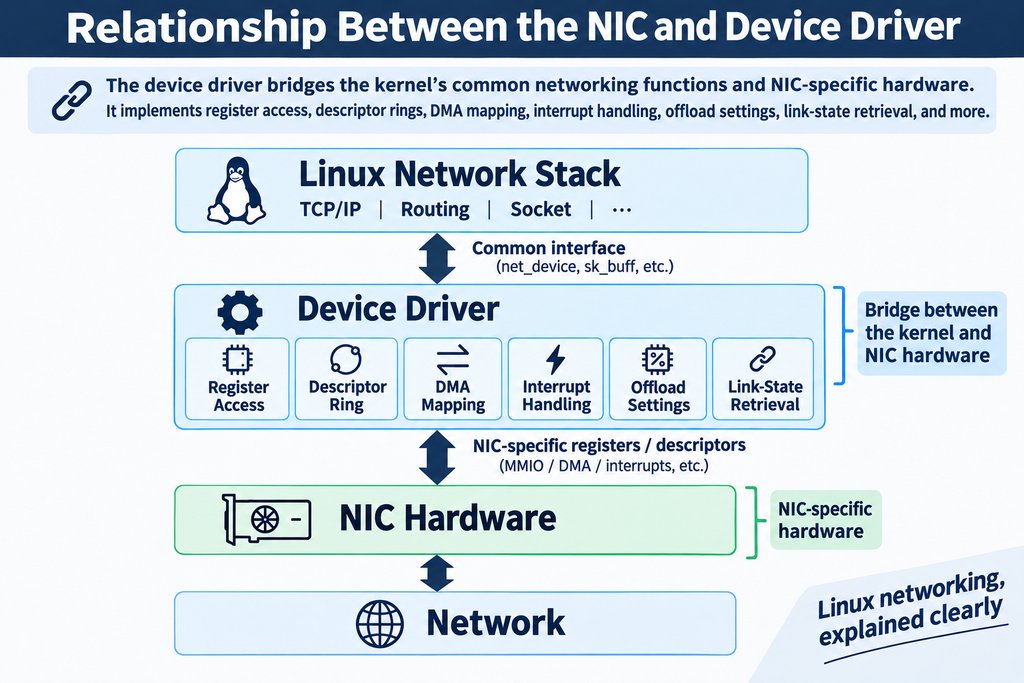
What does a Linux NIC driver actually do?
It bridges the kernel's network stack and NIC hardware.
Key functions:
① Register access
② Descriptor rings
③ DMA mapping
④ Interrupt handling
⑤ Offload settings
⑥ Link-state monitoring
More details👇
https://t.co/vbZbrNCTLf
What does a Linux NIC driver actually do?
It bridges the kernel's network stack and NIC hardware.
Key functions:
① Register access
② Descriptor rings
③ DMA mapping
④ Interrupt handling
⑤ Offload settings
⑥ Link-state monitoring
More details👇
https://t.co/vbZbrNCTLf
How does Linux process an incoming network packet?
The kernel processes it layer by layer:
① Ethernet (L2): MAC & EtherType
② IP (L3): IP addresses & protocol
③ TCP/UDP (L4): Ports & transport data
④ Socket: Receive buffer
More details👇
https://t.co/9bVBm4POsn
#Linux#TCP
What actually happens when Linux boots?
UEFI → GRUB2 → Kernel → initramfs → systemd
Each stage plays a different role.
Visual guide + real AlmaLinux 9 boot logs👇
https://t.co/M5eSObfpAS
CPU Internal👇
https://t.co/eWudDcxnKP
#Linux#RHEL#SRE
qdisc stands for Queueing Discipline.
It can handle:
• Queueing
• Scheduling
• Bandwidth shaping
• Packet dropping/marking
When packets accumulate in qdisc, queueing delay increases. If the queue reaches its limit, packets may be dropped.
What happens after an app sends data on Linux?
Application → TCP/IP → qdisc → Driver → TX Ring → NIC
qdisc queues and schedules packets, controls bandwidth, and may drop packets when queues fill.
More details👇
https://t.co/tLbstm2Eah
#Linux#Networking#TCP
How does Linux process an incoming network packet?
The kernel processes it layer by layer:
① Ethernet (L2): MAC & EtherType
② IP (L3): IP addresses & protocol
③ TCP/UDP (L4): Ports & transport data
④ Socket: Receive buffer
More details👇
https://t.co/9bVBm4POsn
#Linux#TCP
How does Linux process an incoming network packet?
The kernel processes it layer by layer:
① Ethernet (L2): MAC & EtherType
② IP (L3): IP addresses & protocol
③ TCP/UDP (L4): Ports & transport data
④ Socket: Receive buffer
More details👇
https://t.co/9bVBm4POsn
#Linux#TCP
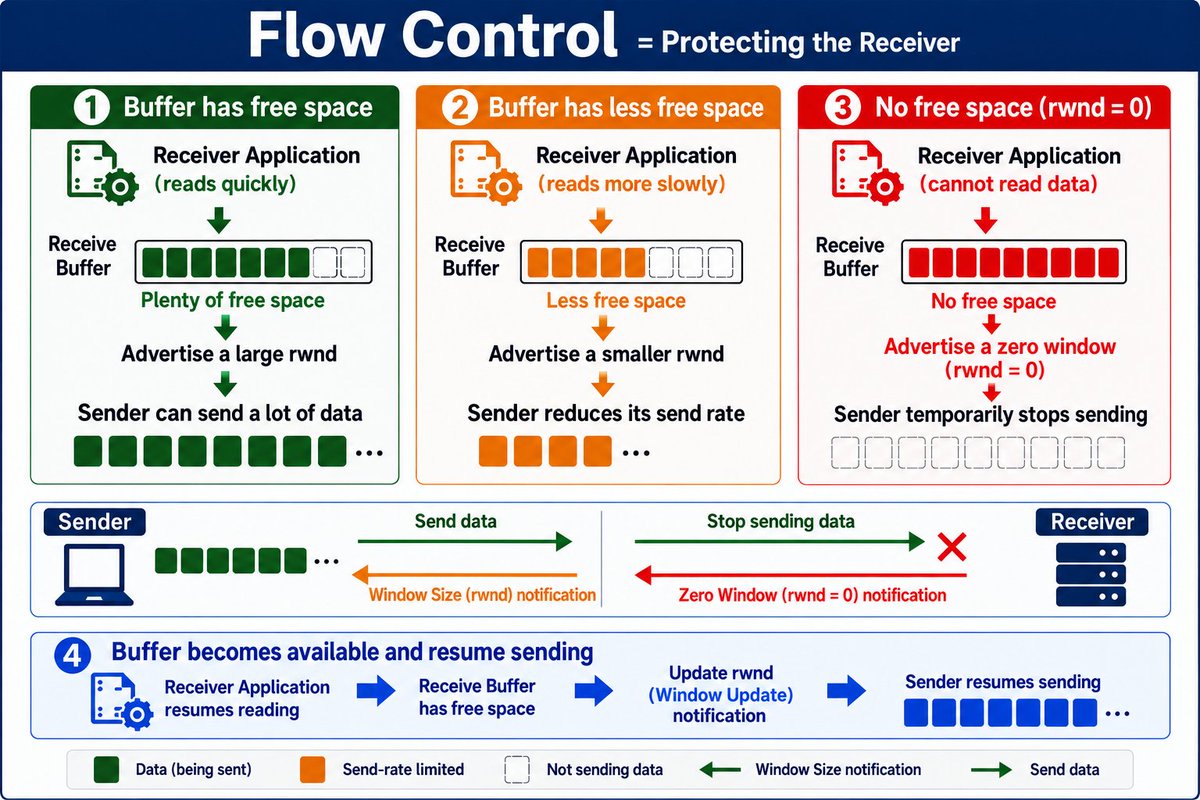
Why does TCP stop sending data even when the network isn't congested?
The answer is Flow Control.
TCP uses the receiver's advertised window (rwnd) to prevent its receive buffer from overflowing.
Here's how it works👇
https://t.co/I53mKjFjSi
#Linux#TCP#Networking
Why does TCP stop sending data even when the network isn't congested?
The answer is Flow Control.
TCP uses the receiver's advertised window (rwnd) to prevent its receive buffer from overflowing.
Here's how it works👇
https://t.co/I53mKjFjSi
#Linux#TCP#Networking