I visit a lot of Indian hardware startups.
I see a lot of JLCPCB boxes.
I always ask, "Why are you getting this done in China? Why not India? Aren't you worried your designs will be copied?"
The answer is always the same: "No Indian firm can beat Chinese prices."
I hate this answer. Not because it's inaccurate (it makes sense and I don't blame them for choosing the most affordable option, especially when they're bootstrapping). I hate this answer because I just really wish the reality were different.
And that's why I'm so glad Vishal Tejwani (@ivishaltejwani) exists. This man is singlehandedly trying to flip the script by putting affordable PCB manufacturing machines into the hands of every Indian hardware startup.
Right now he's offering three systems:
1. StencilStation - Rs. 15k
2. SolderStation - Rs. 22k
3. PlaceStation - Rs. 2 lakh
You can't beat these prices in India right now unless you build these machines yourself.
Also, big shoutout to @prakdadlani for being an early believer in Vishal's vision and implementing PlaceStation in his factory to move PCB assembly from China to India.
@Iamsamirarora I say don't even keep in bank FD as banks can vanish. Just get bundles of Rs 100 notes and keep under the bed storage. Dont keep 500s as they can be demonetized any time. 😂
In 2012, a 19-year-old aeronautical engineering student from Coimbatore presented propulsion research at a NASA event. Dr. APJ Abdul Kalam noticed, sought him out for a meeting, and handed him a recommendation letter with one challenge: prove your concept.
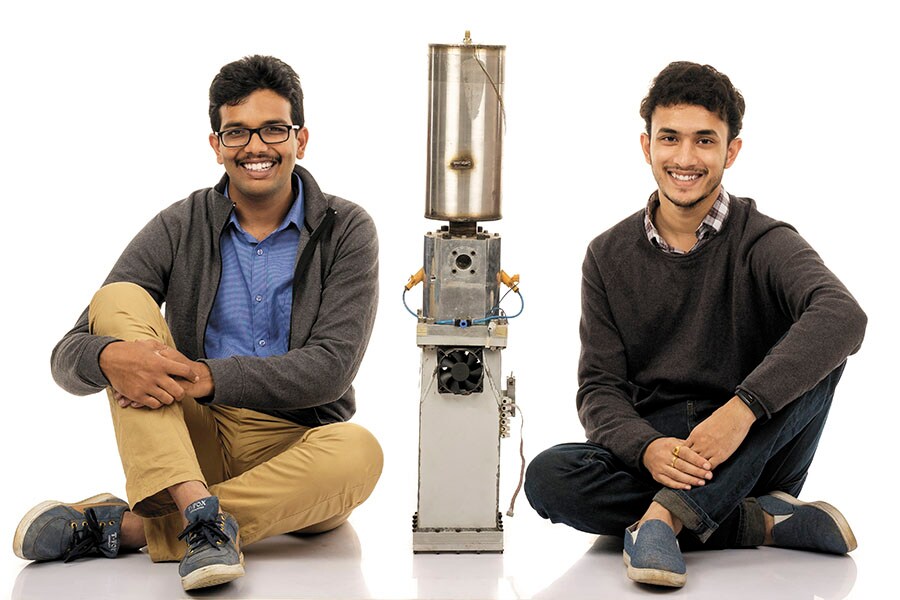
That student was Rohan M. Ganapathy. Three years later, he and family friend Yashas Karanam co-founded Bellatrix Aerospace from IISc's incubation lab in Bengaluru. The problem they chose to solve touches every satellite in orbit.
Nearly all satellites run on hydrazine, a propellant that has been standard since the 1960s. It is deeply toxic, carcinogenic, and so hazardous that it requires specialized crews and loading facilities near the launch site. India imports all of it. Nobody was building an alternative.
Bellatrix built two. Rudra is India's first high-performance green propulsion system, delivering hydrazine-equivalent thrust while cutting handling costs by over 60%.
Jal is a microwave plasma thruster that uses water as propellant, which Bellatrix claims is the world's first such system built by a private company. Both have been tested in orbit: Rudra fired on ISRO's POEM-3 in January 2024, and again on POEM-4 in January 2025.
Their third product, Pushpak, is an orbital transfer vehicle the company says can bring satellite deployment costs from $45,000 to $25,000 per kilogram. In October 2024, Bellatrix signed an MoU with ISRO's commercial arm, NewSpace India Limited, to integrate Pushpak into its launch missions. The company has raised $31 million to date, backed by BASF Venture Capital, Inflexor Ventures, and Cactus Partners.
For India, a domestic green propulsion stack means less dependence on imported hydrazine, lower costs for Indian satellite startups, and export-ready technology in a global market actively moving away from toxic fuels.
Kalam asked Rohan to prove his concept. More than a decade later, the proof has been fired in orbit.
@rohanooty@BellatrixAero@YashasKaranam
@Iamsamirarora Hi Samir Bhai, is there any study of FII in other countries that for how many years they invested and when they started getting out. I mean in decades terms,is it possible that they invest for 20+ years and then start taking money out to move to other markets?
This is the site where our new 100 acre Integrated PCB mega campus will be built in 🇮🇳
We have been working hard to fix the structual gaps in PCB manufacturing in 🇮🇳
Some of the problems are harder than we think and it takes time to fix those.
We have been working on fixing all those problems that every single customer has told us over time and we work hard to make sure that each of those are fixed by identifying the root cause.
Our dedicated team of Terra Circuits will be focused on some of these infrastructre related problems.
PCB Fabs- Inspired by the way TI expanded semicon fabs in Dallas, we will be taking a similar approch here. There will be multiple Fab Units that will be built over time in this campus.
PCBA- we will have enough lines to support our customers scaling to larger numbers.
Components warehouse- a fully automated warehouse to ship components the same or next day.
R&D center- to research and build technologies related to manufacturing, not just pcb. Semicon and advanced applied engg.
I am dedicating my next 10 years building this campus and change the way electronics gets manufactured in 🇮🇳
#JaiHind
Indian students are DIYing a semiconductor fab at IIT Bombay.
In just 10 months they've built:
1. A DLP-based lithography machine.
2. A tube furnace to oxidise silicon.
3. A DC plasma sputter.
Total cost: ₹30 lakh.
Here's a rare behind-the-scenes look at HackerFab IITB.
Over the last 4 years, the Indian American community and the Indian diaspora at large have taken it on the chin by one of the biggest recorded global psyops in history.
While Indians were working their as$es off in the countries they were in. Malevolent forces were secretly plotting against Indians to be dehumanized, scapegoated, and falsely accused.
What started as a basement dwelling groyper and Muslim brotherhood movement in 2022 in a union of the Red-Green alliance, quickly got picked up by many deep state actors and pushed forward.
Here is the official information on Indian origin crime in western countries. The Indian diaspora comprises 15 Million people, and only 10,500 are in jail/prison for various crimes. That’s only 0.06% of the population being used to broadbrush the entire Indian community. Thats absurdly insane and is clearly psychopathic to claim the Indian community.
And the whole H-1B fiasco? A complete fake out designed to distract. About 6600 Indians TOTAL have been caught with Visa issues. An even smaller percentage. Shame on everyone who amplified this narrative and continues to use it to gain false value out of the community. There will be an intake done on this side for that.
No free lunch, as they say.
@1shankarsharma@rab9604 Also with AI + Robotics, we would need fewer humans, so less jobs. In this new era, countries with lower population and higher per capita GDP will thrive, rest will perish.
At IIT Bombay, three undergraduates have spent ten months building a semiconductor fab from scratch, fabricating their first working devices this week.
A complete NMOS transistor — on tools they made themselves — is expected by the end of the summer. 🧵
My assumption is in next 5 years, 99.9% user will have local inference and compute, running on desktop/laptops. Only advance technologies would require Cloud #AI.
SHOCKING: AMD CEO Lisa Su Unveils ‘Lunchbox-Sized’ AI PC That Runs 235B-Parameter Models Locally, Challenging Nvidia’s High-End GPUs
Powered by the Ryzen AI Max+ 395 and up to 128GB of unified memory, the compact system can run massive AI models without the cloud, data centers, or expensive GPU setups.
The move marks a major step toward affordable, private, on-device AI and could reshape how developers, startups, and enterprises deploy large language models.
Inverters, generators, air purifiers, water filters, storage tanks…so much of what we buy is a compensation for inefficiency. On the Inefficient Economy. Today in the TOI
🚨 MASSIVE: DRDO Cracks One of the World's Toughest Jet Engine Technologies, Develops Single Crystal Blade Tech
DRDO has successfully developed and perfected Single Crystal Turbine Blade technology, an achievement that places India among a small group of nations capable of producing one of the most sophisticated components used in modern jet engines.
At first glance, a turbine blade may appear to be just another metal component. In reality, it operates in one of the harshest environments known to engineering. Inside a fighter jet engine, these blades must withstand temperatures exceeding 1,500°C while spinning at tens of thousands of revolutions per minute. Even the smallest structural weakness can lead to catastrophic failure.
That is where single crystal technology becomes crucial.
Unlike conventional metal components, which are made up of multiple grains separated by microscopic boundaries, a single crystal blade is manufactured as one continuous crystal structure. The absence of grain boundaries eliminates weak points, allowing the blade to endure extreme heat, pressure, and mechanical stress that would destroy ordinary materials.
Developing such blades is considered one of the most difficult tasks in aerospace engineering. The manufacturing process requires extraordinary precision, from casting the crystal structure to machining cooling channels and achieving the final surface finish. A minor defect at any stage can render the entire component unusable.
Recognizing the maturity of the technology, DRDO has now invited private-sector companies to participate in its industrialization and large-scale production. The goal is not merely to manufacture the blades but also to obtain airworthiness certification, ensuring they meet the demanding standards required for operational aircraft engines.
The breakthrough carries major strategic implications. It strengthens India's ambitions to develop indigenous aero-engines, including future variants of the Kaveri engine, next-generation fighter jet engines, helicopter engines, and advanced gas turbines. Most importantly, it reduces India's dependence on foreign suppliers for one of the most sensitive technologies in the aerospace sector.
For years, aero-engines remained one of the few areas where India lagged behind the world's leading military powers. With the successful development of single crystal turbine blade technology, that gap has become significantly smaller.
What was once an exclusive capability of a handful of nations is now firmly within India's grasp.