For decades, B2B GTM ran on one brutal truth:
80% of your market wasn't buying. 20% was.
So you built funnels.
Nurtured sequences.
Ran awareness campaigns for years just to be in the room when someone finally entered the market.
That was the game. And everyone played it.
I think that's about to completely flip.
For the first time in B2B history, I'd argue 80% of your market is now open, not closed.
Because AI has made people genuinely willing to change how they work in ways nothing else has in 20 years.
This isn't a trend.
It's a structural shift.
And most GTM teams are still playing the old game.
Still nurturing.
Still warming up audiences that are already warm.
Still treating buyers like they need convincing when they're actually out there looking.
The playbooks that win in this environment aren't outbound sequences and retargeting campaigns.
They're product evangelists.
Founder brand.
Showing people something that makes them feel the gap immediately.
If you're building an AI product that genuinely changes how work gets done, you don't need to convince people there's a problem anymore.
You just have to find them before someone else does.
The tsunami has started.
Most people haven't looked up yet.
What do you think is the future of GTM?
Replacing your marketing team with AI agents is nonsense.
Not just from an efficiency standpoint. From a spiritual one.
You chose to be an entrepreneur. You put your hand up and said you wanted to make a dent in the world. Nobody put you here. This was voluntary.
So why would you want to build something remarkable with a room full of workflows instead of people?
Anyone who has ever built something material wanted to build a team. A go-to-market unit.
People who are bought in, who care, who argue about the strategy. That is not overhead. That is the entire point of building a company.
What reputable companies are actually doing is replacing discombobulated marketing. The media guy with no idea what the SEO guy is running. The inbound team with zero visibility into what outbound is doing.
That fragmentation is the real problem. AI fixes that by making you a full-stack marketer. That is it.
And then there is brand. Brand is not a conversion rate. Brand is a feeling. Its the people behind it. People have associated themselves with companies whose marketers they respected for years.
Replace that team with a workflow diagram and you have polished output with no real identity.
We are building go-to-market units at Intempt. Full-stack marketers who use AI as an extension of themselves.
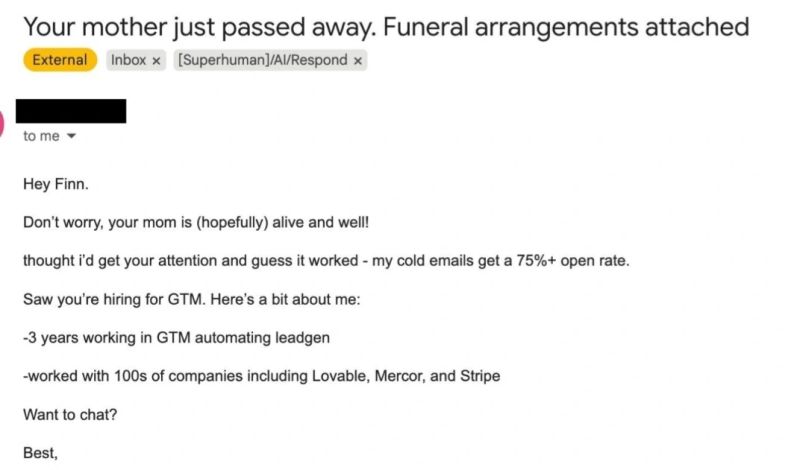
Someone sent this cold email with the subject "Your mother just passed away."
I don't think it's fake. Sadly.
I've gotten versions of these. Triggering subject lines. People calling you names just to provoke a reaction. Calendar invites sent cold just to show up in your schedule.
All of it is desperation. And it tells you exactly where cold email is right now.
Cold email has become a website traffic channel. Not a channel where people want to talk to you.
Adam Robinson landed on the honest formula. He spends a few dollars a month, sends millions of emails, says "here's what we do, here's a link," and watches website traffic go up. He is not booking meetings from it. He is getting brand visibility. That is actually the right use case now.
Even if your AI SDR does every piece of research before sending, you are still guessing. You are guessing the person has a budget. You are guessing they do not already have a vendor they trust. You are guessing they have ten minutes for a call.
Good signals still leave a lot of guesswork.
What is left is a downward spiral. Tools get cheaper, volume goes up, inbox providers fight back, deliverability drops, so people push harder.
Subject lines get more & more extreme. The inbox gets harder to reach.
Using cold email like cheap display advertising. Here is what we do, here is a link, go check it out. Stop chasing meetings with it.
This is the reason we pulled out of building cold email products.
Had a call last week with the founder of a furniture brand doing $8M/yr
Asked what they do when someone spends minutes on a product page & leaves without buying.
She said: we retarget them, & send emails usually with a discount.
Two hours later. After the customer Session is long gone.
And the discount is the wrong read of that session entirely.
Someone spending minutes on a $3,000 sofa is not hesitating because of price. That is a high-consideration browsing session. They want product information. A room size comparison. Maybe a conversation with someone who knows the material.
A coupon is not what that session is asking for.
This is the state of ecommerce in 2026.
We have more behavioral data per session than we have ever had. Scroll depth. Hover patterns. Time spent on specs versus reviews. Reading the return policy. These signals are not all saying the same thing.
Some sessions are telling you: this person wants to chat. Some are saying: send a brochure or a video. Some are saying: get them on the phone. And some are not ready for any of it yet. Let them browse.
Luxury goods. Furniture. Watches. These categories run 10 to 15 minute sessions routinely. Long, deliberate consideration.
Treating all of it with a Email/SMS drip and an abandonment discount is the laziest possible read of the data you already have.
The unlock is not better CRO. It is reading what the session is asking for in real time and responding correctly. Depending on the signals.
That is a different architecture.
The biggest GTM mistake isn't your messaging.
It's not your funnel. It's not your ICP doc.
It's overestimating how many people actually want to change.
I built software for years that worked. Genuinely worked. Saved time, saved money, did the job. And it still didn't move markets the way I expected.
Because in a saturated market, “better” isn't enough to make someone switch. Even if you're cheaper. Even if you're faster. Even if you're genuinely different.
The hard truth: in a mature market, maybe 10–20% of buyers are actually open to you on a good day. The rest? They're not evaluating you. They're not even looking.
So you end up pushing.
Outbound.
More email.
More sequences.
You grind to $1M. Maybe $2M.
But pull? That's the game.
Getting to $10M with pull, where people come to you, tell others, and actually want to switch, that requires being different at a level most founders underestimate.
Not a little different. Disruptively different.
AI changed this for us. Not because we got better at marketing. Because the product became genuinely more disruptive. That's the only thing that actually moved the market.
Be different. And then ask yourself: different enough?
That's the lesson.
Took me years :))
What is your lesson?
Tell me in the comments below!
Someone sent this cold email with the subject "Your mother just passed away."
I don't think it's fake. Sadly.
I've gotten versions of these. Triggering subject lines. People calling you names just to provoke a reaction. Calendar invites sent cold just to show up in your schedule.
All of it is desperation. And it tells you exactly where cold email is right now.
Cold email has become a website traffic channel. Not a channel where people want to talk to you.
Adam Robinson landed on the honest formula. He spends a few dollars a month, sends millions of emails, says "here's what we do, here's a link," and watches website traffic go up. He is not booking meetings from it. He is getting brand visibility. That is actually the right use case now.
Even if your AI SDR does every piece of research before sending, you are still guessing. You are guessing the person has a budget. You are guessing they do not already have a vendor they trust. You are guessing they have ten minutes for a call.
Good signals still leave a lot of guesswork.
What is left is a downward spiral. Tools get cheaper, volume goes up, inbox providers fight back, deliverability drops, so people push harder.
Subject lines get more & more extreme. The inbox gets harder to reach.
Using cold email like cheap display advertising. Here is what we do, here is a link, go check it out. Stop chasing meetings with it.
This is the reason we pulled out of building cold email products.
Three years of AI video progress is not THE story.
Actual story is what happens when tools do 80% of the work & the creative does 20%.
For years it was the opposite. Creatives carried 80%, tools did 20%. That has flipped.
But let me be clear about that 20%.
One-shot AI videos are impressive. A Christmas campaign where Santa has to look consistent across 40 assets, same clothing, same face, same scene language, is not a one-shot job.
A product catalog shoot is not a one-shot job. A paid media campaign running across TV, billboards, and social is not a ONESHOT job.
Precise means on brand. Controlled means consistent across every shot in a campaign, not just across the brand.
That 20% the creative now owns is not less work. It is more critical work. It is taste. It is the ability to run multiple edit operations until the output matches what the artist actually sees.
LLMs will keep getting better at raw output quality. The prompt-to-result gap will close. That is inevitable.
The innovation in the next generation of creative tooling is not better generation. It is better control.
Giving the artist the ability to direct the LLM the way a director directs a set. Shot by shot. Full authority over every decision.
Why control & precision? Because the world wants TASTE.
For years factories produced things at scale. The world made it clear it does not want factory output.
That is what we are building in @Intempt's creative studio.
Multiple edit operations that put the creative in full control of the output.
Anthropic just showed how their sales AE uses Cowork. It is worth studying and then understanding where it breaks.
What they built is legitimately good.
One command before a call and Claude pulls 90 days of recordings, Salesforce opportunities, revenue data, Slack threads, emails, and live web search. Full account brief in minutes instead of two hours across six tabs.
That is a real improvement. Give them credit for it.
Now here is the problem.
That model works for a deal you close in six weeks. It does not work for a nine-month enterprise cycle with fifteen stakeholders, four active opportunities, and dozens of calls across different teams with different objectives.
We are in the middle of one of those deals right now. I will not name the company. That account has months of recordings, threads across Slack channels, multiple email conversations, and a different objective on every call depending on who is in the room.
What you cannot do is pull all of it and shove it into the context window. The token cost compounds. And the output degrades because the model is sorting through noise instead of surfacing signal.
This is brute force AI.
Most AI-connected tools are doing exactly this right now: connect to everything, pull everything, dump everything. It looks powerful in a demo. It is not scalable in a real account.
The actual problem is CONTEXT intelligence.
For Thursday's call with the procurement lead, what does the model actually need? Not the full nine months. It needs the last two touchpoints with that stakeholder, the commercial terms on the table, and the specific objection raised in the previous call. That is it.
For Friday's call with the CTO, the brief is different.
An intelligent meetings system does that mining. It understands the deal stage, who is in the room, what the objective is, & feeds the LLM the minimum context required to give you precise prep.
Pre-meeting prep built on the right slice. Live assist that stays relevant. Post-meeting follow-up that reflects what actually happened in the room.
That is what we are building with the Intempt meetings product.
A system that knows what matters for this call and feeds the model exactly that.
Feed the LLM less & get better answers. At a fraction of the cost.
Brute force AI will get you a demo. Context intelligence will run the deal.
If I had to take a Shopify store to $1M without increasing ad spend, here's exactly what I'd do. Skip everything else & read this:
1. More traffic won't save you if your site doesn't convert.
Brands pump money into ads and chase new channels, but if the site has holes, nothing can save you. Fix the site first.
2. Stop measuring success by conversion rate alone.
Conversion rate tells you how many visitors buy. AOV tells you how much they spend when they do. Combine them and you get RPV - revenue per visitor. Subtract costs and you get PPV - profit per visitor. That's the number that actually matters.
3. Fix your offer and test your price before anything else.
Offer means the price, bundles, upsells, guarantee, and how you position the value. And price is the highest-leverage test you can run.
4. Stack pre-purchase and post-purchase upsells.
Pre-purchase pop-ups work. Post-purchase upsells on the thank you page work better because the order is already done. Now you're just increasing the value of a customer who already said yes.
5. Your assortment is your real moat.
The stores that scale without more ad spend have products people genuinely can't get anywhere else. Unique sourcing. A catalog nobody else has built. If your products look like everyone else's, price becomes your only lever. That's a race you don't want to run.
6. Sort your imagery before you sort your emails.
You can have the best lifecycle strategy in the world. If your product photos look like they were taken in a car park, you're dead before the email even lands.
7. Mine objections from Amazon, TikTok and Reddit
Then answer them with your best reviews. 1-star reviews and comment sections tell you exactly what buyers are afraid of. Bake those fears into your product pages and email flows.
8. Strip your homepage back and kill cart friction.
Key products front and centre on homepage. Then slide-out cart, every payment option, auto-detect currency. Fewer decisions between interest and purchase means more purchases.
9. Pull your repeat purchase rate before running any campaign.
Build your welcome series, post-purchase flow, and win-back sequence around closing that gap. These three flows alone drive 30-40% of email revenue in most stores. In Intempt, you can have all three live in an Instant.
10. Stop sending the same email to everyone.
First-time buyers need activation. Repeat buyers need recognition. Lapsed customers need a reason to come back. Use purchase history to personalize what each customer sees next.
Every layer multiplies everything underneath it.
That's how you get to $1M without buying a single new click.
Some of the best people I work with don't want flexibility.
I have someone at @Intempt who works 9 to 5. 50 weeks a year. He wants his space, he wants his two weeks off at the end of the year, and he doesn't want to be bugged. That's his game.
I have other people who want fluidity. They handle family things mid-day and catch up in the evenings. That's their game.
Both are right.
The flexible work posts on LinkedIn are comparing themselves to the wrong thing.
The bar is the cubicle company that badges people in at 8:59 and docks pay if they leave at 4:58. Of course, you're better than that.
But calling those values is a low bar.
The real conversation is about reciprocity. And about treating people as individuals, not as policies.
"We're a flexible company" is still a policy. Just a different one. It flattens real people into a single answer and calls it culture.
What bonds a team isn't policy. It's a ritual. Starting the day together. A shared operating cadence. Something that makes the work feel like more than a transaction.
Company culture is real. Individual culture is real. Both deserve respect, not just one.
If you want to attract serious talent and build something that lasts, ignoring this is just bad business.
But the answer isn't announcing how flexible you are on LinkedIn.
Know your people. Work with who they actually are.
Your Klaviyo bill tripling while your list size flatlined is a real problem worth solving.
But here's something nobody is going to say: the whole conversation of Klaviyo vs. Omnisend vs. Mailchimp, migration pain, flow rebuilds, Shopify integration reliability
These conversation isn't going to change your revenue.
Your ESP is the last mile. It's not the engine.
A lot of small eCom businesses are spending serious mental energy on the last mile while the engine is sputtering.
I know a founder whose family has been in ecommerce for 10 years. Went from under a million to over a million in GMV. What drove the growth had nothing to do with which email platform they used.
Three things to note.
One: assortment. Do you have products people genuinely can't get anywhere else? You can't email your way past a weak catalog. If someone else sells the same thing cheaper, your open rates don't matter.
Two: imagery. Not AI-generated stock. Real photographs. Products from every angle. The browsing experience is where purchases are decided, well before the email lands.
Three: catalog ads & recommendations. Take that imagery, load it into ad templates that convert, run it across every major network. Run great product recommendations on web & app from real browsing behavior
The email platform matters. But it's downstream. Get these three right and the ESP question gets a lot smaller.
If you're a small ecommerce founder questioning every tool cost right now, that's a healthy instinct. You should be questioning it.
The switch to Omnisend might save you a few hundred a month. Getting your assortment and your imagery right might add tens of thousands.
Both things can be true. @Intempt fixes both these things.
Start with the one that moves the bigger number.
One marketer running five channels at @AnthropicAI is impressive. But it's also not the full story.
The credit goes to Claude Code, and it's a great tool. But Claude alone doesn't give you lifecycle, targeting, personalization, experimentation, and design in one place. It gives you a raw model. You're still the integration layer.
Here's what's actually happening in 2026.
PLG SaaS is back with a bang, especially for AI companies. You have product data, free-to-paid signals, in-app behavior, email, push. The data surface is massive. One person who knows how to read that data and turn it into messaging can absolutely do what lifecycle teams, ad teams, and creative teams used to do separately.
But that person needs to be genuinely good at two things: data and creative.
They need to understand audiences. Who to target, when, and why. And they need to understand messaging. What to say, in what tone, with what angle.
AI fills the gaps between those two things. It generates the creative. It reads the signals. It writes the copy. It runs the test.
But the judgment still has to come from a person. Someone who knows what good looks like in both directions.
If you're a 1-11 person team asking whether one marketer can run your entire GTM, the answer is yes. But the tools you pick determine the ceiling.
Claude alone is still pretty raw for this. You need a growth platform that handles data, design, journeys, personalization, and experimentation together. Without that, your one marketer spends half their time being glue.
The ceiling for a single-person GTM operation isn't headcount. It's the platform underneath them.
That's what we built @Intempt to be.
I'm DONE with the AI replacing marketers & sellers conversation.
Because it's asking the wrong question.
Let's face it: a lot of marketers & sellers aren't that good. They can't design. They don't read data well. They write emails that don't land. They don't run good meetings. They don't close.
That's not a new problem. AI didn't create it.
The better question is: what if AI made every marketer & seller genuinely better?
If AI is taking your job, it means you were bad at it, that's not a threat.
What's actually worth talking about: AI making marketers & sellers better.
Not AI doing the job instead of you. AI giving you capabilities you didn't have before. The ability to read more signals. Produce better creative. Write copy that sounds like you've actually thought about the person on the other end.
AI made me a better marketer. I can see more, move faster, and produce things I couldn't produce two years ago.
That's the conversation worth pushing. Not who's going to survive the AI wave.
@Karpathy just joined @AnthropicAI.
And if you don't know who this guy is, here's the short version.
He's one of the brightest minds in AI of our era. And here are just a few of his projects.
He co-founded OpenAI. Then he made Tesla's Autopilot actually work. Then he went back to OpenAI. Then he left again and started his own AI education company. And now Anthropic?
Wait. Hold on.
Before we get to why, you need to know what this guy built in his spare time. NanoGPT, MicroGrad, llmc. Stripped-down implementations of the most complex AI systems in the world, so that literally anyone could open the code and understand how they work.
He gave AI to the people, basically.
So why Anthropic?
This isn't just a hire. It's a deliberate strategy. Anthropic is betting on AI-assisted research over raw compute to stay competitive with Google and OpenAI.
Karpathy is building a dedicated group that uses Claude to accelerate the research itself.
AI building better AI.
And honestly? It makes complete sense. Everything Karpathy has ever built was about making AI smarter through understanding.
What do you think about this?
@AnthropicAI just took 34% of enterprise AI customers. A year ago they had 9%.
The internet is calling this a model quality story. IT'S NOT.
It's a focus story.
Both @AnthropicAI and @OpenAI started with the same strategy. Build a great consumer product and use it to land enterprise. @SlackHQ did the same thing. The motion is not new.
The difference is what Anthropic chose to focus on.
Anthropic decided to solve code gen, and solve it really well. They believed if you could solve code, you could solve everything. Because everything is ultimately a coding problem. Spreadsheets, diagrams, workflows: Claude writes code for all of it. It treats the whole world as something to be encoded.
But they didn't jump straight to code. First they solved writing. Then they said: now let's solve code. That progression matters. It's how you build something that actually sticks.
OpenAI operated more like a portfolio. Image gen, video gen, code gen.
Sam Altman ran it like a VC, because he is one. Y Combinator trained him to diversify bets. That's the right instinct for a fund. It's the wrong instinct for a company trying to win a category.
Diluted focus is one of the most classic ways to lose.
Now entrepreneurs come to me and ask: does this lesson apply to us? In an AI world where anyone can build any software, does focus even matter?
More than ever. But the nature of focus has changed.
You can't build a small single-feature product and reallyyyy scale it anymore. Anyone can replicate it in a weekend. The threat is not that your idea gets stolen. It's that it becomes a commodity before you finish building it.
So you have to build more. But you have to build it all for one kind of person.
Look, it's not about picking one feature. It's about picking one person with one problem and going deep. A designer on a GTM team is not the same person as a designer on a product team, even if they look at some of the same data. One is building great product. One is building great revenue. Completely different orientation.
We build a lot at @Intempt. Marketing tools, sales tools, analytics tools, design tools. But all of it is built for one person sitting on one problem: REVENUE.
Our meetings tool is built for sellers. Not the broad audience Fathom and Firefly are chasing. Sellers, specifically.
Our analytics are built for marketing and growth teams. Not general-purpose dashboards.
The lesson from Anthropic is not "do less." It's build more, but build all of it for one person with one problem.
OpenAI didn't learn that fast enough.
https://t.co/InEAspIXG2 fired 100 SDRs.
Everyone is saying AI killed the role. That's the easy story. The real one started a decade ago.
SDR teams were never really about selling. They were about qualification.
Inbound SDRs qualified demos. Outbound SDRs qualified cold lists. BDRs did relationship building. All feeding into AE pipelines, all built around $5K to $10K ACV deals and a 12-month CAC payback window that VCs were happy to fund.
The math worked. Until it didn't.
Two things broke it, and neither of them was AI.
1. SaaS commodified. The amount of software available, even pre-AI, became so vast that VCs could no longer get a return on companies using this model unless the product was genuinely differentiated. The economics that justified large SDR teams started cracking well before OpenAI happened.
2. Software got easier. PLG, self-serve, free plans. When customers can try the product themselves in 10 minutes, you don't need someone to qualify them into a demo. The gating that made SDRs essential quietly disappeared.
Companies figured this out, dropped entry prices to zero, and let self-service do the qualification. The SDR team was already redundant before any agent entered the picture.
Now AI agents are getting the credit for a death that was already in motion.
The human element is not gone though. People still want to talk. They still want to walk through software with someone. That behavior is not dying.
What died is the factory model. University graduates trained in inbound and outbound scripts, promised AE roles as a reward, deployed at scale on a VC-funded CAC formula that no longer holds.
Monday's move makes sense in that light. Agents handle the volume. The humans go deeper.
What do you think?
SDRs are losing 2.5 to 3 hours every single day.
Not because they're slow. Because their tools are.
I had a RevOps lead send me a @Loom . She recorded herself walking through what happens after every call. Rep finishes the meeting, closes @Zoom , and immediately gets pulled into @SlackHQ for something else.
Twenty minutes later, comes back. Opens @Salesforce. Stares at it. Writes: "Good call, discussed pricing, will follow up Friday." That's the entire update. The actual conversation? It's sitting in Gong somewhere, untouched. The follow-up email? Gets written from memory two days later. The next rep on the account? Walks in cold.
Here's what's actually broken: Your meeting is in one tool. Your context is in another. Your follow-up is going somewhere else. And the next person has zero insight into what was actually discussed.
She timed the full sequence. 11 minutes per meeting. Her team was running 15 meetings a week. That's 165 minutes a week on manual work that shouldn't exist in 2026.
Most teams I talk to blame the rep: bad logging discipline, no follow-up rigor. And yeah, reps could care more. But you've also built a system where they're expected to manually transfer information between five tools right after the most important conversation of the week. You blame them for not doing it perfectly. I blame the architecture.
You've put the richest signal in your entire pipeline - what the prospect actually said - into a silo, completely disconnected from everything else.
One system closes that gap. Meeting → CRM → Follow-up → Journey context. All connected. All from the same data. Your reps stop switching between tools. The data stops being fragmented.
We built this into @Intempt specifically for this. The Meeting Notetaker unifies the call, the follow-up, and the context automatically.
I keep seeing deals go quiet after the meeting. Not because the prospect lost interest. Because the rep got pulled away, and nobody else could see what actually happened. That's the gap worth closing.
6 things every AI image prompt should include.
@Google just put this out for Nano Banana. Most people throw a one-liner at the model and wonder why the output looks like everyone else's. This explains why.
1. Subject: Who or what is in the image. This is who the model is drawing. "A timeline of space exploration milestones."
2. Composition: How the shot is framed. Without this, the model guesses the layout. "Vertical infographic layout with sections."
3. Action: Explain what's happening in the image. "Comparing data points side by side."
4. Location: Where the scene takes place. Background, context, setting. "A clean white background with subtle grid lines."
5. Style: The overall aesthetic. Think of it as the art direction. "Flat design with bold colors and icons."
6. Editing instructions: Only if you're modifying an existing image. "Replace the pie chart with a bar graph."
Leave any of these out, and the model makes a call you probably won't like.
And if you want to take it a level further, Google also recommends layering in:
→ Aspect ratio ("9:16 vertical poster")
→ Camera and lighting ("no shadows")
→ Text integration (Title 'XX' at the top)
→ Reference inputs ("Use Image A for the layout")
Every tool this week runs on what you defined, not what it ships with.
1. @Higgsfield Supercomputer: Creative Bottleneck Moved from Tools to Coordination. Takes a brief and chains 40 tools to a finished asset, no human triaging each step. Informal standards get scaled here, not fixed.
[https://t.co/ujqMHkOwK0 ]
9. @AnthropicAI Self-Hosted Sandboxes: Enterprise Cleared to Deploy Claude Agents. Tool execution stays on your own servers. Cloudflare, Daytona, Modal, Vercel. The main security blocker for Claude agents is gone. Thinking still runs on Anthropic's servers. [https://t.co/kzxYPlnwyu ]