Introducing Cues: Voice & Gesture control for Matic
We raised $115M and spent 9 years to make the world’s first intuitive home robot
Say you spilled coffee: Point to the spill and say, "Hey Matic, clean this" and it will hear, see, locate in 3D, and go clean on its own.
Matic comes with a lot of features:
1. Say "Hey Matic" - it locates your voice, turns, and looks at you
2. Say "Hey Matic, follow me" and start walking. Matic will follow behind
3. Say "Hey Matic, go clean the living room". Since it knows your house map, it navigates and just does it
It's so easy, a 5 year old and an 80 year old can use it and it understands 75 different languages.
Matic has 8x the airflow, specialised cleaning algorithms for rugs, corners, toekicks, mopping, etc and cleans better than any other robot vacuum.
Also keeps improving with software updates.
13,000 families use and love Matic.
WIRED magazine gave it a 10/10 (the only hardware to receive this rating in a decade)
Buy yours at https://t.co/nLfY5pchxB and if you don't love it after 6 months, we'll give you a full refund.
To celebrate our launch, we're cleaning 300 homes with Matic in San Francisco and New York City.
Comment "Matic" below, we'll send you the link to sign up and come to your doorstep to clean your home with Matic.
January 23rd was the first time our robot heard "Hey Matic" and turned to look at the person who said it.
Matic Cues came from one idea: being useful is not in conflict with delight, intentionality, and purpose. A remarkable product does something you wouldn't expect it to do and makes you want to tell someone about it.
Every revolutionary product introduced an interface - the mouse made the personal computer, the click wheel made the iPod, and multi-touch made the phone.
This pattern applies to robots because of a fact that applies to none of those objects: a robot is never with you. A computer is under your hands; a phone is in your pocket; a robot is in the next room, under the table you're eating at. Every interface we've inherited assumes the device is within reach. A robot is the first consumer object where that's false.
And that's why it turns to face you: a device that's never within reach has to find you. You don't tap a robot. You don't learn an app for a robot. You tell it what you want, and if it's somewhere in particular, you point. Voice carries what. Gestures carry where.
How we built it, in the thread:
I didn’t design Matic Cues UX/UI for “users.” I built it for my mom, my grandma, and my 7 year old niece.
I kept asking myself the same questions: Could my mom do this without calling me first? Would a kid read even one line of instructions?
No, they wouldn’t. So I stopped writing long paragraphs of instructions.
“Hey Matic, clean the kitchen” is an easy thing to say. Keeping it that simple took a lot of work.
Two rules guided the whole thing. First, show exactly what Matic will do and what it’s doing right now. Do not explain with paragraphs. Second, don’t explain the feature in onboarding. Give someone a real command and let them say it out loud.
Then the tester notes started coming in. A daughter playing with “follow me.” A son who won’t stop bossing Matic around. A niece who says “Hey Matic” every morning, and nobody told her to.
Those notes meant more to me than any metric. I didn’t care whether people understood the feature. I cared whether it could become part of their everyday lives and eventually stop feeling like a feature at all.
One of the details from the design process 👇
How do you tell someone “I didn’t get that” without saying a word? Humans use body language and sound. So does @maticrobots - that’s cues and it goes both ways
It took us 9 years, 11 prototypes, and our life savings to learn that every great product has the same design process.
Matic is now decisively the best home robot for families (I'm biased)
A 500-word thread and video on the Universal Design Process behind every great product:
It took us 9 years, 11 prototypes, and our life savings to learn that every great product has the same design process.
Matic is now decisively the best home robot for families (I'm biased)
A 500-word thread and video on the Universal Design Process behind every great product:
100% Privacy:
Matic works on Nvidia Jetson Orin Nano so you never have to trade your family's privacy for a clean floor.
Every data Matic collects is processed on the device and is deleted and discarded in real-time.
Matic has 5 cameras. Why not LiDAR like every other vacuum?
LiDAR fires lasers to detect that something is there.
But it can't tell a wall from a toy from a cable. So the vacuum gets stuck, shreds rugs, and needs babysitting.
Cameras let Matic actually see like a human.
Announcing $60M for @maticrobots.
We didn't ask "What's the most impressive robot we can demo?"
We asked "What's the most useful robot we can ship? What comes after Roomba?"
Customers answered with their wallets: It's Matic.
After 25 years of robots going in circles... it's time for something smarter.
To get your own custom Matic lego kit ⬇️
✅ Tag @Matic
✅ Repost
✅ Copy & submit using this link: https://t.co/9nqVYkxXxC
You have until February 2nd to participate!
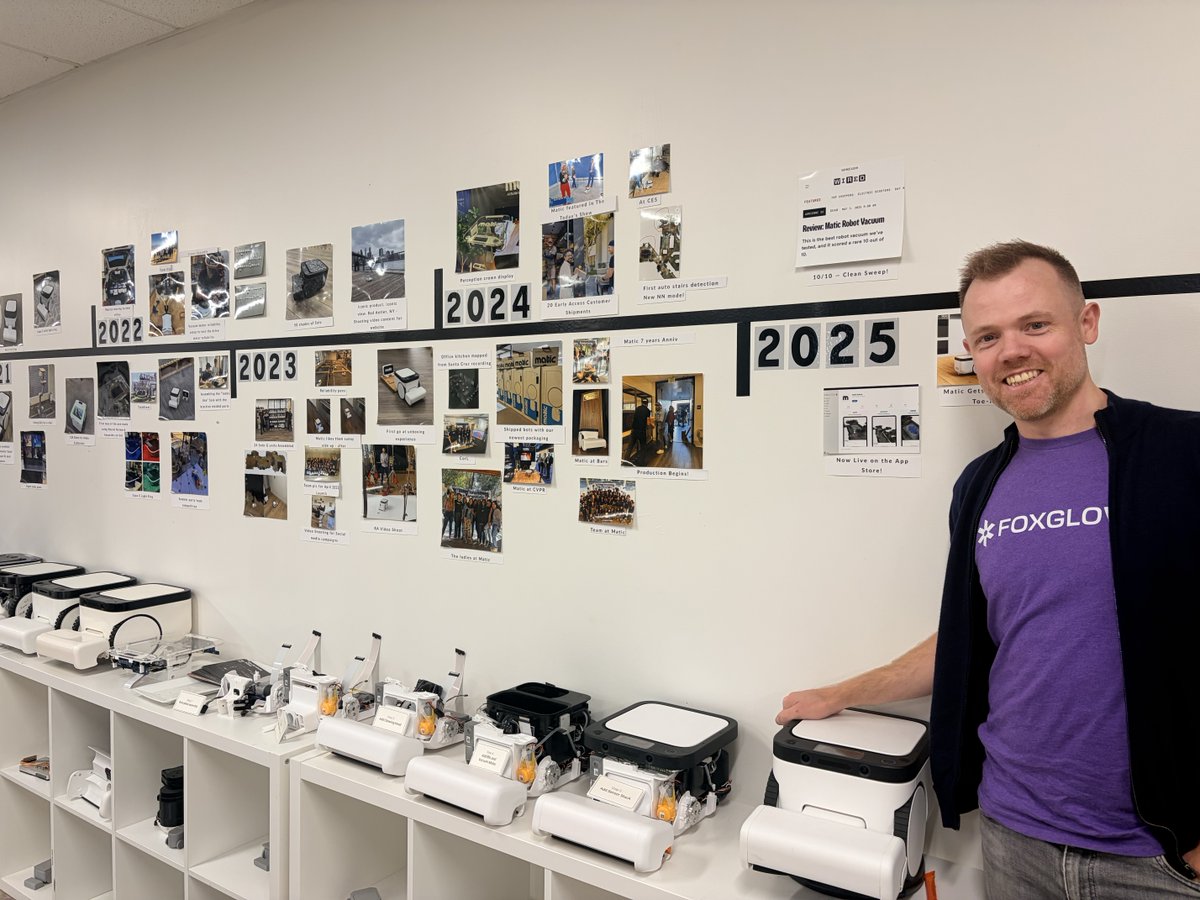
Dropped in to visit @mehul@maticrobots yesterday. Really incredible what this small team has achieved - one of the few shipping real robots into homes!
Best part: we now have a pet Matic roaming the @foxglove office.