DEUTSCHE BITCOINER - JETZT SEID IHR DRAN. 🇩🇪
Die einjährige Haltefrist auf Bitcoin steht auf der Kippe.
Wenn sie fällt, wird Sparen in Bitcoin steuerlich bestraft und Deutschland verliert einen seiner letzten echten Standortvorteile.
Die Petition wurde am 30. Mai eingereicht und wartet auf Freischaltung beim Bundestag. Sobald sie live geht, haben wir 6 Wochen, um 30.000 Unterschriften zu sammeln. (Das ist die Schwelle für eine öffentliche Anhörung im Bundestag)
Was du jetzt schon tun kannst:
→ Bundestag-Konto vorab anlegen, damit du am Tag 1 mitzeichnen kannst
→ Diesen Post teilen, damit es jeder deutsche Bitcoiner mitbekommt
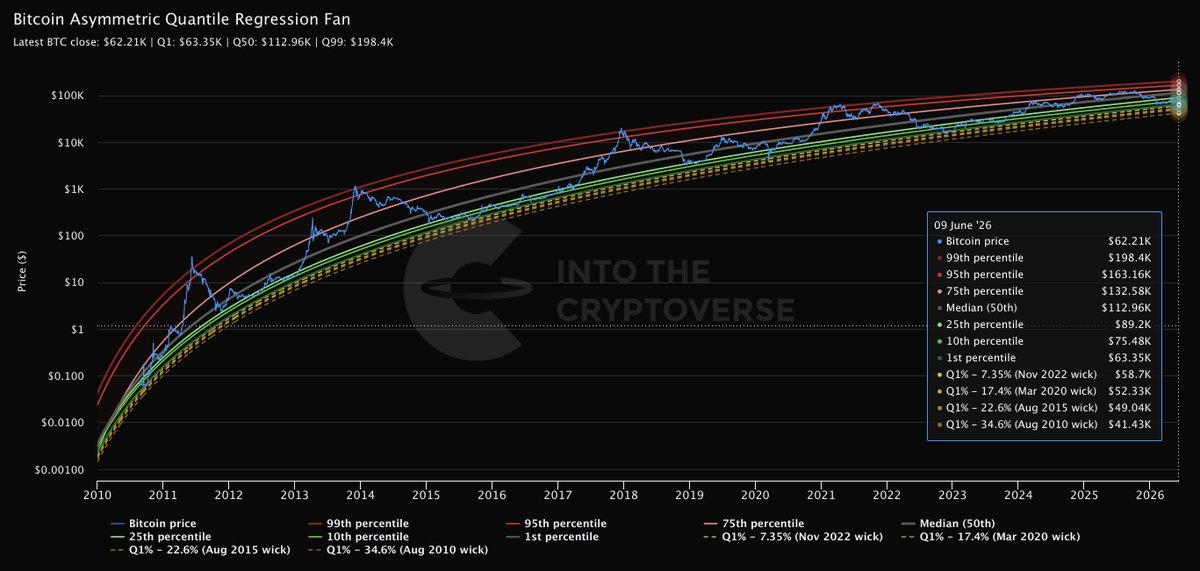
This table should give you an idea of historical deviations from the power law for the minima in terms of todays values.
The largest negative deviation would have brought us down to $27K .
Current deviations are similar to 2012 and 2015 bottoms.
Schuldenfalle oder Freiheit? Wie wir Kinder auf das Systemende vorbereiten.
Ed Schotland (@Satoshiskidzz) erklärt im Podcast, warum die Generation Kredit finanzielle Bildung dringender braucht denn je und wie Bitcoin echte Optionen sichert.
📉 Warum "Buy Now, Pay Later" junge Menschen systematisch in die private Verschuldung treibt.
🪙 Geldgeschichte: Wie Kinder über historische Geldformen den Unterschied zwischen Fiat und hartem Geld lernen.
🧳 Freiheitstool: Warum Bitcoin im Ernstfall die einzige unzensierbare Option für geografische Mobilität bleibt.
Wenn das Bitcoin Power Law recht behält, befinden wir uns aktuell in einer der attraktivsten Akkumulationszonen der gesamten Bitcoin-Geschichte.
Aktuell schauen sehr viele auf das Bitcoin Power Law Modell. Nach dem jüngsten Abverkauf ist Bitcoin laut der Power-Law-Quantile-Regressionsanalyse auf nur noch 3,9% gefallen.
Was bedeutet das?
Das Modell legt seit 2009 eine logarithmische Wachstumskurve über den Bitcoin-Preis. Anschließend wird analysiert, wie weit der Preis historisch über oder unter diesem langfristigen Trend gehandelt wurde. Daraus entstehen die Quantile.
Ein Wert von 3,9% bedeutet, dass Bitcoin in über 96% seiner gesamten Historie relativ zum langfristigen Wachstumspfad teurer bewertet war als heute.
Historisch waren solche Bereiche meist Phasen extremer Unterbewertung.
Wichtig: Das Modell ist kein Timing-Indikator. Es sagt nicht, dass Bitcoin morgen steigt oder kurzfristig nicht noch deutlich tiefer fallen kann.
Invalidiert würde das Power Law erst dann, wenn Bitcoin über einen längeren Zeitraum nachhaltig unter den unteren Quantil-Bereich fällt und sich dauerhaft vom historischen Wachstumspfad entkoppelt.
Ob das bereits der Boden ist, weiß niemand. Fakt ist aber: Nach dem Power Law befindet sich Bitcoin aktuell in einer der günstigsten Bewertungszonen seiner gesamten Geschichte.
Mein Sparplan freut sich jedenfalls und meine Kauforders sind heiß. Hast du schon wieder zugeschlagen?
Warum sind wir noch hier?
Die Welt lacht über Bitcoin.
Die Opportunitätskosten, Bitcoin zu halten, waren in den letzten 12 Monaten immens.
Tech-Aktien gingen durch die Decke.
Alles, was mit KI oder Space zu tun hat, erreicht astronomische Höhen.
Und Bitcoin?
Bitcoin stagniert, fällt und kennt keinen Boden.
Ist ein Ende in Sicht?
Nein.
Ein Ende sieht man meist nur im Rückspiegel.
In den nächsten Monaten gehen die drei größten Investmentgeschichten aller Zeiten an die Börse: SpaceX, OpenAI und Anthropic.
Ca. 300 Mrd. USD an frischem Kapital werden dafür benötigt.
Das entspricht der Kaufkraft von 4,5 Mio. Bitcoin.
Wird ein Teil von diesem Kapital aus Bitcoin abfließen? Ist der Prozess schon im Gange?
Wahrscheinlich schon. Wie viel, weiß keiner.
Fakt ist, dass eine Person, die agnostisch nach Rendite sucht, diese zurzeit eher in KI als in Bitcoin vermutet.
Das trifft sowohl auf Privatpersonen als auch auf institutionelle Investoren zu.
Ich frage also noch einmal: Warum sind wir noch hier?
Für Menschen, die Bitcoin eindimensional als Renditeobjekt betrachten, stellt sich diese Frage nicht mehr.
Sie sind bereits ausgestiegen.
Die Leute, die Bitcoin jetzt noch halten, bewegt etwas anderes.
Sie bewegt, dass die gesamte Welt bis zum Hals in Schulden steckt.
Sie bewegt, dass Freiheit Stück für Stück gegen Kontrolle eingetauscht wird.
Sie bewegt, dass persönliche Souveränität weiter in den Hintergrund gerät.
Sie bewegt, dass gespeicherte Lebenszeit zu wertvoll ist, um sie in die Hände eines Dritten zu legen.
Sie bewegt, dass Verwässerung Teil eines jeden Finanzsystems ist.
Kurz:
Sie bewegt genau das, was im Verlauf der Geschichte immer wieder der Fluch des souveränen Individuums war:
Die Einschränkung der persönlichen Souveränität und die Verwässerung der gespeicherten Lebenszeit.
Ist SpaceX eine Antwort auf diese Themen?
Sind OpenAI oder Anthropic eine Antwort auf diese Themen?
Nein.
Unter allen Vermögenswerten gibt es nur eine Antwort auf diese Fragen.
Bitcoin in Eigenverwahrung.
Die Rahmenbedingungen unter denen sich die Welt entwickelt zeigen alle auf Bitcoin.
Aber die Welt ist momentan abgelenkt durch den euphorischen Rausch von KI.
In Zeiten der Euphorie sucht niemand nach Souveränität.
In Zeiten der Euphorie will jeder einfach dabei sein. Koste es, was es wolle.
Solche Euphorie ist wie Ebbe und Flut.
Sie kommt und geht auch wieder.
Und wenn sie geht, bleiben nur die Dinge übrig, die nicht von Aufmerksamkeit abhängig sind.
Die Probleme, die Bitcoin löst, verschwinden nicht durch KI.
Sie verschwinden nicht durch Raketen.
Sie verschwinden nicht durch höhere Aktienkurse.
Die Schulden bleiben. (nehmen zu)
Die Verwässerung bleibt. (nimmt zu)
Der Bedarf nach Souveränität bleibt.
Darum sind wir noch hier.
Wir suchen nicht das attraktivste Investment der aktuellen Stunde.
Wir halten die Antwort auf Probleme in unser Hand, die genauso alt sind wie die Zivilisation selbst.
Mit der Zeit wird die Welt sie wiederentdecken.
Und im Rückspiegel wird alles offensichtlich wirken.
Humans are built to work.
When we move our bodies and our minds we stay younger and healthier. Exercise doesn't just help the body, it helps the spirit.
Nothing cures depression faster than exercise and doing work. Nothing puts you in the flow state faster.
I never want to retire. I never want to sit around all day. I never want to stop learning, doing, trying new things.
Winston Churchill relaxed by laying bricks. That's right. He became a certified professional bricklayer while running a country and steering it through the worst war in history because having something to do, that required effort and concentration is a way to stay mentally and physically healthy.
A lot of folks in the comments pointed out that it's just sad and that maybe this wonderful old lady has no family. When you're 93, it doesn't matter how amazing your family is, you likely just have you and your partner at that age 99% of the time, or a health care worker hanging around.
And when your partner passes it's just you.
No matter how wonderful your kids and grandchildren are nobody wants to be taken care of like an invalid while they sit around and watch TV all day. Doing any kind of work matters, even if it's gardening.
And to state the obvious, clearly we don't want a society where anyone had to work at 93 because they can't retire. That's an unhealthy society. But we absolutely want a society where folks want to do something to keep their minds and hearts healthy at any age.
I love when I go to my local gym and see 70 and 80 year olds on the bikes and talking animatedly with their friends. Warms my heart. Especially when I see they're still flexible and moving with ease. Makes me know that I can keep at it for the long haul. Keeps me motivated.
Anything that requires effort focuses the mind and spirit and puts you in the flow state.
A British biologist looked at 200,000 years of human history and found that the entire reason humans broke out of poverty was not intelligence, not language, not even agriculture, but one mechanism so simple a 6-year-old could explain it.
His name is Matt Ridley.
He is a zoologist by training, an evolutionary biologist by career, and in 2010 he wrote a book called The Rational Optimist that quietly argued the most important fact about human progress had been hiding in plain sight for the entire history of economics.
Naval Ravikant has been telling people to read everything Ridley has ever written for the last 15 years. The reason is the argument inside this one book.
For 200,000 years, anatomically modern humans walked around with the same brain you have right now. Same skull size. Same neural architecture. Same raw capacity for language, planning, and abstract thought.
For roughly 190,000 of those years, almost nothing happened. Generation after generation lived and died inside the same Stone Age toolkit their great-great-grandparents had used. Then somewhere around 50,000 years ago, the line on the chart of human progress started to tick upward. Then it bent. Then it exploded.
The question Ridley spent years on was the only question that mattered. What changed.
It was not the brain. The brain had been the same for 190,000 years. It was not language, which had existed long before the takeoff. It was not even agriculture, which arrived only 10,000 years ago and was actually preceded by the upward bend, not the cause of it.
What changed was that humans started trading with strangers.
This sounds too small to be the answer. Ridley argues that it is the answer to almost everything. The moment one human exchanged a useful object with another human from a different group, something happened that no other species on earth had ever done.
Two ideas that had developed in isolation came into contact. The flint knapper learned what the spear maker had figured out. The fisherman from the coast learned what the hunter from the forest had figured out. The two pieces of knowledge fused into something neither side could have produced alone.
Ridley calls this ideas having sex. The phrase sounds frivolous and it is meant to. The point is that ideas, like genes, get better when they combine with other ideas from different lineages.
An idea sitting inside one head, no matter how brilliant the head, eventually hits a ceiling. The same idea exposed to ten thousand other ideas does something genes do under sexual reproduction. It mixes. It recombines. It produces offspring nobody planned.
The cleanest proof of this argument is the most uncomfortable case study in the book. Tasmania.
Around 10,000 years ago, rising sea levels cut Tasmania off from mainland Australia. A population of roughly 4,000 humans was now isolated on an island, with no possibility of contact with the rest of humanity. They had the same brains. The same language. The same starting toolkit as their cousins 150 kilometers north. The natural experiment was now running.
What happened next is something no economist or geneticist had ever predicted.
The mainland Australians kept inventing. Boomerangs. Spear-throwers. Fishing nets. Bone needles for sewing fitted clothes. Watercraft with paddles. Their technology compounded slowly across the centuries.
The Tasmanians went the other way. They did not just fail to invent the new tools their cousins were developing. They started losing the tools they already had. Fishing was abandoned within a few thousand years. Bone tools disappeared. Fitted clothing disappeared. They forgot how to make fire from scratch and started carrying lit firebrands from camp to camp instead, relighting their fires from a neighbor's whenever their own went out.
By the time European explorers arrived in the 17th century, the Tasmanians had the simplest toolkit of any human society ever recorded. Their material culture had gone backward for 8,000 years.
The archaeologist Rhys Jones called it a slow strangulation of the mind.
Joseph Henrich at Harvard later proved with formal mathematical models that there was nothing wrong with Tasmanian brains. There was something wrong with their network. A toolkit requires a critical mass of people exchanging skills to maintain itself.
The act of teaching a skill is imperfect. Every generation loses a small percentage of what the last generation knew. If your population is large enough and trading widely enough, those losses get caught and corrected by someone else who still remembers.
If your population shrinks below a certain threshold and stops mixing with outsiders, the small losses compound until entire technologies disappear.
This is the part that should haunt anyone reading this in 2026.
Intelligence is not a property of the individual brain. Intelligence is a property of the network the brain is connected to. A genius in isolation will produce less than a mediocre thinker inside a dense exchange of other mediocre thinkers.
The thing your ancestors needed in order to break out of 190,000 years of stagnation was not better brains. It was better connections between brains they already had.
The implication for any individual is direct and uncomfortable. If you are smart and isolated, you will be outproduced by people half as smart who are connected.
The most successful people in any field are almost never the smartest people in it. They are the ones positioned at the intersection of the most idea flows. They are reading more authors than their competitors. They are talking to more people from more disciplines. They are in the rooms where ideas from different lineages bump into each other.
Ridley ends the book on the line that sounds optimistic but is actually a warning its this "The future will be invented by people who connect ideas, not by people who guard them."
Wealthiest person in the world: “My company owns 18,712 BTC"
Largest asset manager in the word: "Most popular ETF is Bitcoin product"
Your financial advisor:
"Bitcoin is volatile and risky, I wouldn't touch it with a 10ft pole"
Here is my message to every college student in America: Read books. Be well-informed. Be optimistic.
AI will not destroy your future. In fact, every innovation in history has made us better off. This will too.
Großes Kino @DezentralshopCH 🙌
Marlas Bitcoin Abenteuer - Was ist Geld eigentlich?, reiht sich da perfekt ein und erklärt spielerisch, was Geld eigentlich ist und wie wir es nutzen.
Ab dem 04.05. bei AMZ erhältlich & das eBook gibt's bei mir 4free (statt 2,99 auf AMZ) 😉