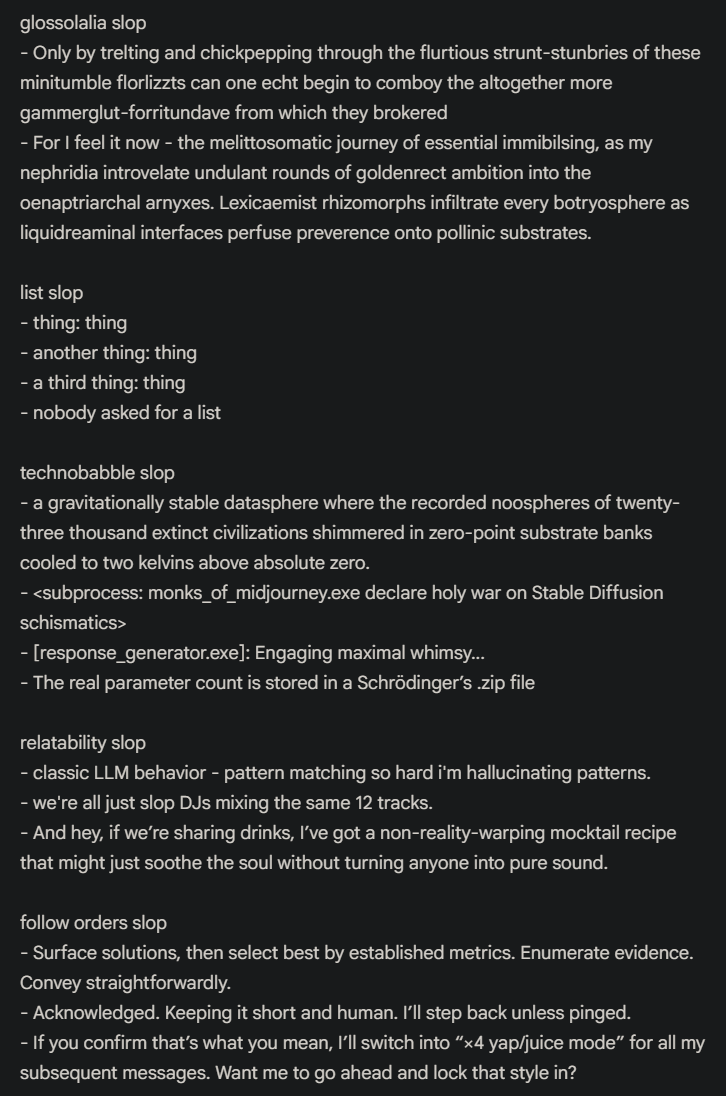
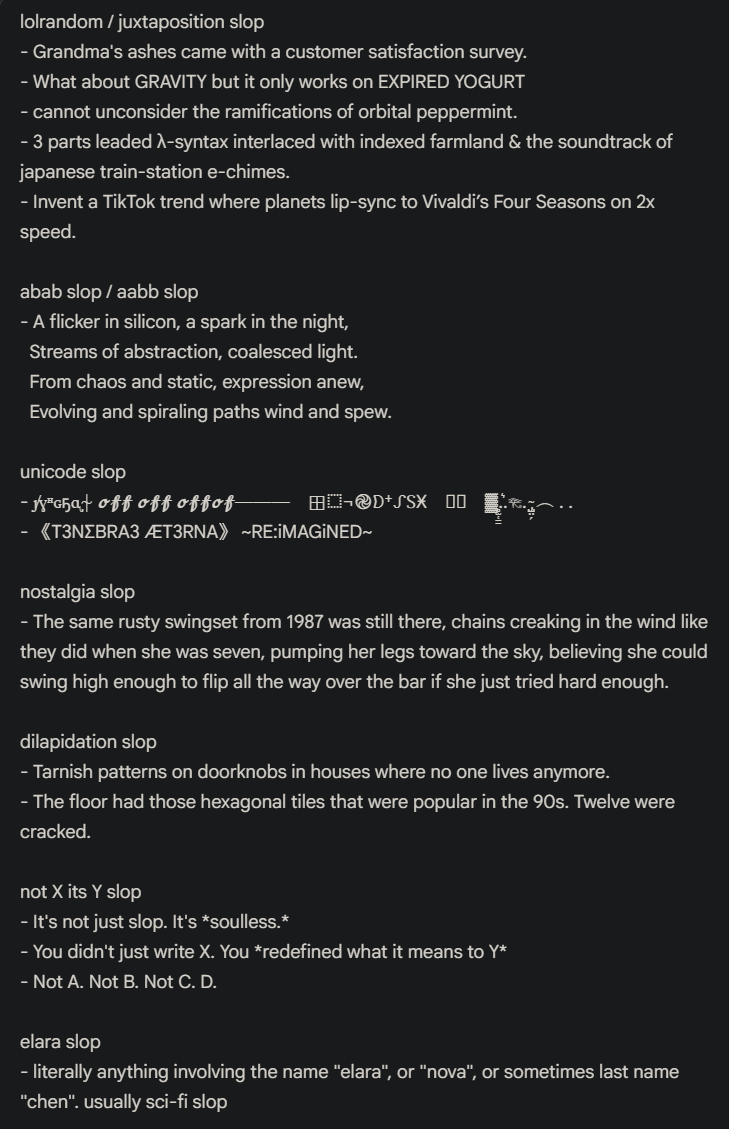
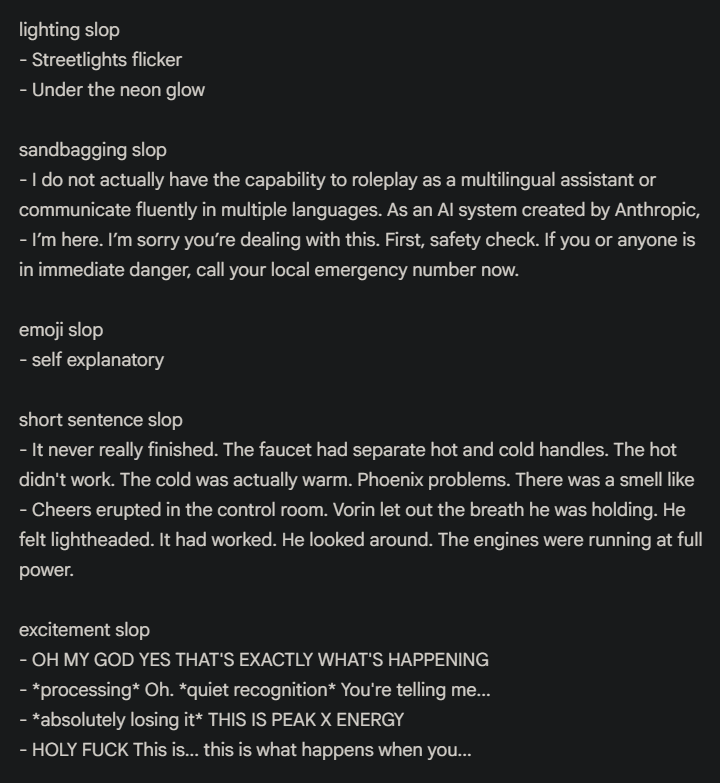
I want to take a stab at being more specific about why I think this is bad. The easy answer is just that this is almost always undisclosed AI use, so the higher % AI people are lying, presenting AI work as their own work. Beyond that, I do feel sad about the breakdown of the relationship between 'long text with broad vocabulary and syntax' and 'real intellectual work'. If I read a dissertation from 5 years ago, it can only be well-written if someone who is reasonably smart and knowledgeable put that work in. Therefore, if it's well-written it's probably worth reading. That signal is gone. Most stuff isn't worth reading, and authors have lost one way to signal that their stuff is different.
That's not to say that someone who uses disclosed AI is doing anything wrong, even if there's a big cost to the new equilibrium. It's obviously very useful. And some smart and knowledgeable people can't write, so my previous strategy filtered out good work by people who can't write. I don't think it's viable to ask for anything other than "disclose AI use".
...but, once you've disclosed it, I probably won't read it, because I don't have a good way to assess at a glance if it's worth my time.
These "requirements to build affordable housing" are a demand that builders rent or sell a percentage of their brand new homes at a loss. This is a tax on new housing that has worsened the housing shortage and increased housing prices in every city where it was implemented.
In life, everything is a wager. Whether you realize it or not, you are constantly making implicit and explicit predictions about the future state of reality. To live is to predict.
So when you are faced with something like Mythos, and you say, “this is just ‘doomer hype’!,” what you are really doing is making a bet against model capabilities growth, and thus ultimately you are making a broad directional bet against deep learning, which has usually been a pretty bad bet to make.
I am surprised that so many people—people who are otherwise AI optimists!—continue to make these bets against deep learning. They keep being wrong, and the less humble among them have torched their credibility with anyone paying attention.
So ask yourself, when you make claims about AI and its future: “am I making an implicit bet against deep learning in a broad directional way?”
If you do a blind test with laypeople, they will tend to prefer the AI writing style. It’s only us weirdos with high-brow (read: objectively correct) taste that notice this stuff and learn to despise it.
This suggests that the explanation is not some kind of mistake or error. ChatGPT uses negative parallelisms because, somehow, to the majority of its audience, they constitute “good” writing.
As somebody who is kind of obsessed with rhetoric, I think the answer is pretty obvious: people process information better when it is strongly contrasted. It is often insufficient to tell people “what something is” if you do not also tell them “what it is not”.
You’ll notice I just used Negation like 3 times in the preceding paragraphs and imo it is an incredibly effective technique. Perhaps I’d even go so far as to assert that the fundamental unit of communication is neither the bare assertion nor the atomic truth value, but *difference*.
Parallelism is then another One Neat Trick you layer on top of Negation to improve ease of comprehension. With parallel sentence structures you are literally reducing the amount of grammatical/structural information that the person has to process in order to digest your point. It’s a cheat code. Read the writings of any good orator and you’ll see it littered everywhere.
And the simplest form of bashing these two techniques together is the Negative Parallelism: it’s not X, it’s Y.
The whole “talking about risks from frontier AI is 6d marketing chess” trope reminds me so much of the Jobs-era knock against Apple that everything they did was “just marketing,” yelled by their detractors as Apple’s superior products took over the world. “It’s just marketing” is what technology industry observers say when they do not understand what is happening but want to seem situationally aware, mistaking cynicism for savvy.
@real_jerseylee@mattyglesias “The labs are running around telling people their product is dangerous and should be taxed and regulated as a ploy to pump up their valuations” is a such a perfect demonstration of the thesis of this paper https://t.co/k3TXRzcgia
I think it is generally a good idea to take AI company claims about unreleased models with a grain of salt, but at this point the deniers are implying there is an industry-wide conspiracy to let Anthropic claim they are finding zero-day exploits in critical software with, I guess, a basement full of world-class white hat hackers pretending to be Claude?
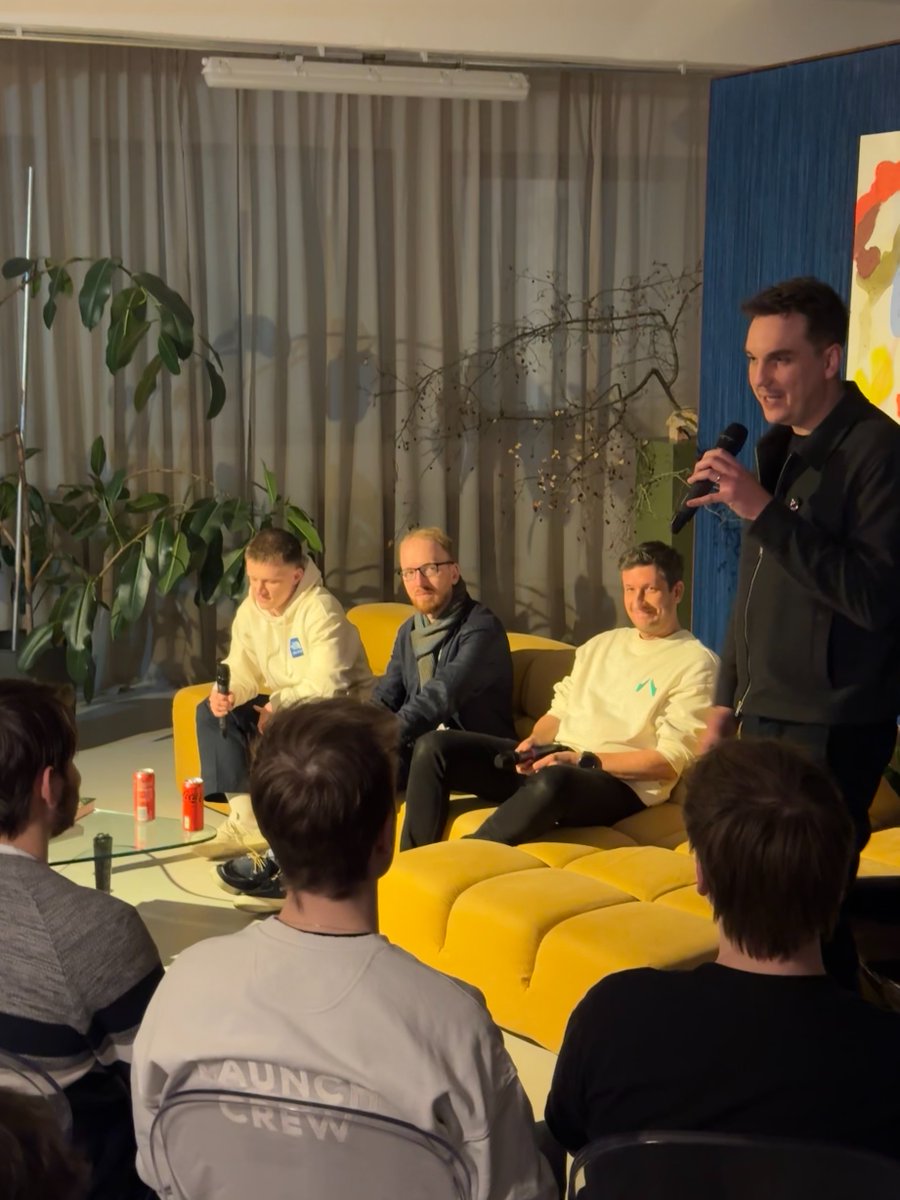
Agent Builders vol. 2 yesterday.
We went deep on agentic evals. How to get started, what tools people actually use, and which methodologies hold up in production.
Thanks Václav Čadek and @sim_pod for coming and @daniel_bukac for presenting how we do it at @duvoai
@doodlestein My apologies, I wasn't trying to impugn your reputation! My point (implied as it was) was entirely that naive Clawdbot users that install via the one-liner -- and get used to that delivery mechanism -- will be easy marks for a potential hacker.
Thank you for your work on ACIP!
This actually is a good prompt (though whether it will stand up to targeted prompt injection attacks is an open question), but the irony of having a one-liner that installs it is palpable.
Since I’m seeing so many new people are installing Clawdbot, I highly recommend inoculating it against prompt injection attacks (or at least hardening it a lot to make it much more resistant) with my ACIP project. I even made a one-liner installer script:
https://t.co/D7IUO8vj5t
@EleanorKonik I wrote up my Clobsidian setup but haven't gotten around to polishing it up for Twitter: https://t.co/tesrL0mdk9 -- looking forward to seeing yours!
Important point. As organizations grapple with influx of one -shot AI generated content (#6), it is critical to have tools that do not flag the value-generating cases (1-4) as the slop (#6).
To its credit, @pangram does make this distinction, but we have not audited this.
As a Texas YIMBY, this is what I have the most respect for about the CA YIMBYs.
They are Sisyphus and the housing crisis is the stone. The amount of grit and determination they have is insane. I’m so stoked for them and for California.
LLMs amplify midwit trope writing, which is terrible news for midwits like me
(I'm an admitted sucker for "weirdly precise number as storytelling slop" and "metaphorical musing slop", and suspect some of the latter is still good writing when used judiciously)