📢New paper out on measuring global #migration flows using online data in @PNASNews
We use privacy-protected records from over 3 billion Facebook users to estimate migration flows between 181 countries, accounting for biases in social media usage.
🔗https://t.co/OUYIqxqnc5
📊The data explorer features a variety of interactive data visualisation methods.
Switch between the global maps, chord diagrams and Sankey charts to track migration across different country corridors - with options for toggling map types, filtering chord sizes and many more
🚨Out today in @Nature our new paper uses deep learning to map four decades of global human migration.
By building the first comprehensive dataset of global annual flows (1990-2023), we reveal that migration has nearly tripled since 2000.
🔗https://t.co/DuPQKF1asT
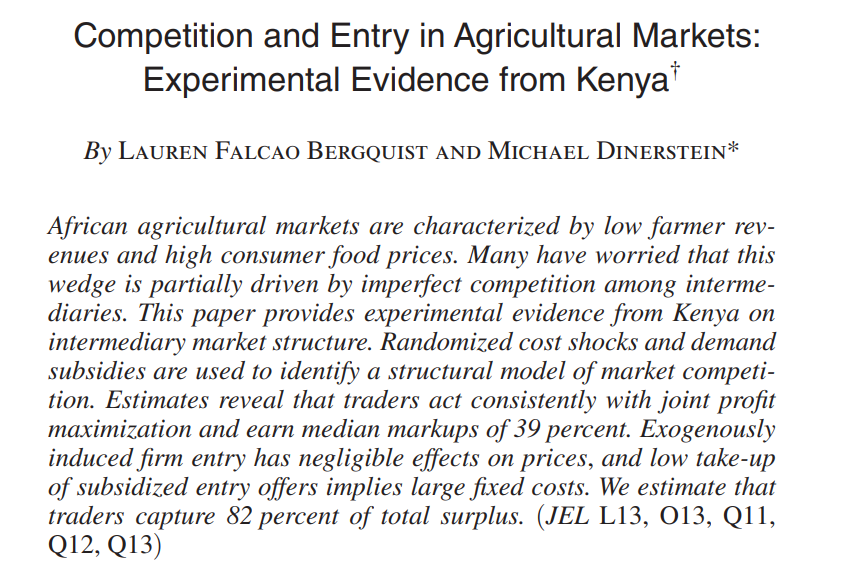
This paper is so unbelievably good. Absolutely blown away. Why is it the case in Kenya that the cost of food is so high, but the prices received by farmers so low? It's the intermediaries -- they all know each other, and they're colluding. 1/
Today, the European Union took a major step forward.
All Member States agreed to open the first accession negotiations cluster with Ukraine and Moldova.
At the first Intergovernmental Conference on Monday, we will open the cluster on fundamentals; the backbone of the accession process.
It covers the core values and principles on which the EU is built, from the rule of law to strong democratic institutions.
This is a recognition of the determination, courage and hard work shown by both countries in advancing reforms, even in the face of immense challenges.
And a signal that the EU’s offer of peace, stability and opportunity is unmatchable.
Enlargement is a strategic choice.
By bringing our nations closer together, we strengthen peace, security and prosperity across our continent.
In a world marked by growing uncertainty, a larger European Union is in our common interest.
Enlargement remains one of the EU’s greatest success stories and our best investment in our shared future.
Super interesting!
"Data-driven automation" by Maryam Farboodi, Andrew Koh, and Anchi Xia.
"We build a dynamic model of data-driven automation in which data (i) is heterogeneous and task-specific; (ii) accumulates endogenously as a byproduct of economic activity; and (iii) exhibits spillovers such that data generated by one task can augment the productivity of another. Along the transition path of automation, data plays a dual role in simultaneously augmenting the productivity of already-automated tasks and expanding the automation frontier. We derive tight conditions for the economy to be partially versus fully automated in the long-run. In the latter case, automation exhibits rich short-run dynamics that depend on the pattern of data spillovers but is always slow in the long-run: the share of tasks produced by labor decays asymptotically as a power law in time. We show that the economy is generically inefficient and analyze how a planner optimally tilts the direction of data accumulation. With endogenous capital accumulation, data-driven automation generates explosive growth but stagnant long-run wages."
https://t.co/V0eAuCYQCZ
Watch: Episodes 6 & 7 of Paul Goldsmith-Pinkham's mini series with @MarkusEconomist on Claude Code for Applied Economists are out now!
Together, the episodes cover Claude skills, permissions, and OpenClaw.
View on BCF: https://t.co/kVN1Pecrjg
Substack: https://t.co/8y4AJQ55v2
Honored to give the keynote at the IMFER conference, co-hosted by @IMFNews and @bankofthailand , chaired by @pogourinchas, on: "The Economic Policies for a Globally Interdependent and Geopolitically Fragmented World."
Global interdependence can be weaponized for economic leverage but interdependence can also act as a stabilizer bringing resilience for the global economy.
https://t.co/qnyxSNVC2d
I am often unsure how to make the case for you to read a paper thread. Not everything reduces down to easy single empirical finding. When I read this paper, I got the same feeling one would get watching Picasso or Federer; these are masters at work.
📢#CallForPapers - Central Bank of Ireland, UCD, CEPR Conference on Macro-Finance and Financial Stability Policies 2026
Deadline: 23 June
Keynote: @skalemliozcan
Organisers: Fergal McCann, @rivluc, Laura Moretti, @PeiaOana, Yota Deli, @Diana__Bonfim, @ioannidou_vasso
https://t.co/XLwQgbt1a5
Forthcoming in EJ: ‘News Shocks, Precautionary Saving and Frictional Labour Markets,’ by Andrew Preston https://t.co/aX2EsNk538 @andypreston_UK@RoyalEconSoc#EconTwitter
Deutschlands John Bates Clark Medaillengewinner @ludwigstraub jetzt mit seiner Keynote bei der CES @ifo_Institut Area Konferenz “Macro with Micro Data.”
The International Economic Review has just published a new exciting paper by Luis Araujo and Antonio Doblas-Madrid on Rational Expectations Fools' Bubbles. It is available through @WileyEconomics here: https://t.co/qdVEbDS4P1