Before the hardware, we made the walk honest: loaded the robot to its full 25 kg (legs + upper-body mass), capped every motor at its real torque limit, and made the legs physically collide instead of passing through each other. Then we retrained it.
Now it takes shoves and stays up without ever commanding more torque than the real motors can deliver.
Torque data below 👇
This is what happens when you stop telling a humanoid how to walk — and start showing it one motion to imitate. Left: a hand-crafted reward → stiff, robotic gait. Right: imitate one reference motion → natural gait. Built on open-source mjlab
Built on mjlab by @kevin_zakka (RL on MuJoCo-Warp), with BeyondMimic-style motion tracking. Huge thanks to the teams behind these open-source tools 🙏
https://t.co/28WRprIiUN
Joint Design Log #002 is live.
Building a humanoid knee inside real human proportions. 1 DOF, 2 motors, 100° range of motion.
New: real-time trajectory control—host sends waypoints at 50-100 Hz, controller interpolates smoothly.
https://t.co/yyoPDZM3B5
#robotics#humanoid
Projects like OpenAI’s Operator are to the digital world as Humanoid robots are to the physical world. One general setting (monitor keyboard and mouse, or human body) that can in principle gradually perform arbitrarily general tasks, via an I/O interface originally designed for humans. In both cases, it leads to a gradually mixed autonomy world, where humans become high-level supervisors of low-level automation. A bit like a driver monitoring the Autopilot. This will happen faster in digital world than in physical world because flipping bits is somewhere around 1000X less expensive than moving atoms. Though the market size and opportunity feels a lot bigger in physical world.
We actually worked on this idea in very early OpenAI (see Universe and World of Bits projects), but it was incorrectly sequenced - LLMs had to happen first. Even now I am not 100% sure if it is ready. Multimodal (images, video, audio) just barely got integrated with LLMs last 1-2 years, often bolted on as adapters. Worse, we haven’t really been to the territory of very very long task horizons. E.g. videos are a huge amount of information and I’m not sure that we can expect to just stuff it all into context windows (current paradigm) and then expect it to also work. I could imagine a breakthrough or two needed here, as an example.
People on my TL are saying 2025 is the year of agents. Personally I think 2025-2035 is the decade of agents. I feel a huge amount of work across the board to make it actually work. But it *should* work. Today, Operator can find you lunch on DoorDash or check a hotel etc, sometimes and maybe. Tomorrow, you’ll spin up organizations of Operators for long-running tasks of your choice (eg running a whole company). You could be a kind of CEO monitoring 10 of them at once, maybe dropping in to the trenches sometimes to unblock something. And things will get pretty interesting.
LLM model size competition is intensifying… backwards!
My bet is that we'll see models that "think" very well and reliably that are very very small. There is most likely a setting even of GPT-2 parameters for which most people will consider GPT-2 "smart". The reason current models are so large is because we're still being very wasteful during training - we're asking them to memorize the internet and, remarkably, they do and can e.g. recite SHA hashes of common numbers, or recall really esoteric facts. (Actually LLMs are really good at memorization, qualitatively a lot better than humans, sometimes needing just a single update to remember a lot of detail for a long time). But imagine if you were going to be tested, closed book, on reciting arbitrary passages of the internet given the first few words. This is the standard (pre)training objective for models today. The reason doing better is hard is because demonstrations of thinking are "entangled" with knowledge, in the training data.
Therefore, the models have to first get larger before they can get smaller, because we need their (automated) help to refactor and mold the training data into ideal, synthetic formats.
It's a staircase of improvement - of one model helping to generate the training data for next, until we're left with "perfect training set". When you train GPT-2 on it, it will be a really strong / smart model by today's standards. Maybe the MMLU will be a bit lower because it won't remember all of its chemistry perfectly. Maybe it needs to look something up once in a while to make sure.
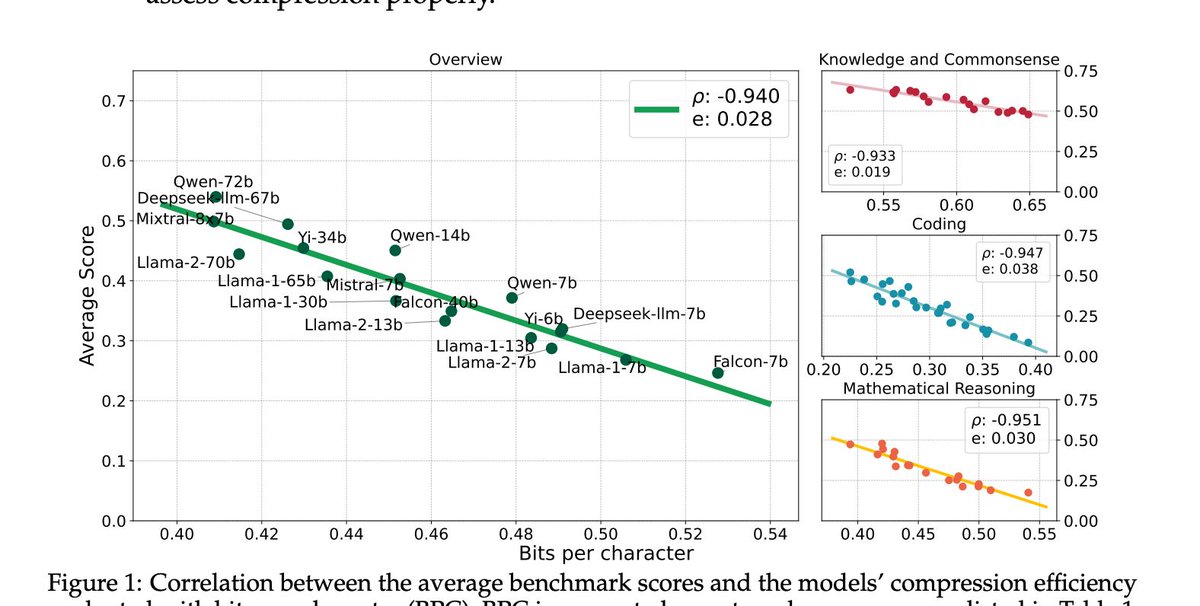
Compression Represents Intelligence Linearly
There is a belief that learning to compress well will lead to intelligence. Recently, language modeling has been shown to be equivalent to compression, which offers a compelling rationale for the success of large language models
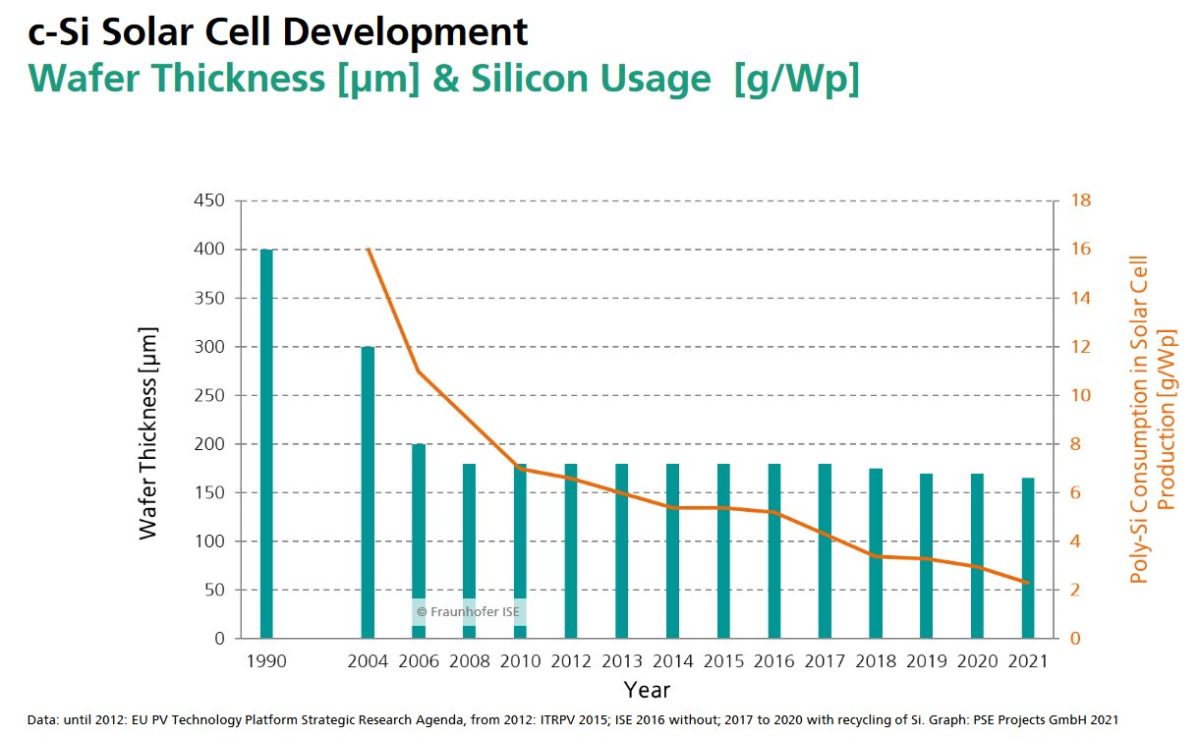
I don't think people appreciate the dimensions solar is improving in.
Conversion efficiency isn't the full story.
Yes, conversion efficiency doubled (~10% -> 20%) in the last 20 years, but silicon use per watt fell by 87%! (16g/W -> 2g/W)
Longi now has cells that use just half a gram per watt and are 26% efficient.
At 1.9 W/g (1.2 horsepower/pound), they're more power dense than most combustion engines!
Glass/glass bifacial panels solve the degradation issues of plastic back sheets. And they harvest light from both sides which increases output in cloudy conditions (higher % diffuse light vs directional).
That's way more valuable than just the increase in overall output because it means more power when it's needed most.
Larger format panels may not seem revolutionary, but they lower balance of system and labor costs.
Even the production of silicon itself is getting more efficient. We use less energy to refine silicon today and get more watts and more watt hours from that silicon.
The energy return on solar isn't about what percentage of sunlight you convert. It's about how much energy it takes to make panels, how much power they produce, and how long they last.
Solar is making huge strides in all these areas. If you're not amazed by solar, you're not looking at the right units. Earth's solar resource is 173,000 TW. Capturing just 1% of that would 100x humanity's energy supply.
# on shortification of "learning"
There are a lot of videos on YouTube/TikTok etc. that give the appearance of education, but if you look closely they are really just entertainment. This is very convenient for everyone involved : the people watching enjoy thinking they are learning (but actually they are just having fun). The people creating this content also enjoy it because fun has a much larger audience, fame and revenue. But as far as learning goes, this is a trap. This content is an epsilon away from watching the Bachelorette. It's like snacking on those "Garden Veggie Straws", which feel like you're eating healthy vegetables until you look at the ingredients.
Learning is not supposed to be fun. It doesn't have to be actively not fun either, but the primary feeling should be that of effort. It should look a lot less like that "10 minute full body" workout from your local digital media creator and a lot more like a serious session at the gym. You want the mental equivalent of sweating. It's not that the quickie doesn't do anything, it's just that it is wildly suboptimal if you actually care to learn.
I find it helpful to explicitly declare your intent up front as a sharp, binary variable in your mind. If you are consuming content: are you trying to be entertained or are you trying to learn? And if you are creating content: are you trying to entertain or are you trying to teach? You'll go down a different path in each case. Attempts to seek the stuff in between actually clamp to zero.
So for those who actually want to learn. Unless you are trying to learn something narrow and specific, close those tabs with quick blog posts. Close those tabs of "Learn XYZ in 10 minutes". Consider the opportunity cost of snacking and seek the meal - the textbooks, docs, papers, manuals, longform. Allocate a 4 hour window. Don't just read, take notes, re-read, re-phrase, process, manipulate, learn.
And for those actually trying to educate, please consider writing/recording longform, designed for someone to get "sweaty", especially in today's era of quantity over quality. Give someone a real workout. This is what I aspire to in my own educational work too. My audience will decrease. The ones that remain might not even like it. But at least we'll learn something.
"Dear friends, scientifically, this is not a #ClimateCrisis. We are now facing something deeper. Mass extinction. Air pollution. Undermining ecosystem functions. Really putting humanity’s future at risk. This is a #PlanetaryCrisis."
— Professor @jrockstrom#ActOnClimate
While the underlying physics is quite well understood, many will keep denying the increased rate of warming.
Hiding heads in the 'sand of statistical relevance'.
👉We increased the net forcing, which made Earth's Energy Imbalance and now surface warming increase.
Speculative execution for LLMs is an excellent inference-time optimization.
It hinges on the following unintuitive observation: forwarding an LLM on a single input token takes about as much time as forwarding an LLM on K input tokens in a batch (for larger K than you might think). This unintuitive fact is because sampling is heavily memory bound: most of the "work" is not doing compute, it is reading in the weights of the transformer from VRAM into on-chip cache for processing. So if you're going to do all that work of reading in all those weights, you might as well apply them to a whole batch of input vectors. I went into more detail in an earlier thread:
https://t.co/Lbtpq4VDeY
The reason we can't naively use this fact to sample in chunks of K tokens at a time is that every N-th token depends on what token we sample at time at step N-1. There is a serial dependency, so the baseline implementation just goes one by one left to right.
Now the clever idea is to use a small and cheap draft model to first generate a candidate sequence of K tokens - a "draft". Then we feed all of these together through the big model in a batch. This is almost as fast as feeding in just one token, per the above. Then we go from left to right over the logits predicted by the model and sample tokens. Any sample that agrees with the draft allows us to immediately skip forward to the next token. If there is a disagreement then we throw the draft away and eat the cost of doing some throwaway work (sampling the draft and the forward passing for all the later tokens).
The reason this works in practice is that most of the time the draft tokens get accepted, because they are easy, so even a much smaller draft model gets them. As these easy tokens get accepted, we skip through those parts in leaps. The hard tokens where the big model disagrees "fall back" to original speed, but actually a bit slower because of all the extra work.
So TLDR: this one weird trick works because LLMs are memory bound at inference time, in the "batch size 1" setting of sampling a single sequence of interest, that a large fraction of "local LLM" use cases fall into. And because most tokens are "easy".
References
https://t.co/sIBCSmsyKN
https://t.co/uSpmTzfWhR
https://t.co/7t7orHBybo
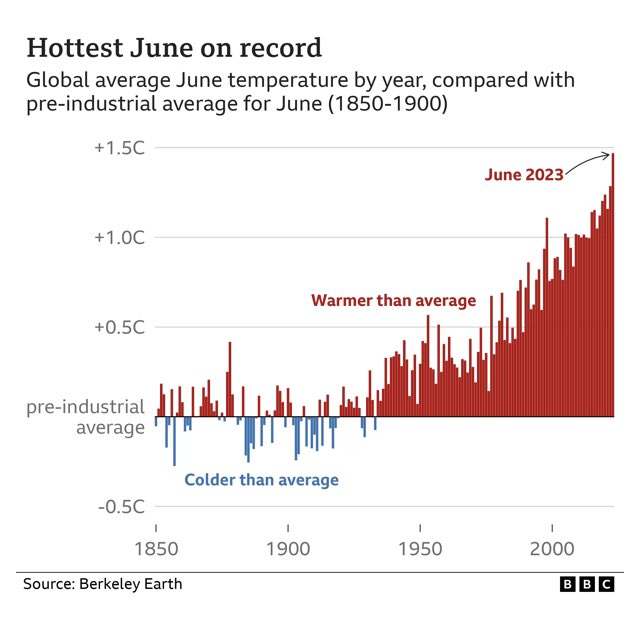
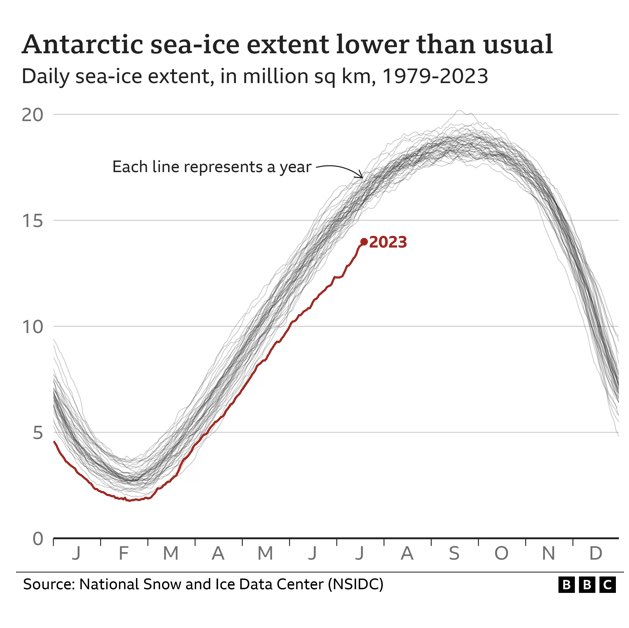
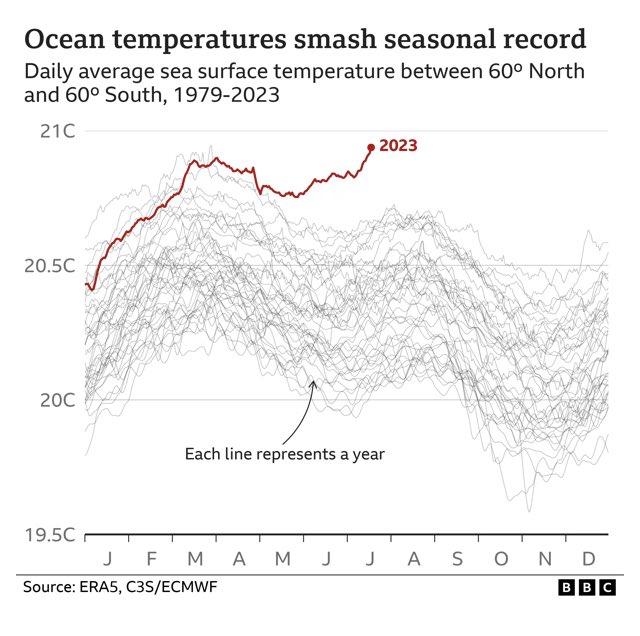
If we would live in a society caring about the physical reality of our planet, this would be headline and frontpage news around the world.
Of course we don't.
Climate records tumble, leaving Earth in uncharted territory
A series of climate records on temperature, ocean heat, and Antarctic sea ice have alarmed some scientists who say their speed and timing is "unprecedented".
#climatechange
https://t.co/zydyJJfi9Y