Great to see this write-up of my microeconomics textbook w/ Sam Bowles. It was published in July by @OxUniPress You can see details & free pdf at my website here: https://t.co/ASIy8AtCzS or at OUP here: https://t.co/GbpuTwIB5u Some Endorsements quoted below. 🧵 (1/8)
A new #economics textbook by SFI Prof Samuel Bowles and Simon Halliday (@BristolUni) upends convention and offers a new, more engaging way of teaching the subject — one that actually acknowledges #inequality, #climatechange, #sustainability, and #poverty:
https://t.co/5PAxHG5v6Z
Reading my copy of @WorksInProgMag #23 on plan to LAS. Strong overlaps with talks on how to AI-proof your teaching w/ @Afinetheorem@matthewgburgess & others: reporting for stories on UK nuclear, ASML, freezing eggs, & others hard to do w/o phone calls, dirty hands=>originality.
@Afinetheorem@paulnovosad So many possibilities here: in Venice, one of my favorite churches is Santa Maria dei Miracoli. Been basically alone a bunch of times. In RSA (biased), so many beaches outside of big cities. In US, so many places in VT, NH, Maine, NM, CO outside of “big” ones.
I'm not on the hiring committee for this, but I have worked closely with CORE (I'm on the CORE Editorial Board and working on a new CORE textbook). I'm happy to field questions related to it from credible candidates. @sndurlauf@sfiscience Please RT if you wouldn't mind :-)
We're hiring a Postdoctoral Research Fellow in Economics Education and Inequality, jointly hosted by CORE Econ and the Stone Centre network.
12-month position starting September 2026.
Deadline: 22 May 2026.
Details and how to apply: https://t.co/XTNFrx3Ai6
One of the things we’re doing at @HopkinsCES and @SNFAgora is thinking through what education and pedagogy around progress, civics, and the C21st look like. Really happy to be a part of this collaboration.
Three keynote course presentations:
-- @Afinetheorem (U of Toronto): Progress, or How Big Things Get Done
-- @simondhalliday (Johns Hopkins): New first-year seminar on progress
-- @matthewgburgess (U of Wyoming): American Economic Success
Other talks and discussion sessions on law, regulation, and abundance; maintaining progress; industrial policy; progress in medicine, and more.
@AndyMasley Who are these people who have so much laundry and no children? I am noticing, too, a distinct lack of children messing with the robot’s trying to fold the clothing. #notmyrobotlamp
@JeremiahDJohns@HistoryBoomer I’d hate to have to tell him about no-name authors like George Eliot and Leo Tolstoy, then, or perhaps Camus or Kafka, or that guy who wrote 1984.
I really think that the public's understanding of how data centers physically interact with their communities is bordering on a low level mass delusion. The actual numbers and impact just do not at all bear out how people feel about them.
@ryancbriggs@savage_acro Do you have anyone coaching you? There are remarkable gains in deadlifting from relatively small improvements in technique. (As a reference point, I’m saying this as someone who loves a workout that includes 75 deadlifts at 250#).
In the original paper, this video comes to mind (post hoc ergo prophet hoc in the West Wing). https://t.co/q3ANiUeQdT
See Kai Gehring’s piece as recognizing this concern.
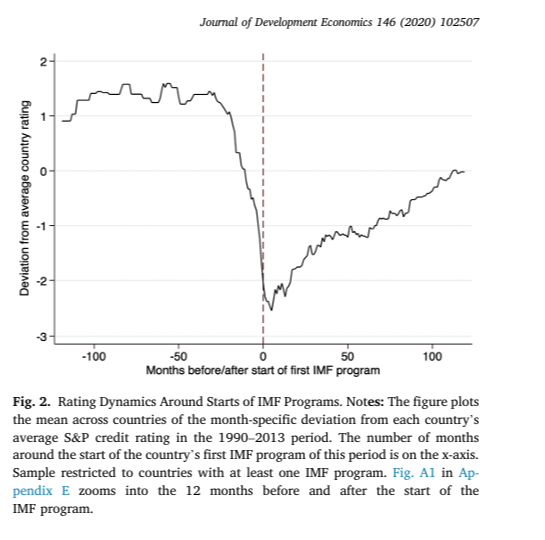
So annoying sth like this gets published that is pure selection bias. If you want to understand what I mean, look at this graph from our paper: Countries contract and are on a declining path when they get an IMF program, not because of it. Evidence on programs is much more mixed.
@ryancbriggs@AndrewM_Fischer Just reinforcing what you’ve said here. The point I emphasize to students with this book specifically (not saying it’s perfect) is that even with SAPs S-SA policymakers had agency in choice of how and what to implement & degree of compliance. Existence of SAP =\> implementation.
What if the most important thing an economics research lab could produce was not a paper but a novel?
Karen Jennings wrote First of December as a writer-in-residence at our lab, @LEAP_SU It follows three people in the final days before slave emancipation at the Cape in 1838. The aim was to carry research on Cape Slavery far beyond the academy.
South Africa’s history of slavery remains locked up in archives that almost no one opens. What would it take to resurface it in everyday conversation? A novel might do the work that no academic paper could.
First of December will be released in the UK on 26 March and in South Africa in August.
@Afinetheorem Totally agree. I’ve been doing this a lot with Claude with very specific guidelines for the textbook and it helps find things I can improve all over the place. Especially if I was writing a first draft while tired 😂
@Afinetheorem Relatedly, I think this is an underrated paper from two UCLA folks (Makowski and Ostroy) whose work I only came to know after reading this paper: https://t.co/DbSZWKuBjp. Both did good work and I learned important ideas from them.