The UK has the best hyperkalaemia guidelines in the world, and they’ve just been updated.
No one can cover all 171 pages, but here are 3 quick important bits in a thread👇
https://t.co/pZpyHhXjJX
There's still time to reserve your place at the Interventional #Nephrology Pre-course!
A day of lectures, multi-professional workshops & hands-on learning for all healthcare professionals.
📅 Sunday 4 June
🕗 8:30 - 17:30
📍 @ICCWales
🎟️ https://t.co/68rISw8pTR
People with fatty liver disease keep asking me in my DM's for treatment advice. Here are 10 points that you can do to modify/reverse fatty liver.
1. Exercise
Three types of exercise have benefits on fatty liver. Aerobic exercise, resistance training, high-intensity interval training. Include any in your routine.
▶️https://t.co/008s2OArki
2. Diet
It is not the carbohydrates or the fat, but the calories. Low calorie dietary interventions are most effective. Low-calorie = 1000 to 1500 calories/d with deficits of 500-750 calories/d. Apart from low-calorie deficits, the only other diet intervention with proven use is Mediterranean type without alcohol.
▶️https://t.co/yP1Tabafyk
3. Sleep
Poor sleep, inadequate sleep (< 6h), non-restorative sleep and daytime napping >60 mins are all independently associated with new onset or worsening fatty liver. Pamper your liver by getting some good sleep in your routine.
▶️https://t.co/bXCm7vMdep
4. Coffee
Much to the offence and annoyance of tea connoisseurs, coffee intake has been shown to reduce fatty liver disease independent of other dietary modifications [limited evidence vs no evidence]. Ideally, it is black coffee, no sugar, no milk, a minimum of 3 cups a day, complete intake before late evening & never into the night. This dose will not affect your blood pressure, in fact may reduce it.
▶️https://t.co/7xI2f4cTpH
5. Alcohol
The most common cause of fatty liver is possibly alcohol use. The safest level of alcohol in preventing fatty liver is ZERO. Stop alcohol use and switch to non-alcoholic alcohol-like low calorie beverages instead.
▶️https://t.co/F34UKnSNEc
6. Sugar-sweetened beverages and fructose-containing processed foods
Stay away from these two. These can increase liver fat immensely and has been linked to fatty liver in both children and adults.
▶️https://t.co/qQrFJI4mvb
7. Artificial sweeteners
Artificial sweeteners are safer to use than natural sugars, even though preclinical studies have shown increased liver fat in animal models due to action on gut bacteria. Stevia is supposedly the safest bet among artificial sweeteners. In case of diabetes/obesity, speak with your specialist before you want to use them.
▶️https://t.co/LGXVH6KMem
8. Drug therapy
There are NO approved drugs for the treatment of fatty liver disease. Recommended drugs include vitamin E and pioglitazone. NO OTHER DRUGS ARE USEFUL. These are not used life long, but only until other associated risk factors are well-controlled. Drug therapy should be initiated in only those with CONFIRMED NASH (ideally biopsy proven or Fibroscan/Shearwave).
NEVER initiate treatment based on ONLY ultrasound scan fatty liver identification.
▶️https://t.co/OESXkKIWtL
9. Rational approach
Fatty liver disease is a misnomer. It is really not a disease, but an association. Treatments should be aimed at controlling causes of fatty liver disease (alcohol use, diabetes, obesity, hypothyroidism, sleep disorder, sedentary life etc.) rather than liver.
https://t.co/uylt2jyCkO [see management/updates section]
10. What does NOT work?
Ursodeoxycholic acid, milk-thistle, green tea, omega-3 supplements, detox products, yoga (because it is not aerobic), fruitarian diets, crash diets, turmeric/cinnamon supplements, shifting to honey or coconut sugars, herbal formulations, multiherbal products, any product with "liver detox" written on it & any product or advertisement with "reverse fatty liver" written on it.
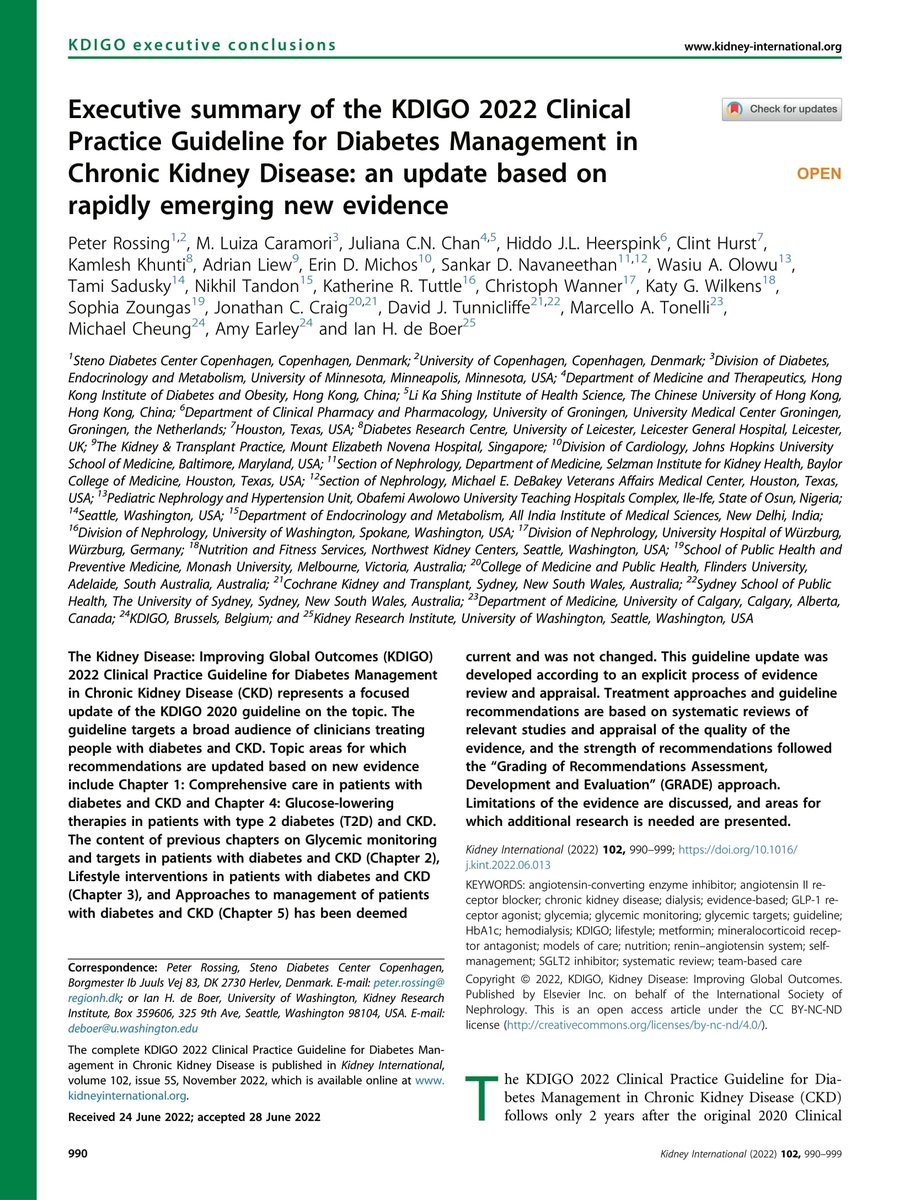
KDIGO is pleased to announce the publication of the 2022 Diabetes Management in CKD Guideline.
Read the Guideline:
https://t.co/A6LdZbr3qg
Read the Executive Summary:
https://t.co/vnt32SGix3
Read the News Release:
https://t.co/LMc8JRFyM2
#diabetes#CKD
@DxRxEdu @rabihmgeha This is great. Question - urea is an ineffective osmole so how does it generate a diuresis? Does it become an effective osmole in the tubules? Keen to learn 🙏
Management guidelines for acute pancreatitis recommend early aggressive fluid resuscitation, yet evidence supporting this approach is limited. New research findings are summarized in a short video. https://t.co/0m9geyWRBH
I’m just starting to use cystatin C as a marker for renal function, particularly in cases where Cr is probably not reliable, but I’m not super familiar with it. What should a Hospitalist know about cystatin C for gfr? @kidney_boy
@doc_kidney Thanks for the advice. On max MRA, suggest switch to ENaC inhibitor? Pre stent values in SI units: aldo 860pmol/L, renin 480mIU/L, ratio 2 - consistent with hyperreninism
30yo male, renal artery stenosis, stented with initial improvement in BP but recurrence of HTN. eGFR >90. Patent stents on repeat imaging. Maxed out ACE, BB, thiazide, alpha blocker. Did not tolerate CCB. Next option for BP management? Methyldopa? #askrenal
@NephroPeeps Excellent thank you 🙏 angio used to confirm patent stents and MRA at max. Initial aldo:renin ratio low but not repeated. Is there a role for renin other than excluding primary hyperaldo?
@jamiekwillows Yeah otherwise normal vasculature as far as I can see on imaging and ESR (unlikely vasculitis), normal urine metanephrines, low Aldo:renin ratio









![theliverdoc's tweet photo. People with fatty liver disease keep asking me in my DM's for treatment advice. Here are 10 points that you can do to modify/reverse fatty liver.
1. Exercise
Three types of exercise have benefits on fatty liver. Aerobic exercise, resistance training, high-intensity interval training. Include any in your routine.
▶️https://t.co/008s2OArki
2. Diet
It is not the carbohydrates or the fat, but the calories. Low calorie dietary interventions are most effective. Low-calorie = 1000 to 1500 calories/d with deficits of 500-750 calories/d. Apart from low-calorie deficits, the only other diet intervention with proven use is Mediterranean type without alcohol.
▶️https://t.co/yP1Tabafyk
3. Sleep
Poor sleep, inadequate sleep (< 6h), non-restorative sleep and daytime napping >60 mins are all independently associated with new onset or worsening fatty liver. Pamper your liver by getting some good sleep in your routine.
▶️https://t.co/bXCm7vMdep
4. Coffee
Much to the offence and annoyance of tea connoisseurs, coffee intake has been shown to reduce fatty liver disease independent of other dietary modifications [limited evidence vs no evidence]. Ideally, it is black coffee, no sugar, no milk, a minimum of 3 cups a day, complete intake before late evening & never into the night. This dose will not affect your blood pressure, in fact may reduce it.
▶️https://t.co/7xI2f4cTpH
5. Alcohol
The most common cause of fatty liver is possibly alcohol use. The safest level of alcohol in preventing fatty liver is ZERO. Stop alcohol use and switch to non-alcoholic alcohol-like low calorie beverages instead.
▶️https://t.co/F34UKnSNEc
6. Sugar-sweetened beverages and fructose-containing processed foods
Stay away from these two. These can increase liver fat immensely and has been linked to fatty liver in both children and adults.
▶️https://t.co/qQrFJI4mvb
7. Artificial sweeteners
Artificial sweeteners are safer to use than natural sugars, even though preclinical studies have shown increased liver fat in animal models due to action on gut bacteria. Stevia is supposedly the safest bet among artificial sweeteners. In case of diabetes/obesity, speak with your specialist before you want to use them.
▶️https://t.co/LGXVH6KMem
8. Drug therapy
There are NO approved drugs for the treatment of fatty liver disease. Recommended drugs include vitamin E and pioglitazone. NO OTHER DRUGS ARE USEFUL. These are not used life long, but only until other associated risk factors are well-controlled. Drug therapy should be initiated in only those with CONFIRMED NASH (ideally biopsy proven or Fibroscan/Shearwave).
NEVER initiate treatment based on ONLY ultrasound scan fatty liver identification.
▶️https://t.co/OESXkKIWtL
9. Rational approach
Fatty liver disease is a misnomer. It is really not a disease, but an association. Treatments should be aimed at controlling causes of fatty liver disease (alcohol use, diabetes, obesity, hypothyroidism, sleep disorder, sedentary life etc.) rather than liver.
https://t.co/uylt2jyCkO [see management/updates section]
10. What does NOT work?
Ursodeoxycholic acid, milk-thistle, green tea, omega-3 supplements, detox products, yoga (because it is not aerobic), fruitarian diets, crash diets, turmeric/cinnamon supplements, shifting to honey or coconut sugars, herbal formulations, multiherbal products, any product with "liver detox" written on it & any product or advertisement with "reverse fatty liver" written on it.](https://pbs.twimg.com/media/FrU3aUZaIAI-tKy.png)