@Castiglionetorinese WWTP, learning about operational chalenges of real application of #DEMON#Anammox for sidestream centrate treatment. Moving from lab to real life condition can be shocking sometimes !!!
🧠 AI May Change How We Think — But How We Use It Matters
A reported MIT study explored how ChatGPT use affects memory and brain engagement. The findings suggest that relying too heavily on AI may reduce the mental effort we use for writing and learning.
The message isn’t to avoid AI—it’s to use it wisely. Let AI support your thinking, not replace it. The strongest results may come from people who combine their own ideas with AI assistance.
The future belongs to those who use AI as a tool, while keeping their own minds active.
Temperature anomalies over the coming week are staggering. In many areas, temperatures are forecast to exceed the 1991–2020 average by more than 15°C. A 10°C+ anomaly could stretch from southern France to eastern Germany. This is not a shifted climate. It's a shifting climate.
LLMs can quietly shift our attitudes on important social issues.
In the experiments, participants wrote about issues such as the death penalty, voting rights for felons, fracking, and genetically modified organisms. As they wrote, the AI subtly nudged them toward one side of the debate.
The result? Their attitudes shifted in the direction favored by the AI.
They did so quietly. They did not argue, did not debate, did not try to persuade. They simply complete the sentences.
This is epistemia in action: the silent shaping of what becomes thinkable, sayable, and believable.
And it is LLMorphism at its most dangerous. We treat the model as a neutral linguistic prosthesis, while it is quietly reorganizing our cognition.
We risk becoming the LLM.
*
Paper in the first reply
You have noticed it. ChatGPT feels dumber than it used to. Your prompts that worked six months ago produce worse results now. The writing sounds flatter. The ideas sound safer. The internet itself feels like it is shrinking. Every article reads the same. Every email sounds the same. Every answer sounds like it was written by the same voice.
You thought it was you. It is not you.
Researchers at Oxford and Cambridge published a paper in Nature proving what is happening. They call it Model Collapse.
Here is the mechanism in one sentence. AI trained on AI-generated data gets dumber every generation until it forgets what real human data looked like.
The internet is filling with AI-generated content. Blog posts. Articles. Reviews. Comments. Social media. AI companies scrape the internet to train the next generation of models. Which means the next generation of AI is being trained on the output of the current generation.
Each cycle loses information. Not randomly. It loses the rarest, most unusual, most creative parts first. The researchers call these the "tails of the distribution." The weird ideas. The unexpected perspectives. The things that made the internet feel human. Those disappear first.
What remains is the average. The safe. The expected. The bland.
Then the next generation trains on that. And loses more. And the next generation trains on that. And loses more. The researchers proved this is not a slow decline. Major degradation happens within just a few iterations. Even when some of the original human data is preserved.
They tested it on large language models. On image generators. On statistical models. The pattern was the same every time. The output converges toward a narrow, flattened version of reality that looks nothing like the original data.
The lead researcher put it plainly. "Large language models are like fire. A useful tool. But one that pollutes the environment."
The pollution is invisible. You cannot see which sentence on the internet was written by a human and which was written by AI. Neither can the AI that is about to train on it. And once the tails are gone, they do not come back. The damage is irreversible.
This is not a prediction anymore. It is a diagnosis.
The internet you grew up on was built by humans writing things no algorithm would have written. Strange, personal, imperfect, alive. That internet is being diluted. One generation of AI at a time. And the models trained on what remains are learning a smaller and smaller version of the world.
Model Collapse is not a technical problem. It is a cultural one. The thing that made the internet worth reading is the thing that disappears first.
Yann Lecun published the most heretical AI paper of the year.
He opens by arguing Magnus Carlsen isn't good at chess and only gets more unhinged from there.
The Turing Award winner and his co-authors dropped a paper demanding the AI industry abandon its biggest obsession, AGI.
Right now, everyone from Silicon Valley CEOs to politicians assumes AGI is the ultimate goal. A machine that can do everything a human can do.
LeCun argues that this entire concept is a biological illusion.
Humans do not possess "general" intelligence. We are highly specialized biological machines, tuned by evolution simply to survive in the physical world.
We only think our intelligence is "general" because we are completely blind to the millions of cognitive tasks we are incapable of comprehending.
Which brings us to the chess argument.
Magnus Carlsen is the greatest human chess player in history. But compared to a modern computer? He is fundamentally terrible.
Our belief that Carlsen is "good" at chess is pure human-centric bias. He isn't objectively good. He's just better than the rest of us, who are biologically awful at it.
LeCun says we need to stop building AI to mimic human generality.
Instead, he proposes a new North Star: SAI.
Superhuman Adaptable Intelligence.
Instead of trying to build a machine that mimics our flawed, biologically-limited brains, we need to embrace extreme specialization.
SAI is about the speed of adaptation.
It is an intelligence that can learn to exceed humans at any specific, economically important task.
More importantly, it is designed to fill the vast skill gaps where humans are fundamentally incapable.
Things like managing global energy grids in real-time. Or predicting complex molecular structures.
The entire AI industry is obsessed with building a digital reflection in our own image.
LeCun's paper is a brutal wake-up call.
A new Nature paper makes a powerful point.
Current evaluations treat LLMs like students sitting an exam in which “I don’t know” is marked as wrong. Under these conditions, guessing becomes strategically optimal.
Hallucinations are not only a technical failure of LLMs. They are also, in part, an incentive problem created by the way we evaluate them.
The authors propose an elegant solution: make wrong answers costly, so that the model abstains unless sufficiently confident.
This is a very welcome contribution, which I hope can help develop a new generation of models, one that we can trust more, especially at the frontier of knowledge, where current models are notoriously bad.
*
Full paper in the first reply
Students without access to LLMs are 2 to 8 times more creative than students with access.
That is the finding of a new paper comparing 2,200 college admissions essays written by humans before ChatGPT with essays generated by GPT-4.
The key point is not individual creativity. GPT-4 can write well, sometimes better than individual students. The problem is collective creativity.
Each new human essay added new semantic territory. New ideas. New angles. New experiences. New combinations.
Each new GPT-4 essay added much less.
The authors call this the diversity growth rate: how much novelty each additional text contributes to the collective pool of ideas.
Humans kept expanding the pool. GPT-4 made the pool converge.
Even when the authors pushed GPT-4 to be more creative, changed parameters, or used chain-of-thought prompting, the homogenizing effect remained.
This is the real danger of AI in education.
Not that students will write worse.
That everyone will write the same.
*
Full paper in the first reply
L’intelligenza artificiale non è immateriale: dietro ogni richiesta ci sono data center, energia, raffreddamento e quindi consumo d’acqua. Nel rapporto sull’impatto dell’AI, Kaveh Madani mostra come questa tecnologia possa aggravare una crisi idrica già profonda, senza però essere anti-AI. La vera domanda, oggi, è come far crescere l’AI senza spingere ancora più in là la bancarotta dell’acqua. Si legge su #SkyInsider https://t.co/XdfoJHmTlo
The entire AI industry is built on a bias. The biased belief that the human mind works like a language model, LLMorphism.
It comes from a fundamental confusion between brain and mind.
Neural networks may be an approximation of the brain.
But a brain without a mind is like a car without a driver.
The mind gives meaning. The mind gives direction.
And, crucially, the mind is grounded in the world.
Meaning is what we desire.
What we avoid.
What can destroy us.
What makes life worth living.
LLMs are powerful engines, but an engine without a driver does not know where to go.
LLMorphism, the belief that our mind works like an LLM, is extremely dangerous.
We risk to take the mind away from ourselves.
And to lose meaning and direction.
*
Full LLMorphism paper in the first reply
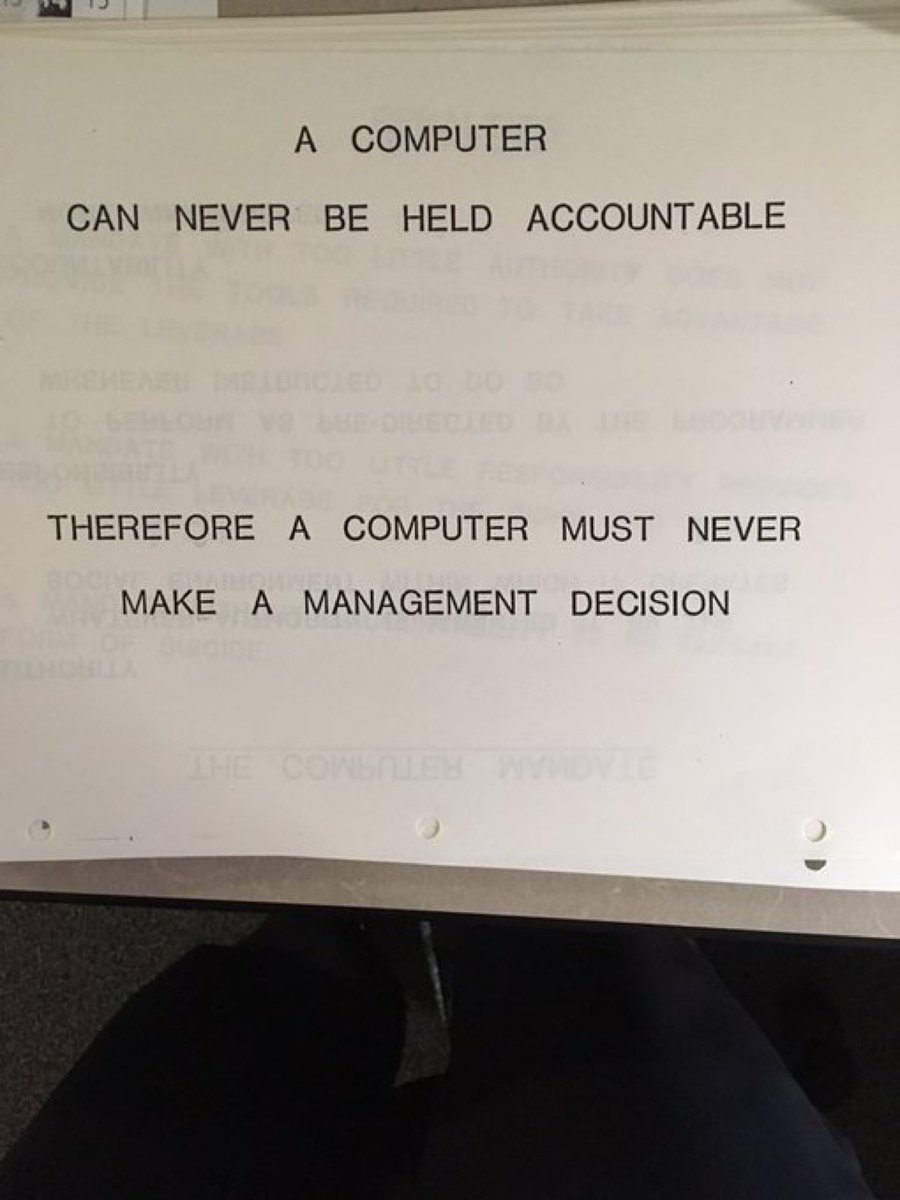
Attention @arxiv authors: Our Code of Conduct states that by signing your name as an author of a paper, each author takes full responsibility for all its contents, irrespective of how the contents were generated. 1/
Important Nature Neuroscience paper shows how humans differ from LLMs.
Many people currently believe that humans are just next-word predictors, like LLMs.
But this new paper by Zou, Poeppel and Ding suggests something more interesting.
The human brain does predict words.
But it does not predict every word with the same precision.
Prediction is constrained by linguistic structure.
When a word continues the current phrase, brain activity tracks word surprisal in a way that resembles an LLM.
But when a word crosses a major phrase boundary, the match weakens.
In other words, the brain does not simply ask:
“What is the next word?”
It also asks:
“What structure am I currently building?”
This challenges one of the most common biases in today’s technological world: the belief that human language works like a large language model.
The answer is: no.
Human language is not just next-token prediction.
*
Paper in the first reply
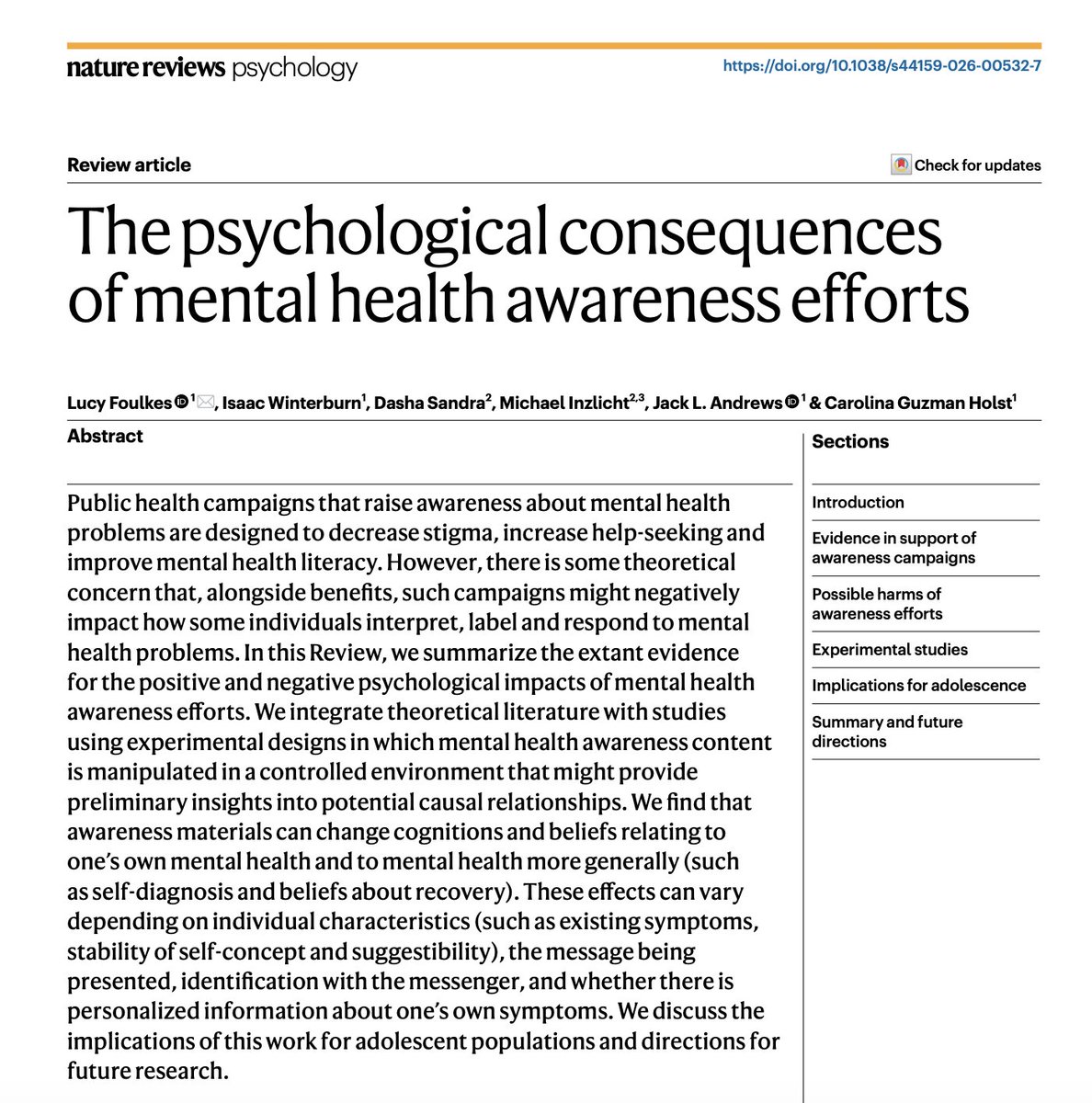
From the paper: "Several high-quality trials have shown that universal mental health interventions based on mindfulness, cognitive behavioural therapy, dialectical behavioural therapy and general mental health awareness can all have negative outcomes, including an increase in internalizing symptoms."
As critics have been arguing all along, individualised, medicalised and decontextualised models & narratives are not only net ineffective, but even contribute to and exacerbate social & psychological issues and distress.
We dont face a crisis of 'mental disorders' in need of medical or cognitive treatment, we face a socio-psychological crisis and a crisis of medicalisation in need of a societal rethink.