Diploma Fabrikasında Yetiştirilen Kuşak
Y kuşağına çocukluğundan itibaren tek bir kurtuluş senaryosu ezberletildi:
Oku. Daha çok oku. İyi bir okul kazan.
Bir yabancı dil daha ekle.
Sertifikalar al. Staj yap.
Kendini geliştir. Sonra gerçek
hayatın başlayacak….
Hayat, sanki bir üniversite kampüsünün çıkış kapısında bekliyormuş gibi anlatıldı.
O kapıdan geçildiğinde insanın yalnızca mesleği değil; itibarı, geliri, aşk hayatı, özgüveni, sosyal çevresi, hatta aile içindeki değeri bile kendiliğinden yükselecekmiş gibi garip bir inanç üretildi…
A French engineer who lives quietly in Paris has spent 30 years writing software that the entire internet now runs on without knowing his name.
He wrote the code that streams every YouTube video, every Netflix show, every TikTok clip. He wrote the code that runs the virtual servers underneath AWS, Google Cloud, and Microsoft Azure. He calculated more digits of pi than anyone in history. He has no Twitter. He has no marketing. He just keeps shipping.
His name is Fabrice Bellard.
Here is the story, because almost nobody outside the systems programming world knows what one man has built.
Fabrice was born in 1972 in Grenoble, France. He studied at École Polytechnique, the top French engineering school. He never went to Silicon Valley. He never built a startup empire. He just wrote code.
In 2000 he started a project called FFmpeg, an open-source multimedia framework for encoding, decoding, and streaming video. He was 28. The project did one thing nobody else had done well. It handled every video and audio format that existed, in one library, on every operating system. He led it himself for years.
Today FFmpeg is the invisible engine of the internet. YouTube uses it. Netflix uses it. VLC uses it. Chrome and Firefox use parts of it. Every Android phone, every iPhone, every smart TV, every video editing tool you have ever touched runs FFmpeg somewhere underneath. If you have watched a video on a screen in the last 20 years, Fabrice's code processed it.
He was not done.
In 2003 he started QEMU, a machine emulator and virtualizer. He wrote it solo until version 0.7.1 in 2005. QEMU lets you run any operating system on any other operating system. It became the foundation of modern virtualization. KVM, the Linux kernel hypervisor, runs on top of QEMU. Every major cloud provider, AWS, Google Cloud, Microsoft Azure, IBM Cloud, runs virtual machines on infrastructure built around it. The Quick Emulator is the most cited piece of cloud infrastructure code on Earth.
He kept going.
In 2001 he won the International Obfuscated C Code Contest with a small C compiler that grew into TCC, the Tiny C Compiler. TCC can compile and boot a Linux kernel from source in under 15 seconds. In 2004 he calculated the most digits of pi ever computed at the time, using a personal desktop computer and an algorithm he derived himself called Bellard's formula. In 2011 he wrote a complete PC emulator in pure JavaScript that runs Linux in your browser, a project called JSLinux that engineers still cannot believe is real.
In 2019 he released QuickJS, a small but complete JavaScript engine that fits where V8 cannot. In 2021 he released NNCP, a neural network based lossless data compressor that immediately took the lead on the Large Text Compression Benchmark.
Then he turned his attention to large language models. He built TextSynth Server, a web server with a REST API for running LLMs locally. He released ts_zip and ts_sms, compression utilities that use language models to compress text and short messages at ratios traditional algorithms cannot reach. He released TSAC, a very low bitrate audio compression system. In December 2025 he released Micro QuickJS, a new JavaScript engine for microcontrollers, separate from QuickJS, designed for environments with almost no memory.
Fabrice co-founded a telecom company called Amarisoft in 2012, where he serves as CTO. Amarisoft builds 4G and 5G base station software used by carriers and labs around the world. He has been running it for over a decade while continuing to ship personal projects from his own home page at bellard dot org
He has no Twitter. He has no Instagram. He gives almost no interviews. His personal website is a flat list of projects with no styling, no fonts, no marketing copy. Just titles and links.
A quiet French engineer who never moved to Silicon Valley wrote the code that quietly runs the internet.
He is still shipping.
We have a lot to learn from Google.
Maps, YouTube, Search, Gemini. Product after product becoming bloated, frustrating, and disconnected from users.
Civil engineers learn more from one collapsing bridge than from 1000 standing ones.
We should study Google the same way.
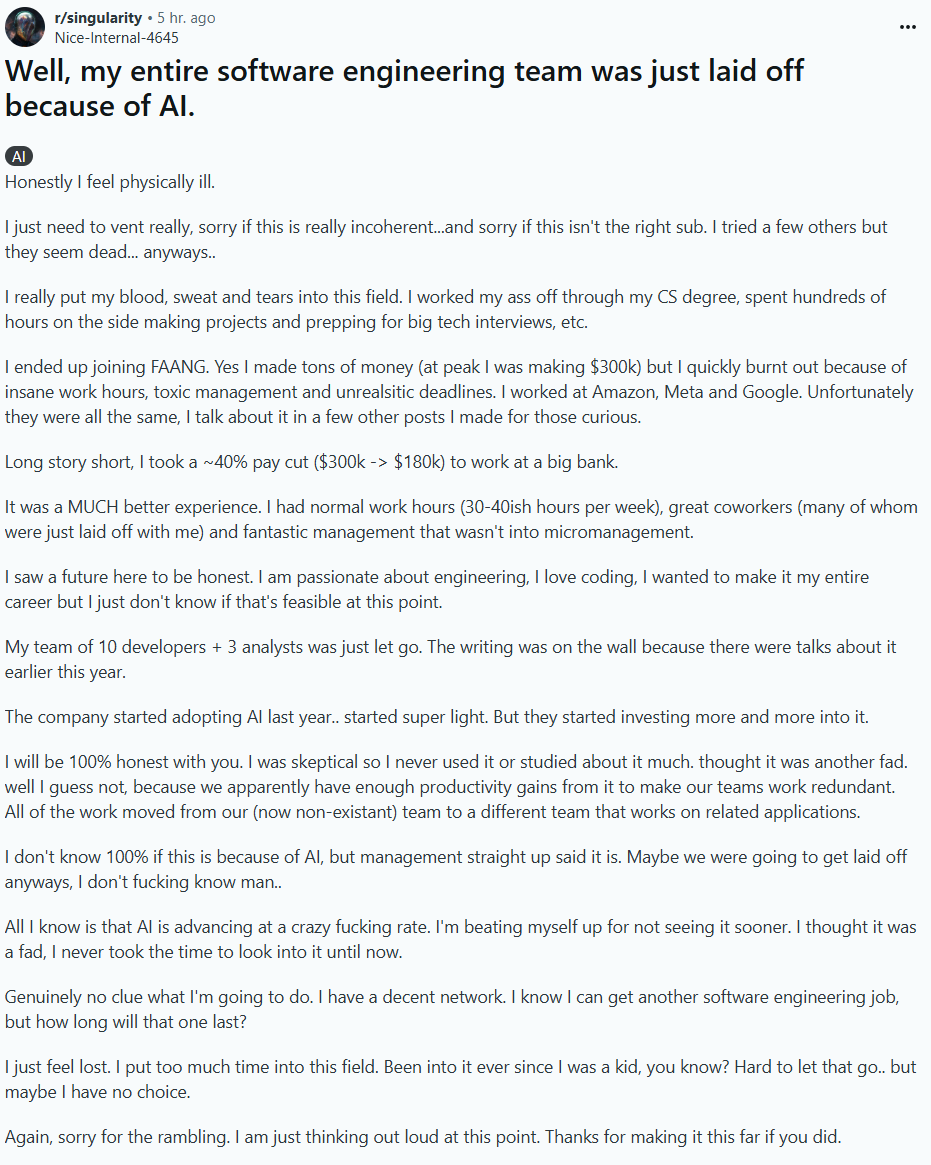
A software engineer at Atlassian got laid off in March after 8 years. His response: a 38-minute YouTube video showing how the company's entire tech works, free for anyone to copy. That same quarter, Atlassian's revenue hit $1.79 billion, a record.
His name is Vasilios Syrakis. He worked in Sydney on Atlassian's digital plumbing: the system that handles the company's web traffic, made up of about 2,000 programs running across 13 regions of the world. Every time someone clicks on Atlassian's software, the system Syrakis worked on decides which of those servers answers. Atlassian's own engineering blog wrote about his team's work in February 2025. On Sunday, Syrakis walked through the whole architecture on YouTube, every box on the diagram.
The financial picture doesn't fit the layoff story. Atlassian's cloud business grew 29% year over year last quarter. The company has 350,000 customers, including 80% of the Fortune 500. None of that looks like a company that needs to cut a tenth of its staff to "self-fund AI investment," as the CEO put it in March.
In the six months before the layoffs, CEO Mike Cannon-Brookes sold 866,145 of his own shares for roughly $134 million. Co-founder Scott Farquhar sold exactly the same number on the same schedule. The board also approved spending $2.5 billion to buy back Atlassian stock from the market, a move that props up the share price. The shares still fell 56% this year. Investors think AI lets companies do more work with fewer employees, and Atlassian charges its customers per employee.
Sam Altman called this practice "AI washing" in February. Of the 1.2 million American jobs cut in 2025, only 55,000 blamed AI. The rest had different reasons, or none at all. The engineer who helped build Atlassian's plumbing is now teaching the internet how it works, for free, because he no longer has a paycheck to protect.
Reality check for Indians dreaming of Germany or Europe.
I lived there for 6 years.
A €70k salary sounds massive in INR.
(~65–70 LPA after conversion)
But reality looks more like this:
- ~40% gone in taxes
- €1.5k+ rent in major cities
- expensive electricity & internet
- high insurance costs
- eating out is costly
- every service costs money
After PPP adjustment,
€70k in Germany feels closer to
~32–35 LPA in India.
So before leaving your well-paid job in India. Think twice.
Weather depression is 100% real
Nobody warned me that weather controls your entire life:
Years 1-20 in Spain:
"Weather is fine, I'm just naturally unmotivated in winter"
Years 20-22 in Central Europe:
"Why do I want to die from November to March?"
Years 23-31 in tropics/subtropics:
"Oh. I was just sad because of the F*CKING weather"
The difference is INSANE. Let me tell you about my personal experience:
🇨🇿 Prague November-March:
❌ Dark at 4pm
❌ Gray every day
❌ Cold and wet
❌ Vitamin D? Never heard of her
❌Everyone's depressed
❌ "It builds character!"
Chiang Mai, Asunción, Gran Canaria:
✅ Sunny 300+ days/year
✅ 25-30°C most days (and you leave when it's hotter)
✅ Wake up energized
✅ Actually want to do things
✅ People are happy
✅ No excuses needed
Seriously... this is one of the most underrated aspects of working online
You can just chase the summer and spend your whole year in perfect weather
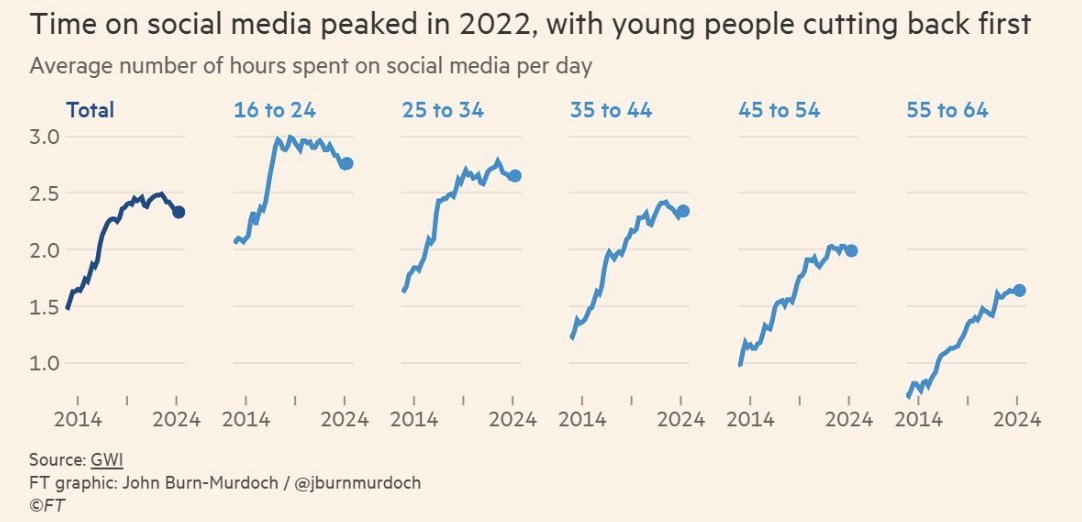
THIS chart is the CLEAREST signal of where the internet is heading.
social media time is SHRINKING for the first time in HISTORY, and young people are leading the pullback.
Brainrot is OUT.
they grew up online, saw the full cycle of social platforms, and learned early that endless scroll doesn’t make you happier or smarter.
they’re the LEADING indicator. their parents will follow in 3-5 years.
AI slop is the nail in the coffin.
every feed feels synthetic familiar faces, identical voices, recycled ideas. the “factory smell” of it all finally broke people’s curiosity.
but there’s an upside. every trend creates its anti-trend.
attention is shifting back to things that feel real, slow, and intentional.
people are paying for spaces that make them feel grounded, informed, and connected again.
the next $100M+ companies will engineer density, trust, and time well spent. they’ll build containers for meaning, then use AI to keep them organized, not optimized.
the internet’s oldest assumption that more engagement equals more value is breaking.
the white space i think is...
• "slow media" formats: weekly briefs, serialized content etc
• private groups that operate like clubs with applications and rituals
• provenance and identity layers that verify real creators and sources
• brands with offline gravity like real events, real belonging
• curated directories and vetted marketplaces
• paid memberships that deliver depth
• note: we share business ideas around this on @ideabrowser
• IRL anything - dinners, meetups, shared experiences
young people are abandoning social media faster than their parents are discovering it.
If you understand what that means, that's a big deal.
i can't stop thinking about this FT/GWI chart.
brainrot is OUT.
meaning is IN.
One of my favorite lessons from neuroscience:
When you start something new, it feels like a struggle and requires your entire focus to figure out. But as you get better, it gets easier and you need far less brain power. Things become automatic and you can dedicate your brain to other tasks.
In the image below, you can see how the brain becomes more efficient at the exact same task as people go from a novice to skilled over the course of a single 60-minute practice session.
If something feels difficult, just keep at it. I've had this experience 100 different times over my life. Things that once took me weeks, now take me minutes. https://t.co/vKqG42WndS
Scaling up RL is all the rage right now, I had a chat with a friend about it yesterday. I'm fairly certain RL will continue to yield more intermediate gains, but I also don't expect it to be the full story. RL is basically "hey this happened to go well (/poorly), let me slightly increase (/decrease) the probability of every action I took for the future". You get a lot more leverage from verifier functions than explicit supervision, this is great. But first, it looks suspicious asymptotically - once the tasks grow to be minutes/hours of interaction long, you're really going to do all that work just to learn a single scalar outcome at the very end, to directly weight the gradient? Beyond asymptotics and second, this doesn't feel like the human mechanism of improvement for majority of intelligence tasks. There's significantly more bits of supervision we extract per rollout via a review/reflect stage along the lines of "what went well? what didn't go so well? what should I try next time?" etc. and the lessons from this stage feel explicit, like a new string to be added to the system prompt for the future, optionally to be distilled into weights (/intuition) later a bit like sleep. In English, we say something becomes "second nature" via this process, and we're missing learning paradigms like this. The new Memory feature is maybe a primordial version of this in ChatGPT, though it is only used for customization not problem solving. Notice that there is no equivalent of this for e.g. Atari RL because there are no LLMs and no in-context learning in those domains.
Example algorithm: given a task, do a few rollouts, stuff them all into one context window (along with the reward in each case), use a meta-prompt to review/reflect on what went well or not to obtain string "lesson", to be added to system prompt (or more generally modify the current lessons database). Many blanks to fill in, many tweaks possible, not obvious.
Example of lesson: we know LLMs can't super easily see letters due to tokenization and can't super easily count inside the residual stream, hence 'r' in 'strawberry' being famously difficult. Claude system prompt had a "quick fix" patch - a string was added along the lines of "If the user asks you to count letters, first separate them by commas and increment an explicit counter each time and do the task like that". This string is the "lesson", explicitly instructing the model how to complete the counting task, except the question is how this might fall out from agentic practice, instead of it being hard-coded by an engineer, how can this be generalized, and how lessons can be distilled over time to not bloat context windows indefinitely.
TLDR: RL will lead to more gains because when done well, it is a lot more leveraged, bitter-lesson-pilled, and superior to SFT. It doesn't feel like the full story, especially as rollout lengths continue to expand. There are more S curves to find beyond, possibly specific to LLMs and without analogues in game/robotics-like environments, which is exciting.
My sleep scores during recent travel were in the 90s. Now back in SF I am consistently back down to 70s, 80s.
I am increasingly convinced that this is due to traffic noise from a nearby road/intersection where I live - every ~10min, a car, truck, bus, or motorcycle with a very loud engine passes by (some are 10X louder than others). In the later less deep stages of sleep, it is much easier to wake and then much harder to go back to sleep.
More generally I think noise pollution (esp early hours) come at a huge societal cost that is not correctly accounted for. E.g. I wouldn't be too surprised if a single motorcycle riding through a neighborhood at 6am creates millions of dollars in damages in the form of hundreds - thousands of people who are more groggy, more moody, less creative, less energetic for the whole day, and more sick in the long term (cardiovascular, metabolic, cognitive). And I think that many people, like me, might not be aware that this happening for a long time because 1) they don't measure their sleep carefully, and 2) your brain isn't fully conscious when waking and isn't able to make a lasting note / association in that state. I really wish future versions of Whoop (or Oura or etc.) would explicitly track and correlate noise to sleep, and raise this to the population.
It's not just traffic, e.g. in SF, as a I recently found out, it is ok by law to begin arbitrarily loud road work or construction starting 7am. Same for leaf blowers and a number of other ways of getting up to 100dB.
I ran a few Deep Research sessions and a number of studies that have tried to isolate noise and show depressing outcomes for cohorts of people who sleep in noisy environments, with increased risk across all of mental health (e.g. depression, bipolar disorders, Alzheimer's incidence) but also a lot more broadly, e.g. cardiovascular disease, diabetes.
Anyway, it took me a while to notice and after (unsuccessfully) trying a number of mitigations I am moving somewhere quiet. But from what I've seen this is a major public health issue with little awareness and with incorrect accounting by the government.
People without coding skills have created apps that top the charts — even before ChatGPT.
Read more: https://t.co/pMlSjU0eqD
It seems many developers asking “Where are the great examples of AI apps?” haven’t read @paulg’s Beating the Average- a must-read: https://t.co/2O3pwdf6Ec
It's the 1950s. COBOL promises an English-like syntax that will allow non-specialists to program software systems, 10x productivity and not needing to understand the underlying system.
It's the 1970s. SQL promises natural language queries that managers can write themselves, "just tell the database what you want, not how to get it," and "no more dependency on programmers for data access."
It's the 1990s. Visual Programming tools promise "program without coding," "drag and drop your way to enterprise applications," and "development at the speed of thought."
It's the 2000s. MDA promises "design once, deploy anywhere," "business users can modify the models," and "automatically generate perfect code from UML diagrams."
It's the 2010s. No-Code platforms promise "anyone can build an app," "eliminate the middleman between business and technology," and "goodbye IT department!"
It's the 2020s. Vibe Coding promises "just describe what you want in natural language," "no programming knowledge required," and "focus on what your software should do, not how it works."
I’ve spent the last 25 years encouraging young people to get into IT.
Yesterday, I didn’t - and that break in the pattern says more than I’m ready to admit.
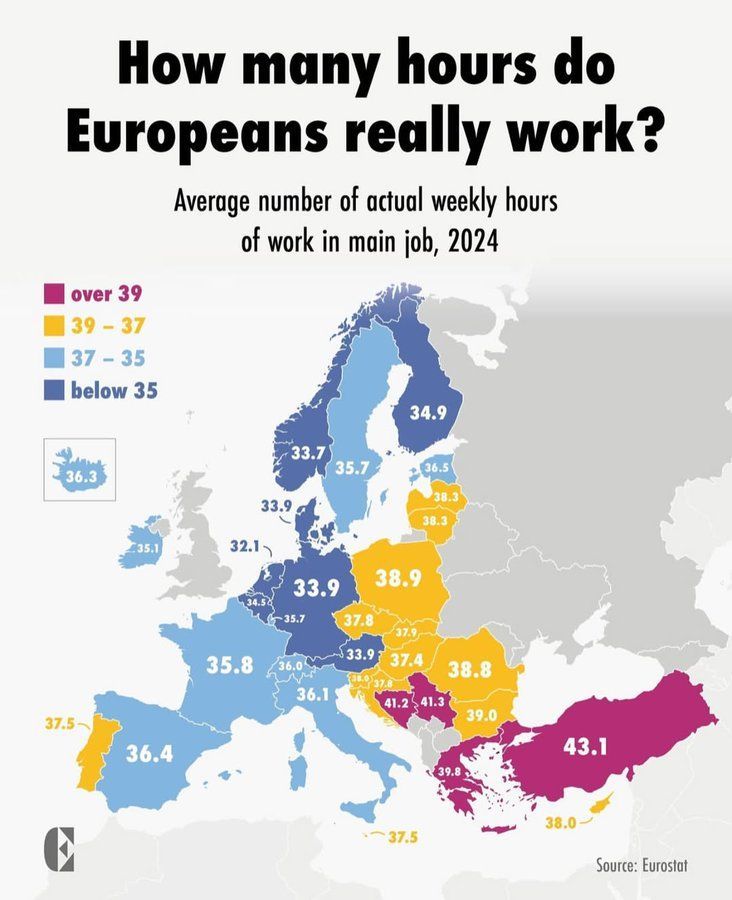
The average Turk works ten hours more every week than the average Dutch. This isn’t a simple story of lazy Dutch workers and industrious Turks but rather a reflection of the complexity of the two economies. In the Netherlands a huge service economy grants its workers shorter working hours whereas an agricultural and industrial workforce in Türkiye has to put in longer hours for much lower pay.
A major mistake I made in my undergrad is that I focused way too much on mathematical lens of computing - computability, decidability, asymptotic complexity etc. And too little on physical lens - energy/heat of state change, data locality, parallelism, computer architecture. The former is interesting; The latter bestows power.