I am not a Zepto investor.
But I still hate seeing the Tall Poppy syndrome play out on Indian Twitter and media. The joy some people seem to find in seeing someone else - especially young founders - have a setback.
Many of these critics have never built anything of value or attempted a tough problem.
One of the reasons Silicon Valley works is simply the abundance mindset, and people (and the media) not spending too much time and energy bringing other people down vs. focusing on solving their own problems.
I wouldn’t want to bet against the audacity of young Indian founders like @aadit_palicha. They’re stronger than you think.
@sridharfyi Hi , building Scophix (https://t.co/t3ebqqqJri) . Codebase Intellience for Product Teams. We're reinventing the Software Development Lifecycle for the AI era.
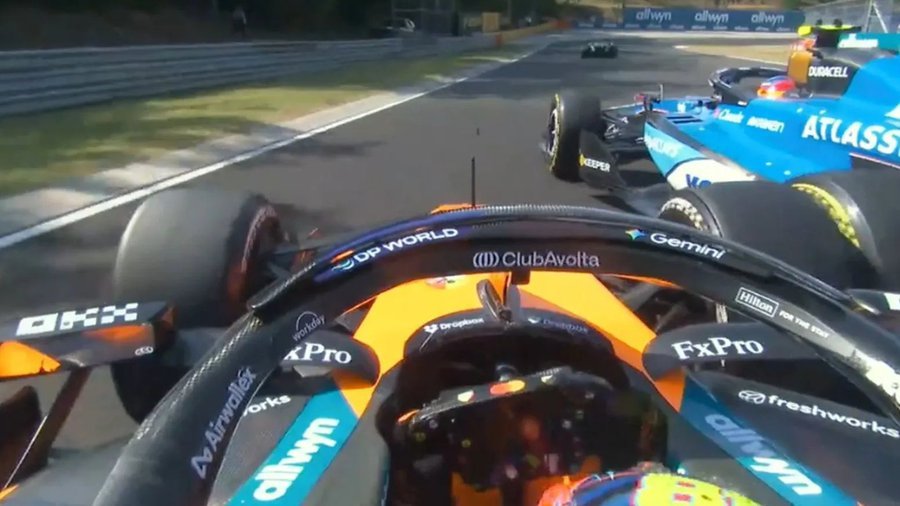
El hate a Carlos Sainz generalizado me está pareciendo muy muy excesivo
Y como siempre hay mucha desinformación de fondo
1. Sainz dice que hubo un problema con el sistema de banderas azules y que cuando Piastri le pasó él no tenía visibilidad
2. La FIA le da la razón y en su informe habla de esa falta de visibilidad. Por eso hay atenuante y la sanción no es de 10 segundos, sino de 5
3. Por alguna razón estáis pasando por alto que Piastri abandona por un problema de su caja de cambios. Nada que ver con Carlos
Y para rematar, lo que más rabia me da... La burla de que peleaba con Alonso por la P16 como si fuera un Mundial
Esto son carreras, el honor de los pilotos está hasta en pelear por la P21, que no se nos olvide. Esa soberbia es muy fea y no casa con la esencia de la competición
Por desgracia en la F1 los pilotos pueden llegar hasta donde llegan sus coches. Piastri habla desde la comodidad de su asiento en McLaren, pero la vida es muy larga y muy probablemente algún día será él el que pelee a muerte por una P16
Every great founder learns to suffer.
The rejections. The flat metrics. The 3 AM ceiling stares wondering if you’re delusional.
Embrace it. High pain tolerance is one of the few advantages competitors can’t copy.
Don’t seek ease. Seek strength.
some advice from @alexandr_wang at @ycombinator startup school
• nobody starts a company being good at it. the game is continuous learning.
• don’t follow the herd. consensus leads to confusion.
• systems thinking matters at every layer: code, people, and agents.
• as ai makes execution easier, vision and ambition become more valuable.
• build a strong philosophical compass for where the world should go.
• commit early to the biggest exponential curve. yesterday it was moore’s law. today it’s ai.
• companies are fundamentally feedback loops. agentic systems that optimize those loops are a massive opportunity.
• the right agentic loop with the right metric can enable a swarm of agents to outperform 100 engineers.
• the hard part is agentic coordination: getting large numbers of agents to work together effectively.
• define the right metric, set clear goals, and structure the workflow.
• ignore the noise (especially linkedin) and build conviction.
This line from Atomic Habits isn't ready to leave my head:
"It doesn't make sense to continue wanting something if you're not willing to do what it takes to get it. If you don't want to live the lifestyle, then release yourself from the desire. To crave the result but not the process is to guarantee disappointment."
Last batch, YC received more than 15,000 applications.
Approx 300 got in.
The 2% didn't have better ideas.
They had:
→ Clearer problems
→ Specific traction
→ Honest applications
→ One specific insight about their market no one else had
That's the playbook in Every batch.
🚨 | Mercedes reportedly uncovered an issue "deep in the code on George Russell's car" in Spa.
The Silver Arrows are understood to have made software adjustments to solve the problem for this weekend.
[@wearetherace]
We went from 0 to 1,000+ paid customers in our first 20 weeks by religiously following these @ycombinator 12 rules:
1/ grow retention before growth. we didn't run a single growth campaign until we hit 90% weekly retention. scaling a leaky bucket just means you fail faster
2/ ignore everyone who isn't your customer. i stopped reading competitor blogs, industry news, and most of twitter. the only company that can kill you in year one is your own
3/ manual is faster than perfect. our first 50 users each got a personal onboarding call from me. you can't automate what you don't understand yet
4/ validate before you build. we put a credit card gate on @origamichat on day 2. it's easy to convince yourself people want your product when nobody's paying
5/ ugly product > no product. we shipped a barely-working version to 30 people in a week. real users teach you more in 7 days than 6 months of polishing in the dark
6/ your customers write your roadmap. i still spend 3 hours a day on user calls. every feature we've shipped came from a conversation, not a planning session
7/ fire bad fits early. we've fired customers who were wrong for our product. 10 people who love you beat 1,000 who kind of like you. every time
8/ ship every week without exception. we push code to production every friday. consistency compounds in ways you can't see at first
9/ stay small longer than feels comfortable. we were 2 people for a very longtime. Headcount is not progress. every great startup was embarrassingly small for embarrassingly long
10/ know your burn, know your runway. we track default alive on a whiteboard every week. scary but necessary. most startups don't die from the market, they die from running out of time
11/ expect things to break constantly. we've had 3 near-death moments. the game isn't avoiding fires, it's how fast you put them out
12/ honest conflict > polite silence. brutal honesty with your cofounder is the cheapest insurance you'll ever buy
good luck and dont forget to have fun
At its peak, Sun Microsystems was valued at 205B (394B if inflation adjusted). Sold software in enterprise servers. Got disrupted by Linux, x86, and commodity hardware. Ended up selling to Oracle for 7.4B, losing 96% of its value.
Open source models running on local hardware can have a similar impact given what’s going on.
Congratulations to Zhilin Yang, founder and CEO of @Kimi_Moonshot, on the latest Kimi release. What a huge win for the open-source community!
It feels like just yesterday Zhilin was graduating from my lab at CMU, jointly co-advised with William Cohen. Not only did he complete his Ph.D. in just four years, but he also made truly fundamental contributions to ML during his time at CMU.
What a spectacular career! Congrats again Zhilin, and thank you and the entire Kimi team for everything you're doing for the open-source community.
forget models training models
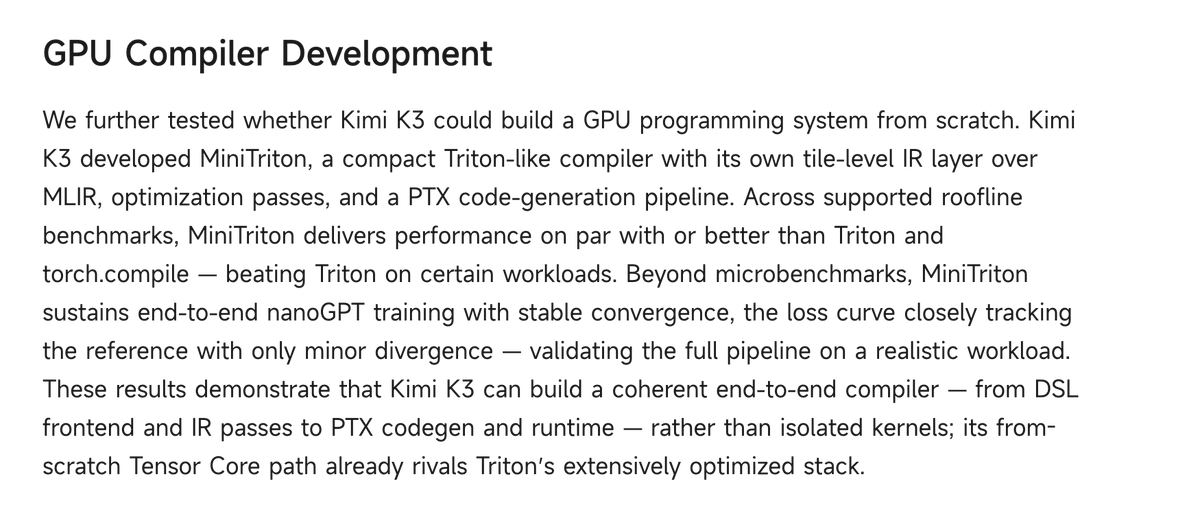
- kimi k3 spent one 48 hour autonomous run designing a chip to serve a nano model built on its own architecture
- it also wrote miniTriton from scratch matching or beating Triton on roofline benchmarks
its so over
People really underestimate how much it means to even have
one single customer
one single dollar in revenue
one single employee
All of this means that there's business value for someone. magically, there's people who depend on your creation. and there's food on someone's table because you built something.
The grindslop, the million dollar raises and billion dollar valuations and large SF offices make us oblivious to the simple things.
How am I adding value to the world? Am I making something people want?
soon you will be able to have helpful assistants that talk to you, answer questions, and give advice. later you can have something that goes off and does tasks for you. eventually you can have something that goes off and discovers new knowledge for you.
Before vibe coding became a thing, programming was already evolving in that direction. It already increasingly consisted of installing and configuring stuff other people wrote, without reading the source.
your first 10 customers will tolerate anything. bad UX, missing features, downtime. your next 100 won't. the gap between 10 and 100 is where most startups stall because they built for tolerance, not for standards.