@airtelindia@Airtel_Presence@airtelnews
What an absolute shit show of customer service are you running. service requests closed without resolutions. Raised a request over a month - No Support from Nodal or Appellate!
Humans working on the back end??
@Airtel_Presence@airtelindia astonished on the varied feedback provided by Airtel customer executives on call and physical store and lack of transparent escalation matrix to resolve customer problems
SR 4500334398
SR 4500334243
@bookingcomPA At what point do you start looking after your customers.
Pending case resolution for over 5 months on an incorrect charge.
Booking #4708-379-821
Would love to hear from you and your grievieance officer -Missing In Action
@BookingHoldings running a full fledged scam,. Zero accountability to customers
Charged 600 Euros incorrectly and not resolved over 5 months
Booking #4708-379-821
@BookingHoldings@TheStreet@priceline Maybe look into your unsustainable business practices.
No prcs / escltn matrix & treating your customers like they belong to bottom of the barrel!
Customer support cannot resolve a dispute in ovr 3 mnths & I still don't see any sight of my funds blocked.
Rsvn #4708379821
@bookingcom@bookingcomPA
Customer support seems to be top notch scam. Dispute has been going on for over three months over an incorrect charge made by the property. Still not refunded by the property or https://t.co/a3leCvvTgn
Do look into the reservation #4708379821
“Unfortunately, the clock is ticking, the hours are going by. The past increases, the future recedes. Possibilities decreasing, regrets mounting.”
— Haruki Murakami
“The nitrogen in our DNA, the calcium in our teeth, the iron in our blood, the carbon in our apple pies were made in the interiors of collapsing stars. We are made of starstuff.”
- Carl Sagan, Cosmos
In the vast deserts and mountains of the Barbary coast in North Africa, the Barbary lions once roamed freely. With their distinctly dark manes, they were thought to have been one of the largest lion species to have ever existed. These majestic creatures captured the imagination of many, and their historical significance reaches far back into antiquity.
The photo taken in 1925 by French photographer Marcelin Flandrin captured a poignant moment, possibly featuring one of the last Barbary lions in the wild before their eventual extinction. Flandrin's lens immortalized a sight that would soon vanish from the natural world forever.
Barbary lions were not only remarkable for their appearance but also for their role in history. These same lions were regularly captured by hunters for the brutal games held in the Roman colosseum. Known as "Damnatio ad bestias" in Latin, this practice was a form of capital punishment where condemned prisoners were executed by Barbary lions and other large cats. The lions' presence in such events added to their mythos and perpetuated their fame.
The decline of the Barbary lion population began with the expansion of the Arab empire from 632 to 1258, leading to the end of the Islamic Golden Age after the Siege of Baghdad by the Mongols. Survivors of that turbulent period claimed that "the waters of the Tigris ran black with ink from the enormous quantities of books flung into the river and red from the blood of the scientists and philosophers killed." Amidst the turmoil in the region and as empires crumbled and fell, the Barbary lions managed to persist until the arrival of European colonists in the 19th century.
During this time, big-game hunting gained popularity, and it proved to be devastating for the already dwindling lion population. As a result, sightings of Barbary lions became scarce, and not a single one was reported from 1901 to 1910. By the 1920s, most scientists believed that they had become extinct in the wild.
There were a few reported sightings in subsequent decades, offering glimmers of hope that some may have survived. In 1948, there was a reported sighting in Morocco, and in 1958, another sighting was claimed in a heavily forested area near the city of Sétif in Algeria. However, the forest was destroyed during the Algerian War in the same year, further exacerbating the challenges faced by these noble creatures.
Today, approximately 100 captive lions possess the genes of the Barbary lions, but none of them are pure descendants. While these lions carry a part of their ancestral legacy, the extinction of the Barbary lions in the wild serves as a stark reminder of the consequences of human actions on the delicate balance of nature. The story of the Barbary lion stands as a poignant testament to the importance of conservation efforts to protect and preserve the incredible diversity of life on our planet.
10 Mental Models that will level up your Thinking:
1. First Principle Thinking - Rethink the problem from the ground up.
Separate the underlying facts from assumptions made based on them.
2. Second-Order Thinking - Instead of thinking about the immediate consequences, think about the second-level consequences.
3. Inversion - Look at the problem at hand from the endpoint instead of the starting point.
Don't ask: "What do I need to do?"
Ask: "What must I avoid?"
4. Opportunity Costs - Think about the costs that arise because you decide in favor of one option and thus against every other option.
5. Randomness - Keep in mind that there aren't always cause-effect relationships.
Lots of stuff is random.
6. Leverage - “Give me a lever long enough and I shall move the world.” - Archimedes
7. Margin of Safety - Assume that your assumptions can be wrong and plan with a safety margin.
8. Occam's Razor - Always choose the less complex explanation/option.
"Never multiply unnecessarily."
9. Law of Diminishing Returns - Up to a certain point, additional units offer more value.
But there's a turning point where additional units offer less and less value and costs rise.
10. Niches - Specializing is an effective way to success. Use it and choose a niche where you become an expert.
What Mental Model helps you the most?
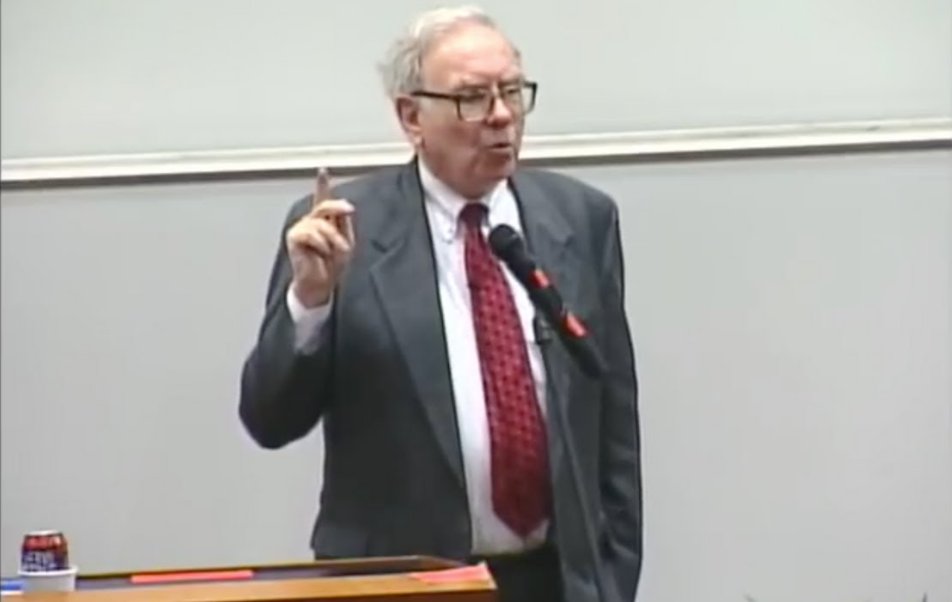
In 2001, Warren Buffett gave a talk at the University of Georgia.
He asked them the most Warren Buffett question ever:
• If you could invest in a friend and get 10% of their income for life -- who would you pick?
Once the students answered the question, he then asked this:
• Why would you invest in that person?
• What character traits do they have?
Now they have a list of character traits to adopt.
Shortly after this, Buffett asked:
If you could short a friend's earnings, who would you pick and why?
Now you have a list of character traits to avoid.
----
1. Do not think this thought experiment is only about money.
You can use it for whatever currency you value.
E.g. Happiness coin
If you could get 10% of a friend's happiness, who would you invest in and why?
If you could short someone's happiness, who would you pick and why?
You can run the same thought experiment with Fitness coin, Friendship coin, Romance coin, etc`
2. This thought experiment is genius because it hacks a bug in life's video game:
Humans are terrible at self-awareness.
But we are great at spotting things in other people.
E.g. If your friend is in the wrong relationship, you can realize in 10 minutes what may take them 10 years.
Daniel Kahneman summarised his book on cognitive biases with the following:
“The premise of this book is that it is easier to recognize other people’s mistakes than our own.” - Daniel Kahneman
3. Nuance - It has to be purely from merit.
Buffett says it can't be because someone will inherit a large sum from their parents.
It has to be based on their behavior.
E.g. If you want 10% of someone's fitness coin, it's not because of incredible genetics -- is because of the actions they take.
Elon Musk fired 6,500 employees at Twitter.
A little birdie told me it's down to:
- 2 designers
- 6 iOS developers
- 20 web developers
- Around 1,400 sales and operations people
How is it possible that we are still using this website?
Two words:
Parkinson's Law.
Have you ever wondered why seemingly simple tech companies have tens of thousands of employees?
Sometimes, it's because they have huge sales forces or tech support/operations people.
But often it's also due to Parkinson's Law.
Parkinson's law is like lighter fluid for bureaucracy.
It's a business tapeworm that slowly eats away at companies, making them less and less efficient and innovative over time.
Parkinson's Law is the idea that the work will generally expand to the amount of time, budget, and number of people allocated to it, and no matter how many people you allocate to it, those people will feel busy.
They'll feel busy because, due to the excess time/slack in the system, they'll start focusing on less and less important tasks.
Here's how it manifests on an individual level:
Let's say you have a report due in a week.
The report might only take you around five hours to finish if you really focus and work efficiently. However, because you know you have a week to complete it, you might find yourself spending a lot more time on it than you need to.
You'll be more prone to distractions, take longer breaks, or perhaps decide to add more details, tables, graphs, and so forth.
Essentially, the task becomes more complex and time-consuming purely because you have more time in which to do it.
And here's how it manifests across organizations:
Imagine a big tech company. A social media company with various departments. Each department has tasks that it must complete to contribute to the overall productivity of the company.
Now, suppose each department is given a budget and a set amount of time to complete its tasks for the year.
According to Parkinson's Law, each department will use its entire budget and the entire allotted time, even if the tasks could have been completed more efficiently.
This is because as resources and time increase, departments tend to become more complex and less efficient.
For example, a department might add more steps to its procedures, requiring more approvals and creating more paperwork, which slows down the process.
Or it might use the full budget on additional personnel or equipment that doesn't necessarily improve productivity.
The department might also use the full budget to justify the same or larger budget for the next year, since budgets in many organizations are often determined based on the previous year's spending.
This is a phenomenon known as "budget padding" or "spend it or lose it" mentality.
Inefficiencies can also develop in staff allocation. If a department expands, it might add managerial positions that aren't strictly necessary.
More employees are hired to manage, creating layers of bureaucracy that may not contribute to productivity and can even slow decision-making.
I have seen this occur over and over again in my career. The larger the team, the larger the budget, the longer the timeline, the less gets accomplished.
I'm very curious to see how many more tech companies come to this realization.
So often, good times + revenue growth = Parkinson's Law.
#SayNoToLivestockBill2023
Dogs and cats for dinner? No way. Amend Livestock Bill 2023. No live transport. No dogs and cats to be traded and eaten. Get real.
Over the next few months the government needs to rebuild its Treasury General Account (TGA) so it issues bonds and it drains ‘’liquidity’’ from the ‘’system’’
And here I can picture you thinking:
What the heck does that mean, and is it true?
Any impact on markets?
Thread
1/
@AxisDirect_In Axis Direct is plagued with problems for which retail investors have to pay.
I cannot even execute a trade from the app filled with technical glitches.
Called customer support and they aren't equipped to resolve the redemption request.
The attraction force exerted by the moon's mass on bodies on Earth, which results in the phenomenon of oceanic water levels rising and falling, can be described as the gravitational pull of the moon.
Credit: Vinny Ravuri













![Rainmaker1973's tweet photo. «In the grand scheme of things, we're all pretty much blind and deaf»
[source, Abstruse Goose: https://t.co/tzB4ZtbNuu] https://t.co/hvCYRlAOmJ](https://pbs.twimg.com/media/FqduwnIX0AMwTU0.png)


