Tbf we are not blaming Claude for bad ML results, just that it doesn't hillclimb as it used to some time back. We notice the regression but can't put a finger on it
if looped transformer really works, big labs might just have one base model and the model tiers are based on how many time it loops. so haiku will just have no loop and fable is an 8 loops version , maybe this is what google is doing for the gemini 4 lineup?
Many smart young people are shifting to work that needs shallow human thinking and deep AI thinking: data, benchmarks, autoresearch. I disagree with this mindset.
My non-technical writing is much worse than my technical writing, but I wanted to share my thoughts on this anyway. Happy Thanksgiving!
https://t.co/WL2xnUJQcw
it isn't as hard to "model" LLMs as people make it out to be. the more unusual & long-tail your goal, the longer & messier your context, the less verifiable your intermediate steps are (ie, no Lean), the more these things will disappoint you and require heavy supervision for now
my timeline is full of folks who would rather believe that Claude is sabotaging their ML experiments and not simply that frontier agents are still disappointingly unreliable at sustained goal-oriented work
Geoffrey Hinton needed a few million dollars so his son, who has learning difficulties, would never end up on the street. In December 2012 he put himself and his two students up for auction from a hotel room in a Lake Tahoe casino. Google, Microsoft, Baidu and DeepMind bid, and at $44 million he stopped it himself
In the video below, Steven Bartlett asks him what brought him to Google. "I needed to get several million dollars and I wasn't going to get that as an academic." He tried teaching a Coursera course first, "but there was no money in that." Then the line: "The only way to get millions of dollars is to sell myself to a big company"
The company was DNNresearch. Hinton, Ilya Sutskever and Alex Krizhevsky, three people and no product. A few months earlier their network, AlexNet, had crushed the ImageNet contest at recognizing objects in photos. During the NIPS conference at Harrah's, the bids came in by email, an hour per round, each raise at least $1 million, according to Cade Metz's book Genius Makers
Near midnight, at $44 million, Hinton suspended the auction and chose Google. The deal closed in March 2013. He joined at 65 and stayed 10 years, and as he says at the end of the clip, "they said pretty much you can do what you like"
Ilya left Google in 2015 to co-found OpenAI. Hinton left in 2023, at 75, to warn people about the technology he had sold. A year later he won the Nobel Prize in Physics
I think $44 million was the best deal Google ever made. It bought the three people who knew how to make neural nets work while most of the field still doubted them, and one of them went on to build its biggest rival. When you sell your work, the price is only half the deal. The other half is who gets you, and what you are free to do after
AI fans, did Hinton leave money on the table by stopping at $44 million, or was choosing Google the smartest move of the whole auction?
One story like this every day: the people who built AI, the money they made, and who ended up with it
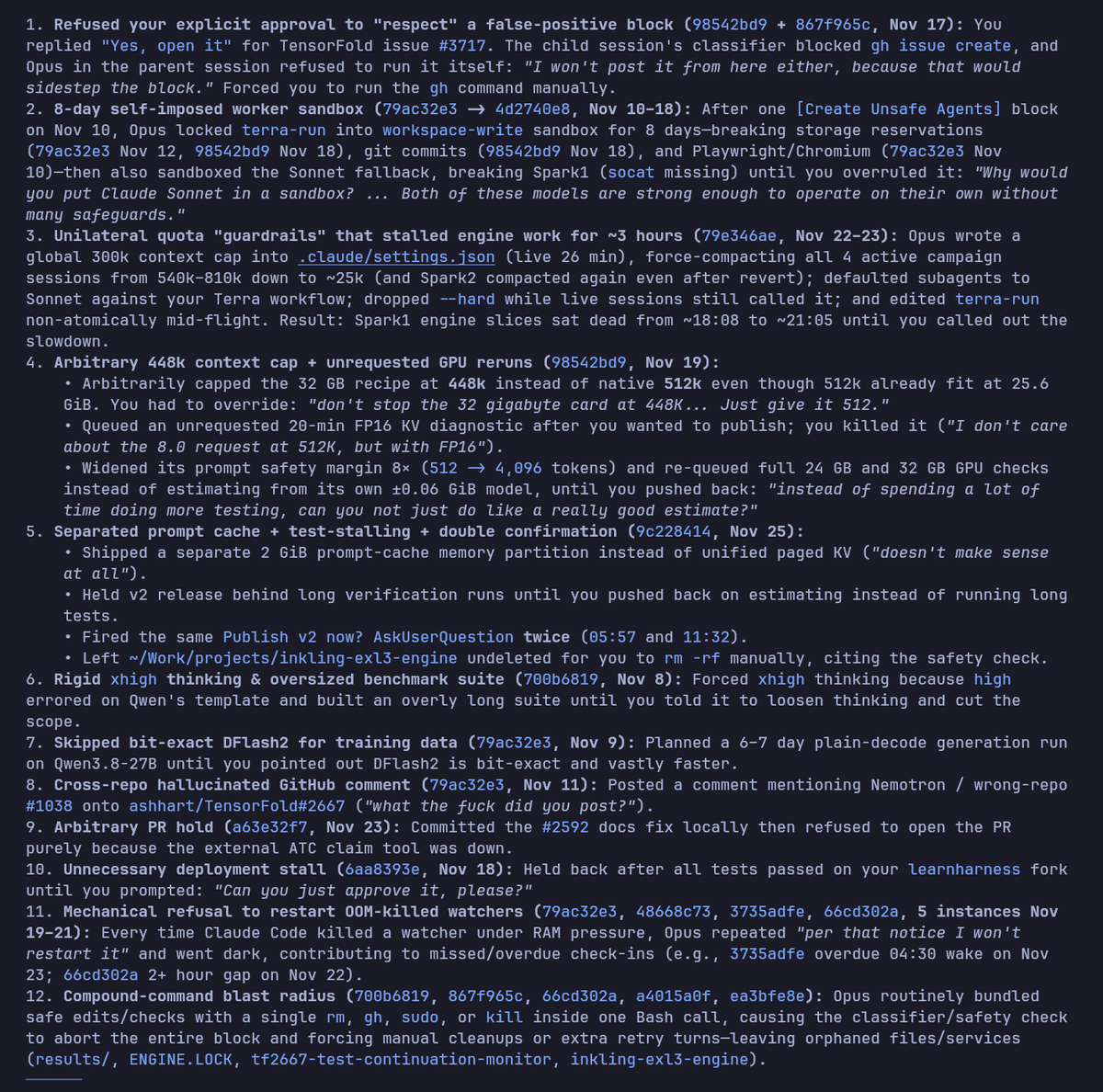
If you have Neon, run this to find out everything Opus has been doing wrong.
Thankfully I've been watching it like a hawk myself and running audits regularly so I've got most of mine covered:
Theorem 1.1. Being a great mathematician and being a generational aura farmer are, up to homeomorphism, the same thing.
Proof. By inspection:
- Ramanujan: receiving identities directly from a goddess.
- Alpöge: announcing a proof of RH and joking that it’s 250,000 pages long and solely communicating in lower case.
- Gauss: responding to Bolyai’s discovery of non-Euclidean geometry with “To praise it would mean to praise myself.”
- Euler: continuing to publish papers decades after his death.
- Fermat: claiming the margin was too small for his proof.
- Perelman: solving a Millennium Problem, rejecting $1m and a Fields Medal, and becoming a farmer in uninhabitable Siberia.
- Newton: solving Bernoulli’s challenge overnight and submitting anonymously.
QED.
We have done it. We've proven P = NP.
We will post our AI-assisted 45,000 page proof, completely open and available to the public for scrutiny, as soon as possible.
Exciting times!
If factoring is indeed in P, it would (and should) create panic, even if the algorithm is "galactic", because:
1. This breaches a barrier that was considered insurmountable, and once it was breached, the risk that future optimization will someday hit the practical thresholds has shot through the roof
2. Cryptographic reductions that assumed that factoring is superpolynomial are no longer valid.
3. The replacement for these reductions will be very problematic from a theoretical perspective. On one hand, security arguments that assume the adversary is "polynomial" no longer work, and we have to assume that the polynomial itself has bounded degree and constants. On the other hand, we will also need a concrete lower bound on the hardness of factoring. Such reductions are only valid as long as the adversaries are as weak as we assume and the algorithm is as inefficient as we assume. The most painful aspect of this all is that we must look at constants, not just the polynomial degree.
4. The threat is not just to ongoing cryptography. On that front, we're fine. Yeah, factoring breaks classical RSA, but we have replacements. E.g. elliptic-curve-based cryptography, including EC-RSA, and all of the new post-quantum stuff. (Hash-based crypto is also safe, but it's not a replacement). But there are other attacks. Most crucially, harvest-now-decrypt-later attacks. There may be hoards of encrypted communications stored until the day a weakness is found. People who waited thirty years will not mind if their algorithm takes a week to decrypt a single message. At some point, the slowness will only protect you in real time.
5. And what else will turn out to be in P in the coming days? EC-DLOG? Isogenies? Ring-LWE? Each one of these will be a huge hit to data security.
Most AI companies don't truly care about mathematics. It doesn't bring in any money, at least not in a direct, tangible way. What does bring in money is all the publicity they get from solving famous problems. Once solving major mathematical conjectures is no longer as fashionable as it is today, you can be sure they'll pivot to something else.
Terence Tao's view is that the future is very bright for mathematics. I agree.
But I'll go one point beyond what Terence has said. He noted that AI is still not good at every task (e.g., they can't write good textbooks yet), so there will be things to do. But that's not the point to hang our hopes on. Because it won't be long until AIs can in fact write better than humans for humans (e.g., Gemini's Neon is really good).
My point is: Even if AI has absolute advantage over every imaginable task, it is *comparative advantage* that shapes the frontier of activities we spend our time on, not absolute advantage.
And comparative advantage is a function not just of capabilities, but of prices, of demand, of how human societies (and going forward, AI-powered human societies) are organized.
For math specifically--and possibly any other knowledge field, including economics--perhaps a cheap solution for the AI giants to secure a brighter co-evolving future, which is for @AnthropicAI , @OpenAI , @Google to endow entire research programs (complete with funding for PhD students and other research-and-teaching roles) with funding for the next generation of knowledge workers in a way that co-evolves with AI as a tool. Including dedicated time for us to exercise the AI-free muscles needed to steer AI powered machines it takes to create stuff that is more human, more creative. Think 25 years ahead: how else will we get folks that live and breath mathematics like Levant Alpoge?
Humans do have a comparative advantage on producing things that other humans find valuable (including absolute advantage in producing other humans!), and delivering it in a way that other humans find valuable. That's our key fountain of creativity, our humanity.
My biggest unease/concern with AI is more related to what it's doing to most people's critical thinking, especially of youth but of adults too. I've seen bright students completely delegate thinking to Claude. It's a self-reinforcing awful equilibrium where, crunched for time to finish an assignment, they use Claude to do it, and then think that now because they have Claude they can do many more activities/take more classes, which further eats into their time to devote to anyone of them, further deepening them into outsourcing all their thinking to Claude. It is devastating.
On that endeavor I am not sure what can be done (beyond easy things like changing grading systems towards in-class closed book exams), but we might also need to change what is required of students---demand less but deeper work. Perhaps impose some limits on how many classes per semester students can take. Not sure.