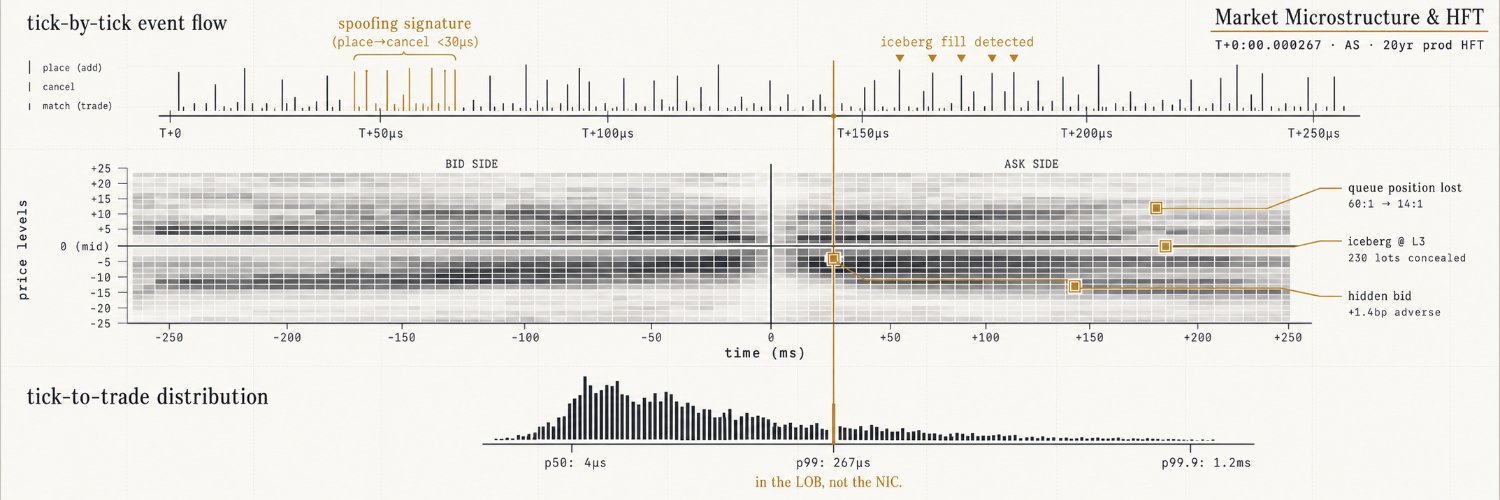
$3.7M of execution cost. None of it on the TCA dashboard.
One quarter, one desk. Four microstructure signals every standard TCA report misses.
Each is a P&L variable. None are exotic.
Here's the breakdown:
The test: replay your fastest session of the past year.
Max divergence between the gate's applied sequence and the OMS's at each approval.
If 0 -- you're covered.
If not 0 -- that's your exposure window.
Worth knowing before the next fast market.
https://t.co/YGUfGOvsSU #hft
A risk gate can pass every compliance audit and still clear orders past the real position limit.
The mechanism: it checks a position from 3 fills ago.
How the two-copy problem manifests, how you find it in fill data, and what actually fixes it:
#hft#marketmicrostructure
The sequencer makes the problem observable.
Gate tracks: applied sequence vs published high-water mark. That gap is staleness.
When gap exceeds the budget: gate refuses. Not "maybe okay." Refuses.
Blocked orders are recoverable. An overrun past a real limit isn't.
the standard: replay yesterday's journal → identical EOD state.
can't demonstrate that in staging? you don't know your recovery window.
run the test. what broke at which boundary is the comment worth seeing.
all 5 decisions: https://t.co/yM3nfiMb2Q
#hft#electronictrading #exchanges
a matching engine can pass every functional test your QA team
designs and still be non-deterministic.
most teams find out during a live incident, not in staging.
5 decisions separate engines that recover in minutes from ones
that take 10 hours. a thread:
#hft#matchingengine #exchanges
determinism is a compliance property.
FINRA fined Citadel $1M in October 2024 for 31.2B CAT errors.
a code error, separate from the engine. but regulators require
reconstructability either way.
two replays, two queue orderings = plausible account, not the account.
v4 uses std::map, which still allocates per insert.
the real win comes from pre-allocated ring buffers and pool allocators, no dynamic memory in the hot path. language is the easy part of the latency story.
I hate these stupid analogies
They haven't stolen anything , they took what was publicly available and put everything in one place for you to use, in Avery advances, intelligent way.
This was something you couldn't have done back then, or even today.
Stop complaining!
Let me trace the timeline here because nobody's connecting it.
Step 1: Scrape the entire internet. Every book, every article, every conversation, every piece of art, every forum post. Do it without asking. Do it without paying.
Step 2: Train a model on all of it. Call it "artificial intelligence."
Step 3: Go to BlackRock's Infrastructure Summit and announce: "We see a future where intelligence is a utility, like electricity or water, and people buy it from us on a meter."
Step 3 is where you sell people's own knowledge back to them. On a meter.
They took the collective output of human thought, compressed it into a model, and now they want to charge you by the token to access a version of what you and everyone you know already created.
One Reddit user put it perfectly: "They stole all this data from us, the people, our life's work, creativity, art, by devouring the internet and blowing through all copyright laws. Now they want to sell it back to us in the form of a utility."
Imagine if someone photocopied every book in the public library, burned the library down, and then opened a subscription service for the copies.
That's the metered intelligence business model.
And they're pitching it to infrastructure investors as though they invented water.
This is a great lecture at MIT by David Shirokoff on Markov Chains.
He covers the fundamentals of Markov Chains using a simple particle movement example.
He starts by explaining how a particle moves between two positions, A & B, with different probabilities. From there, the talk converts the problem into matrix form using a Markov matrix.
The main topics covered are:
- Transition probabilities
- Markov matrices
- Probability vectors
- Matrix multiplication in Markov Chains
- Finding probabilities after n steps
- Eigenvalues and eigenvectors
- Matrix diagonalization
- Long-term steady state distribution
they might have used this blindly, without proper structure, without proper architecture, without proper frameworks.
the advantage is undeniable, but so many orgs still are figuring out how to use it.
To me, this is a management problem, and I am not surprised!!!
Microsoft just banned its own engineers from using AI.
The tool was literally costing MORE than the humans it was supposed to replace.
They lied to you about AI adoption and now the whole narrative is blowing up:
Microsoft gave thousands of engineers access to Claude Code six months ago and encouraged them to use it.
Engineers loved it and adoption exploded. But then the invoices arrived.
Token-based pricing means every query, every code review, every debugging session costs money. At scale across 100,000 engineers, the numbers became so large that Microsoft issued an internal order to cancel nearly all Claude Code licenses by end of June and force everyone onto their own cheaper tool instead.
The company that invested $5 billion in Anthropic just told its own people to stop using Anthropic's product because it costs too much.
Uber's story is even worse...
Their CTO Praveen Neppalli Naga told The Information that the budget he planned for the full year was "blown away already" by April.
Uber had rolled out Claude Code in December 2025. By March, 84% of their 5,000 engineers were using it with 70% of all committed code coming from AI systems.
Heavy users were burning $500 to $2,000 per month each. Naga himself spent $1,200 in a single two-hour demo session.
The company had even built internal leaderboards ranking engineers by how much AI they used. They literally gamified the spending and then ran out of money.
Now look at what Nvidia's own VP of applied deep learning Bryan Catanzaro said to Axios last month. Direct quote:
"For my team, the cost of compute is far beyond the costs of the employees."
This is a VP at the company that SELLS the chips saying that using AI is more expensive than paying humans.
Think about what this means for the entire AI narrative.
Every CEO on every earnings call for the past two years has said the same thing:
AI will make us more efficient, reduce headcount, and cut costs.
The stock market rewarded every company that said it.
Fired workers, stock goes up. Announced AI adoption, stock goes up.
But the actual companies deploying AI at scale are discovering the math doesn't work. The MORE employees use AI, the HIGHER the bill.
Goldman Sachs forecasts a 24x increase in token consumption by 2030 as companies adopt AI agents. Gartner just published a report showing that even though individual token prices will drop 90% by 2030, total enterprise AI costs will go UP because agents consume exponentially more tokens per task than basic tools.
Meta built an internal dashboard called "Claudeonomics" to track which employees use the most AI. Amazon started pushing engineers to "tokenmaxx," their internal term for consuming as many AI tokens as possible.
Both companies are spending hundreds of billions on AI infrastructure this year alone.
And Microsoft, the company that bet its entire future on AI, just told 100,000 engineers to stop using the tool they liked best because the per-token bills got out of control.
The companies building AI are telling investors it saves money. The companies using AI are finding out it costs more than the humans it was supposed to replace. And even the company that makes the chips just admitted it through its own VP.
This is the gap nobody on Wall Street is pricing in.
$725 billion in AI infrastructure spending this year across Big Tech. And the first companies to actually deploy these tools at scale are already pulling back because the economics don't work.
What do you think?